
The Office That Became a Mosque
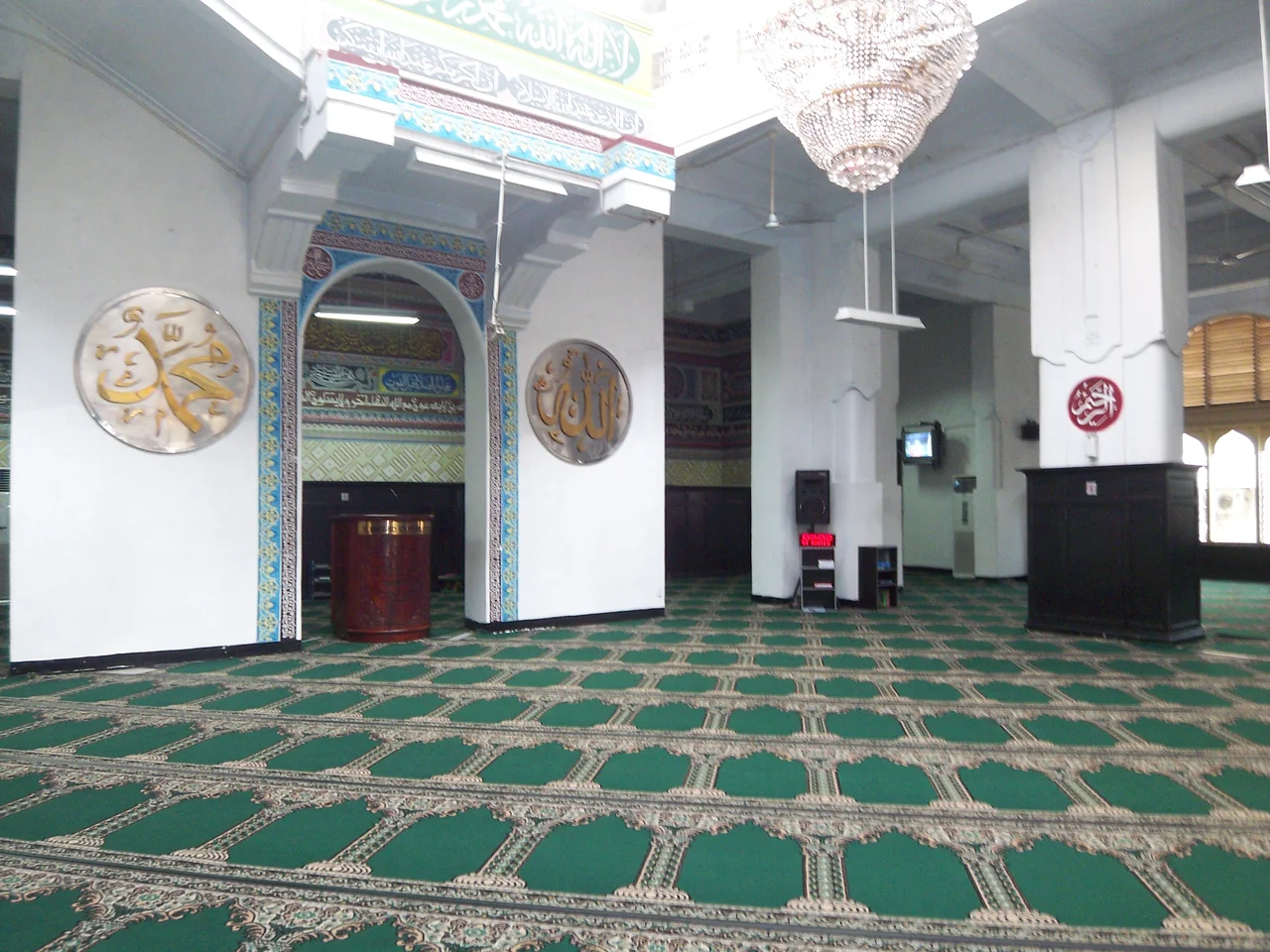
Walk into the Cut Meutia Mosque in Jakarta and something feels slightly off. The prayer hall does not align with the building. Worshippers face roughly 45 degrees to the building's orientation, angled toward Mecca in a structure that was never designed with Mecca in mind. The mihrab and minbar -- normally positioned at the front of a prayer hall against the qibla wall -- stand instead in the center of the room, because there is no qibla wall. There are only the original walls of a Dutch Rationalist architecture office, built in 1922 by a firm called N.V. Bouwploeg, whose architects spent their days designing the upscale residential neighborhood of Gondangdia next door. The building they worked in has outlasted everything they designed from it.
A Heroine's Name
The mosque is named after Cut Nyak Meutia, an Indonesian national heroine who fought against Dutch colonialism in Aceh until her death in 1910 at the age of forty. That a building constructed by Dutch colonizers now carries the name of a woman who took up arms against them is a quiet irony Jakarta does not need to spell out. Meutia was one of the Acehnese guerrilla fighters who continued resisting Dutch rule long after the colonial forces declared the Aceh War won. She fought alongside her husband, Teuku Muhammad, and after his death continued the struggle with a second husband, Pang Nanggroe. Her resistance ended only when she was killed by a Dutch patrol. Indonesia declared her a national heroine in 1964, and when the former Dutch property at Jalan Menteng Raya became a mosque in 1987, it was her name they chose -- honoring a fighter by inscribing her memory onto the architecture of her enemy.
Six Lives Before Prayer
Few buildings in Jakarta have worn as many identities. Pieter Adriaan Jacobus Moojen, a Dutch architect who lived from 1879 to 1955, established N.V. Bouwploeg here in 1922. The firm planned and developed Gondangdia, the residential district in Menteng that attracted Jakarta's colonial elite. After the architecture firm moved on, the building served as the department for drinking water. Then it became a post office. Then a train company office. From 1964 to 1970, it housed the Office of Home and Religion -- a government agency occupying a space that would, decades later, become a house of religion in an entirely different sense. The transformation came under Jakarta Governor Ali Sadikin's legacy: on August 18, 1987, the building was officially converted into a provincial mosque by gubernatorial decree SK no. 5184/1987. An architecture office had become, at last, a work of architecture itself.
Tropics in Rationalist Clothing
Moojen designed the building in the Dutch Rationalist style, but adapted it for equatorial heat. The most prominent feature is a ventilation tower rising from the center of the structure, a signature element of the Indies architectural style that emerged when European forms collided with tropical necessity. The tower draws hot air upward and out, creating natural airflow through the interior -- a passive cooling strategy that predates air conditioning and still functions today. The building's clean lines and geometric proportions mark it as European in origin, but the deep overhangs, open terraces, and that central tower reveal a designer who understood that a building in Batavia could not simply replicate a building in Amsterdam. When the conversion to a mosque began, the architects faced a problem that no amount of ventilation ingenuity could solve: the building faced the wrong direction.
Praying Sideways
Every mosque must orient its prayer hall toward the qibla -- the direction of the Kaaba in Mecca. The N.V. Bouwploeg office, designed for drafting tables and filing cabinets, had no reason to consider compass bearings to Saudi Arabia. The solution was geometric compromise. The prayer hall was rotated approximately 45 degrees within the rectangular footprint of the building, creating a diamond-shaped worship space inside a square structure. Because no wall faces Mecca directly, the mihrab -- the niche indicating the direction of prayer -- was placed in the center of the hall rather than against a wall. The minbar, the pulpit from which the imam delivers the Friday sermon, sits beside it, also in the middle of the room. The central staircase that once connected the ground floor to the upper offices was removed entirely to create the open volume the prayer hall required. New staircases were added to the front terrace instead. The result is a mosque unlike any other in Jakarta: a building where the architecture and the worship exist in creative tension, each accommodating the other without either surrendering its essential character.
From the Air
Cut Meutia Mosque is at 6.19S, 106.83E in the Menteng district of Central Jakarta. From the air, it is a modest colonial-era building along Jalan Menteng Raya, easily overshadowed by surrounding modern development. Look for the Menteng neighborhood south of Merdeka Square -- the mosque sits within the residential grid that the building's original architects helped design. Nearest major airport is Soekarno-Hatta International (WIII), approximately 25 km northwest. Halim Perdanakusuma Airport (WIHH) is about 12 km southeast. The building is not readily distinguishable from altitude; its significance is historical and architectural rather than monumental.
Nearby Stories
- The King's Footprints in the River 2.8 km away
- Rawagede Massacre 6.4 km away
- The Cruiser That Wouldn't Stop Fighting 14 km away
- Four Minutes Over the Java Sea 14 km away
- The Scholar's Mosque 21 km away
- Through the Cidepong Hills 37 km away
- Ujung Kulon National Park 97 km away
- The Islands That Vanished from Sight 352 km away