
Cycladic culture
Look at a Cycladic figurine and you could swear it was carved last week. A flat, pale body of pure white marble. Arms folded across the stomach. A face reduced to a single ridge of nose, the eyes and mouth long since painted away by time. There is nothing fussy or busy about it - just clean line and serene blankness. Yet these figures are roughly five thousand years old, made by a Bronze Age island people in the Aegean, and their radical simplicity would one day reach across the millennia to electrify modern artists like Picasso, Brancusi and Modigliani, who saw in them a purity of form they were themselves chasing.
A Civilization of Islands
The Cyclades are the scatter of Greek islands that ring the sacred isle of Delos in the Aegean Sea - the name comes from the Greek for 'circle.' Across them, starting around 3100 BC, a distinctive culture took shape in the Late Neolithic and Early Bronze Age, contemporary with the Minoans rising on Crete to the south and the Helladic peoples on the mainland. These were seafarers and traders, working without the grand palaces of Knossos, scattered across dozens of small islands. Their reach was real: pottery finds at Knossos itself show Cycladic influence pressing onto Crete between roughly 3400 and 2000 BC. For a thousand years they thrived, until the brilliant palace-culture of Minoan Crete eventually overshadowed them, and the islands faded into its orbit.
The Marble Figures
The culture is best known, by far, for those marble figurines. Most are female, schematic and flat, usually carved with the arms folded right-below-left across the body, and they range from palm-sized to nearly life-size. We do not actually know what they were for. They turn up most often in graves, which suggests something to do with death or the afterlife, but their exact meaning - goddess, ancestor, grave-companion, toy of the gods - is genuinely lost. The blankness that modern eyes read as elegant minimalism was once a painted face, with eyes and details now vanished. That uncertainty is part of their power. They stare past us, refusing to explain themselves, and we project onto them whatever we most want to find.
Stolen Context
Their beauty became their curse. In the mid-20th century, collectors developed an appetite for Cycladic figurines, and looters supplied it. It has been estimated that around 90 percent of known figures were dug up illegally or torn from their original sites without any record - which means archaeologists lost exactly the information that might have explained them. A figurine in a museum case is lovely; a figurine documented in its grave, with its neighbors and its offerings, is evidence. Most were stripped of that forever. Between 2009 and 2010, researchers even sat down with a man known only as 'the forger,' learning how fakes were made and funneled to collectors - knowledge that has since helped scholars spot forgeries and, sometimes, trace looted pieces back home.
Reading the Pots
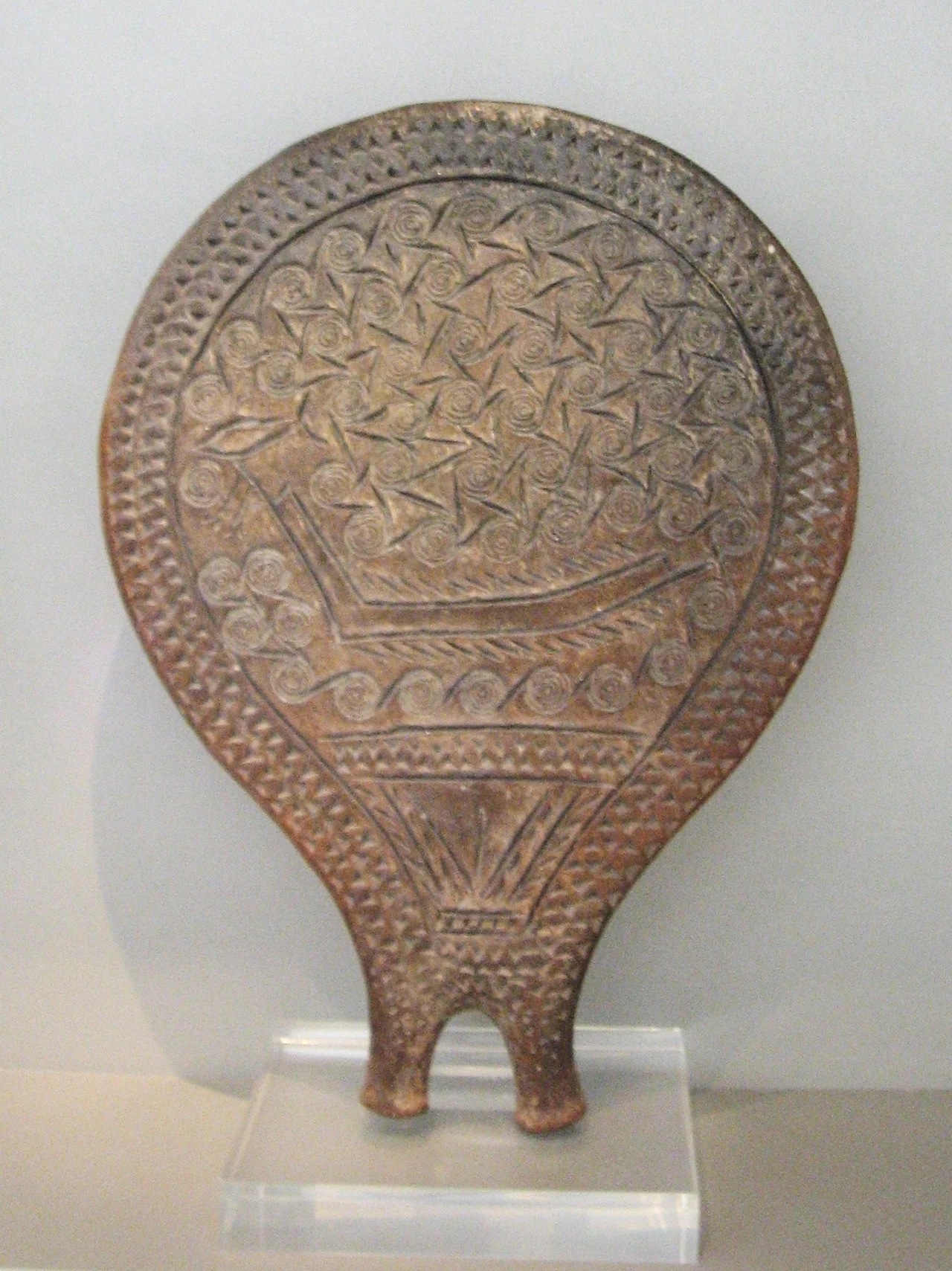
Where the figurines fall silent, the pottery speaks. Plain and unglamorous, ceramics are the workhorse of Cycladic archaeology: their changing shapes, materials and decoration let scholars slice the long span into Early, Middle and Late phases and pin down dates that figurines alone never could. It was painstaking work with the everyday objects of ordinary life. The Greek archaeologist Christos Tsountas, excavating island burial sites in 1898 and 1899, was the first to grasp these islands as a single coherent world, and it was he who coined the term 'Cycladic civilization.' His successors built the chronology pot by pot, grave by grave.
The Long Echo
By around 1000 BC the Cycladic world had effectively merged into the Minoan and Mycenaean civilizations that surrounded it, and its distinct identity dissolved. A few islands held onto their old prestige - Delos above all, which kept its reputation as a sanctuary deep into Classical Greek times and gave its name to the Delian League. But the figurines slept in the ground until the modern age rediscovered them, and when it did, their effect was immediate. Their austere geometry felt astonishingly contemporary to artists hunting for the essence beneath surface detail. Five millennia after a nameless islander first set chisel to marble, that quiet white form became, of all things, modern.
From the Air
Cycladic culture spans the whole Cyclades archipelago in the central Aegean Sea, southeast of mainland Greece. This story's anchor point is near 36.89°N, 25.65°E (the Naxos / Lesser Cyclades area, including Keros, a key Cycladic site). From the air the Cyclades appear as a loose ring of arid, rugged islands around the small central isle of Delos. Recommended viewing altitude 8,000-12,000 ft to take in multiple islands at once. Nearest airports: Naxos (LGNX), Paros (LGPA), Santorini (LGSR), and Mykonos (LGMK). Summer brings excellent visibility and the strong northerly meltemi wind that these ancient seafarers knew well.
Nearby Stories
- Battle of Amorgos 8.3 km away
- Panagia Chrysopigi 23 km away
- Miaouli Square 40 km away
- Astypalaia 42 km away
- Cave of the Apocalypse 53 km away
- Battle of Rhodes (1912) 110 km away
- Battle of Rethymno 138 km away