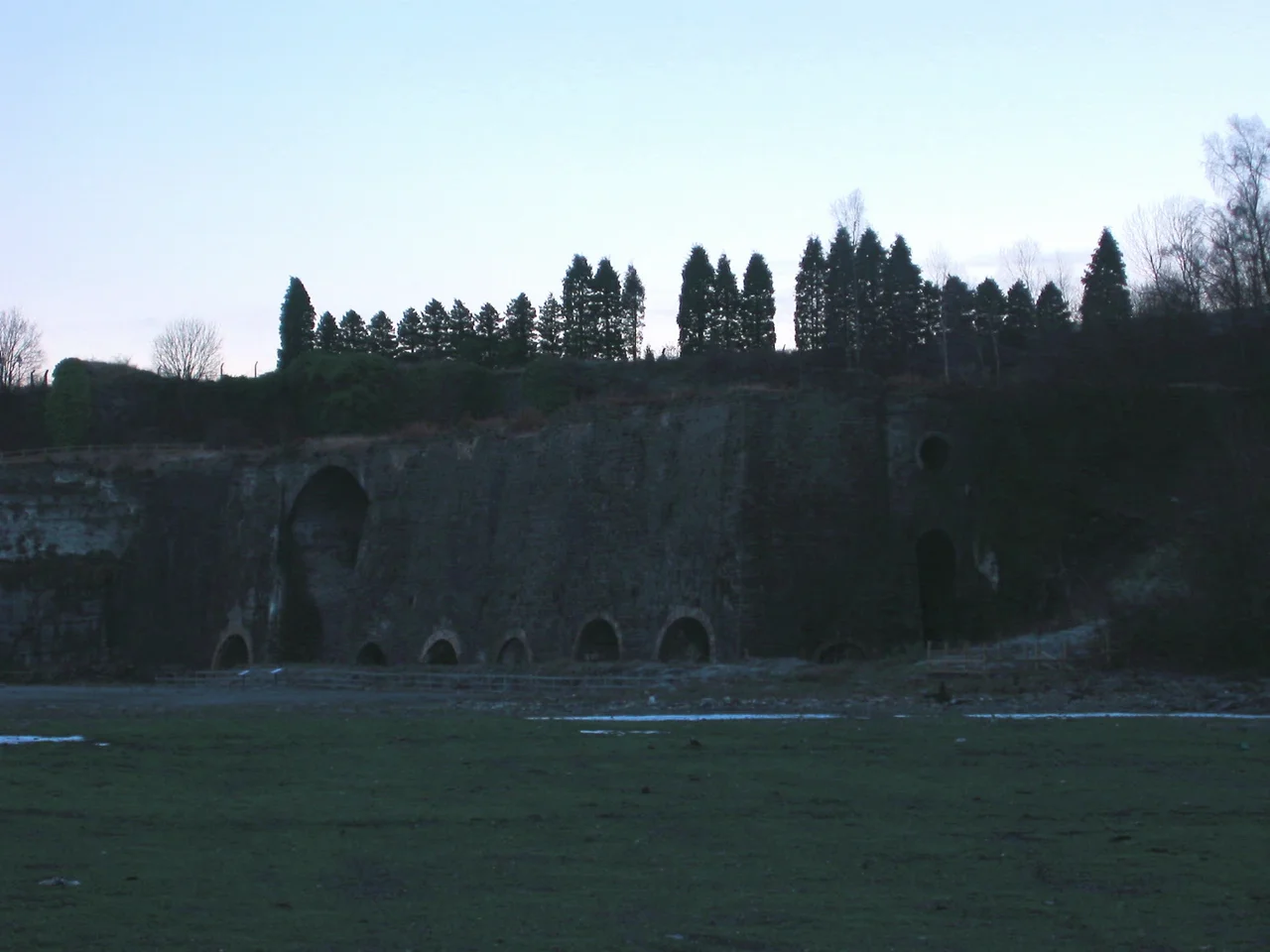

Cyfarthfa Ironworks
When Admiral Nelson came to visit in 1802, he did not come to admire scenery. He came to inspect cannon. The Cyfarthfa Ironworks, on the north-western edge of Merthyr Tydfil, was casting the guns that armed the ships of the line he commanded. Britain was fighting France for control of the world's oceans, and Cyfarthfa was where much of the iron that won those battles came out of the ground. The Crawshay family who owned the works put a pile of cannonballs on their family crest, by way of acknowledgement. For roughly forty years from the 1790s, this ironworks on the River Taff was the largest in the world.
The Lease of 4,000 Acres
Cyfarthfa began in 1765 as a speculation by an MP. Anthony Bacon, member for Aylesbury and a native of Cumbria, secured a ninety-nine-year lease on 4,000 acres of moorland west of Merthyr Tydfil for £100 a year, no royalties. The seam underneath ran with coal, iron ore and limestone, all three of the things you needed to make iron. Bacon brought in Charles Wood to build a furnace and a forge, and in August 1766 they began constructing the first coke-fired blast furnace, fifty feet tall, blown not by leather bellows but by cast iron cylinders. It went into blast probably in the autumn of 1767. The water came from the Taff through a race that split six ways to power a clay mill, two stampers, two hammers and a chafery. Iron began to flow.
Richard Crawshay's War
By 1786, after a tangle of partnerships and lawsuits and Anthony Bacon's death, the lease passed by Chancery order to Richard Crawshay, a Yorkshire-born merchant who had started his career selling flat irons in London. Crawshay licensed Henry Cort's puddling process, the technique that allowed pig iron to be refined into wrought iron at scale, and after a few years of frustration he made it work. Then the wars came. Britain fought France from 1793 to 1815, with brief pauses, and the Royal Navy needed cannon and iron faster than anywhere else in Europe could supply it. Cyfarthfa cast them. The works grew until it employed thousands. The smoke from its furnaces was visible from miles away, and at night, as the painter Penry Williams recorded in 1825, the interior of the works glowed like the inside of a forge in old religious paintings. Cyfarthfa was where the Industrial Revolution learned to scale.
The Castle Across the River
Richard's son William ran the works after him, and William's son, William Crawshay II, built himself a castle to look down at it. In 1825 he commissioned Robert Lugar to design a sham fortress in Norman and Gothic styles, with battlements and turrets and crenellations, on 158 acres of landscaped parkland on the opposite bank of the Taff. The family could sit in their drawing room and watch the furnaces glow at night across the river. Cyfarthfa Castle still stands today, now a museum and an art gallery, surrounded by the same park, looking across at the same valley. It is one of the strangest products of nineteenth-century industrial wealth: a Welsh ironmaster's idea of being a baron, paid for by the cannon that fought Napoleon.
The Long Closing
By the 1870s, the world had moved on. Cheaper iron was coming from elsewhere, the local iron ore was running out, and the Bessemer process meant the future was steel, not iron. Robert Thompson Crawshay, the last of the great Crawshay ironmasters, refused to switch. The works closed in 1875. His sons reopened it, rebuilt it as a steelworks, and kept it going under various owners until 1902, when it was sold to Guest, Keen and Nettlefolds, owners of the rival Dowlais works. The steelworks closed in 1910, reopened briefly to make munitions for the First World War, then closed for good in 1919. By 1928 it had been dismantled. For Merthyr Tydfil, which had grown up entirely around its iron, the loss was catastrophic.
What Remains
Six of the original blast furnaces still stand at Cyfarthfa, the largest and most complete surviving examples of their type anywhere in the world. They are stone-built, massive, hollowed-out cathedrals of industry. In 2013, workers building a do-it-yourself store next to the site dug up a previously buried canal, tram lines, and the plant's coking ovens, structures that had been razed and forgotten after the First World War. Archaeologists got a few weeks with the artefacts before they were reburied to make way for the new development, a quietly Welsh fate. The site is now part of the Cyfarthfa Heritage Area. From the castle's terraces you can still trace where the works lay across the Taff: the ruined furnaces, the bridge of Pont-y-Cafnau just downstream, the leats and weirs that once powered the largest ironworks in the world.
From the Air
Cyfarthfa Ironworks sits at 51.75 N, 3.39 W on the north-western edge of Merthyr Tydfil, in the upper Taff Valley. The surviving blast furnaces and Cyfarthfa Castle are best appreciated from 2,500 to 3,500 feet, with the castle's parkland a clear green block on the eastern bank of the Taff and the ruined furnaces opposite. Cardiff Airport (EGFF) is 25 nm to the south. The Brecon Beacons rise immediately north and west; expect orographic cloud on south-westerly flows.
Nearby Stories
- Portishead Point Lighthouse 3 km away
- St Fagans National Museum of History 5 km away
- Museum of Cider 6.5 km away
- Monmouth 8.3 km away
- Carreg Cennen Castle 11 km away
- Builth Castle 14 km away
- Craig Gwrtheyrn 29 km away
- Ilfracombe Lifeboat Station 37 km away