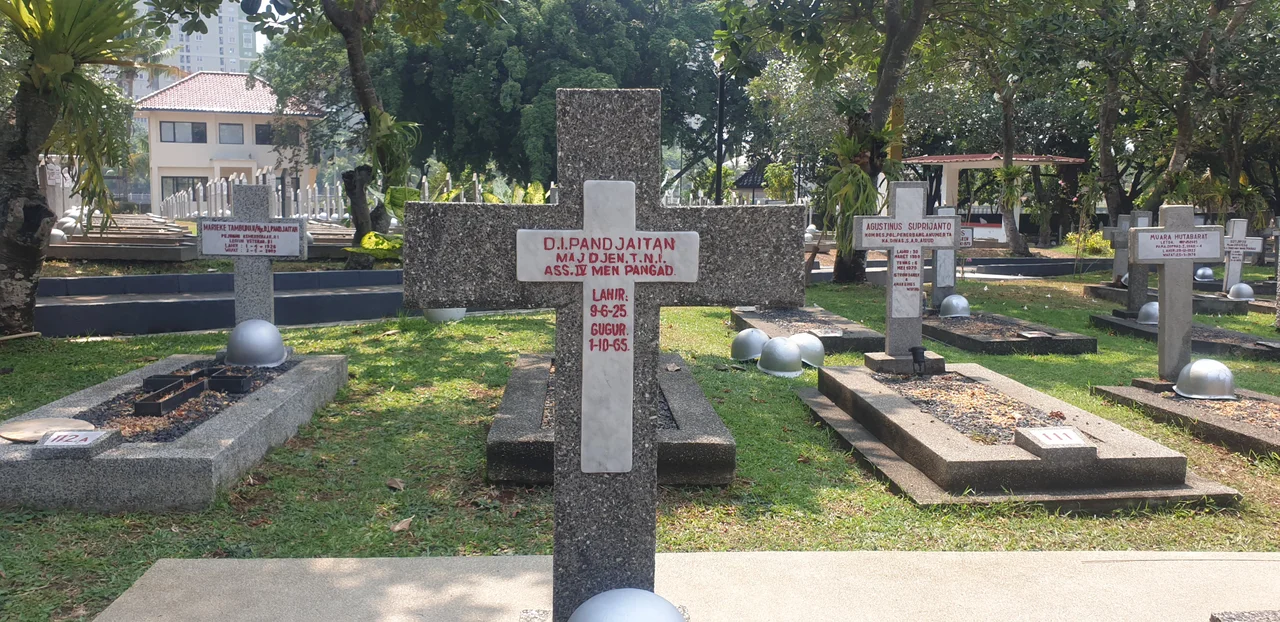

D. I. Pandjaitan
Of the seven military officers seized from their homes before dawn on 1 October 1965, Donald Isaac Pandjaitan was the only Christian. That detail mattered to the men who came for him, and it matters still to Indonesians who remember the night the 30 September Movement tore through Jakarta. Pandjaitan was a Batak from the Tapanuli highlands of North Sumatra -- born in the lakeside village of Sitorang, near Balige, on 9 June 1925. He grew up far from the capital, in a landscape of volcanic ridges and Protestant churches planted by German missionaries decades earlier. Nothing about that upbringing predicted the military career that would carry him to the center of Indonesian power, or the violent end that would make him a national hero.
A Soldier Forged by Occupation
The Japanese invaded the Dutch East Indies in 1942 and dismantled colonial authority with startling speed. For young Indonesians like Pandjaitan, the occupation offered an unlikely opportunity: military training. The Japanese established the Giyugun, a volunteer defense force staffed by Indonesians and led by Japanese officers, intended to bolster Japan's overstretched Pacific defenses. Pandjaitan enrolled and learned the fundamentals of soldiering under an occupying army that would soon be defeated. He was posted to Pekanbaru, in central Sumatra, and was there on 17 August 1945, when Sukarno and Hatta declared Indonesian independence. The Japanese had surrendered. The Dutch wanted their colony back. And a generation of young men trained to fight suddenly had a nation worth fighting for.
From Battalion Commander to National Logistics
Pandjaitan threw himself into the revolution. By November 1945, he was helping to establish a local branch of the People's Security Army, the TKR, and served as a battalion commander in the chaotic early months of Indonesian independence. The new republic was fragile -- poorly armed, politically fractured, and fighting a colonial power that still controlled major cities and infrastructure. Pandjaitan's organizational talent surfaced quickly. In March 1948, he was appointed commander for the organization and education of the XI/Banteng Division at Bukittinggi, in the highlands of West Sumatra. When the Dutch launched Operation Kraai, their second major military offensive against the republic, Pandjaitan took charge of supplies for the Emergency Government -- the shadow administration that kept the Indonesian state alive while its leaders were imprisoned or on the run. Logistics is unglamorous work, but it is the work that determines whether armies eat, whether ammunition arrives, whether a revolution survives its darkest months.
The Night of 1 October
By 1965, Pandjaitan had risen to the rank of brigadier general and held the position of assistant minister and chief of the army's general affairs section. He lived in Jakarta with his family. In the early hours of 1 October, members of the 30 September Movement -- a group of military officers linked, according to the army's later account, to the Communist Party of Indonesia -- launched simultaneous raids on the homes of senior army leaders. The movement sought to neutralize the army's top brass in a single night. Six generals and one lieutenant were killed. Pandjaitan was among them. His body was taken to Lubang Buaya, the movement's staging ground on the outskirts of Jakarta, and thrown into a disused well along with the other victims. Three days passed before the bodies were recovered, on 4 October. The nation recoiled.
A Hero's Burial and a Contested Legacy
The state funeral on 5 October 1965 was broadcast across Indonesia. Pandjaitan and his fallen colleagues were interred at Kalibata Heroes' Cemetery in South Jakarta, where their graves remain a site of annual commemoration. Pandjaitan was posthumously promoted to major general and declared a Hero of the Revolution, one of Indonesia's highest honors. Streets, schools, and military installations across the country bear his name. Yet the events surrounding his death remain among the most debated in Indonesian history. The army's official narrative -- that the Communist Party orchestrated the coup -- justified the mass killings of suspected communists that followed, claiming an estimated 500,000 to over a million lives. Scholars continue to examine the evidence, and the full truth of what happened on that October night has never been settled to everyone's satisfaction. What is beyond dispute is that a man from a small village on the shores of Lake Toba gave his life to a country he had spent twenty years helping to build.
From the Air
Pandjaitan's memorial is at Kalibata Heroes' Cemetery in South Jakarta, located at approximately 6.26S, 106.85E. The cemetery is a large green space visible from lower altitudes, situated south of central Jakarta. Nearest major airport is Soekarno-Hatta International (WIII), approximately 30 km northwest. Halim Perdanakusuma Airport (WIIH) is closer, roughly 8 km to the east. The Lubang Buaya memorial site, where Pandjaitan's body was recovered, lies near Halim and includes a monument complex visible from the air.
Nearby Stories
- The King's Footprints in the River 2.8 km away
- Rawagede Massacre 6.4 km away
- The Cruiser That Wouldn't Stop Fighting 14 km away
- Four Minutes Over the Java Sea 14 km away
- The Scholar's Mosque 21 km away
- Through the Cidepong Hills 37 km away
- Ujung Kulon National Park 97 km away
- The Islands That Vanished from Sight 352 km away