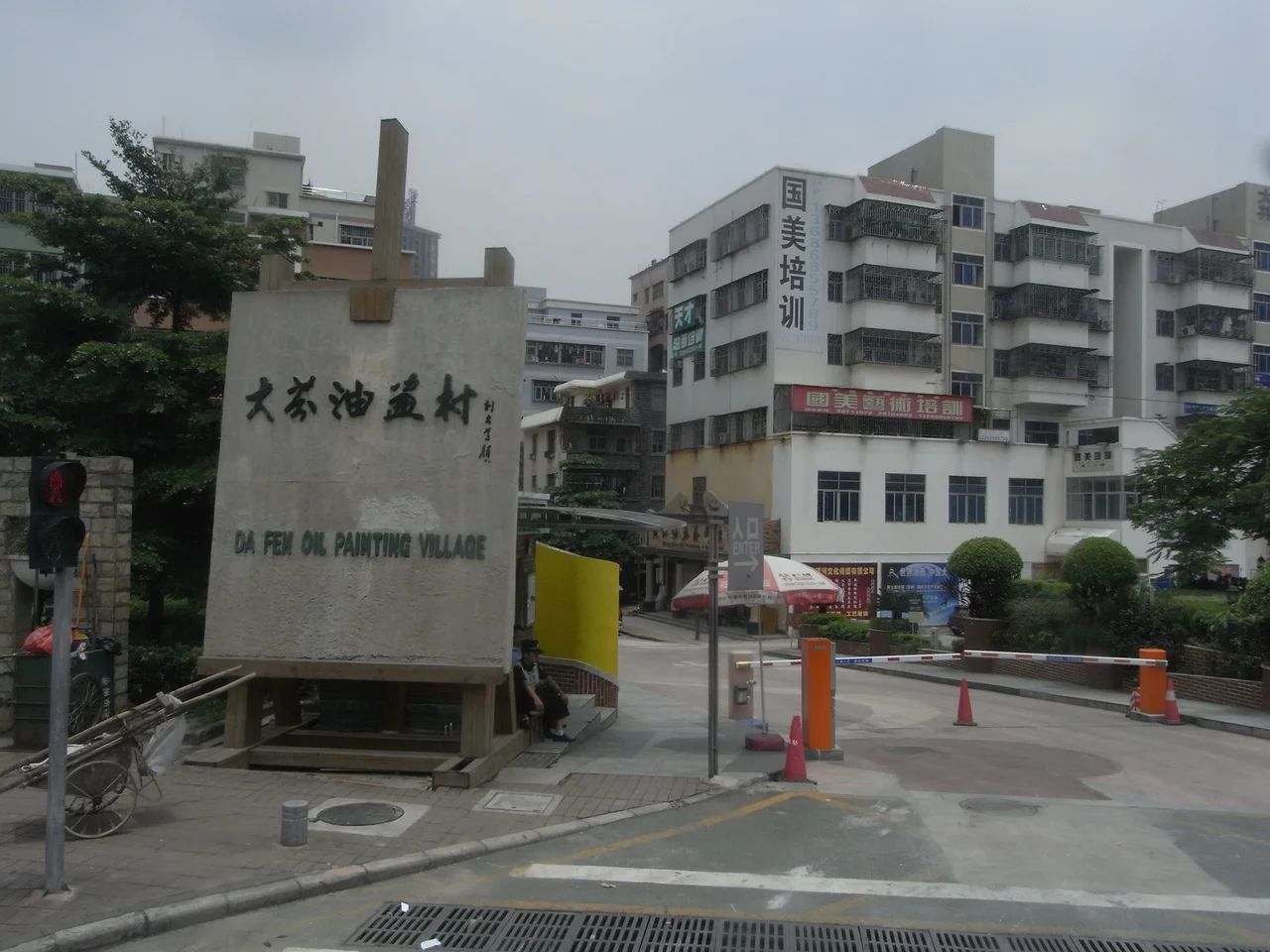

Dafen Village
Somewhere in Dafen Village, a painter is copying a Starry Night. Another is finishing a Mona Lisa. Across the lane, someone is completing their fiftieth Sunflowers of the week. This suburb of Shenzhen's Longgang District has been the world's most prolific art factory since 1989, when a Hong Kong businessman named Huang Jiang arrived with an idea: that oil-painting reproduction could work as an industry, not just a craft. It did. What followed was one of the stranger economic experiments in modern art history.
Huang Jiang's Gamble
In 1989, Huang Jiang started copying paintings in what was then an obscure Shenzhen suburb, recruiting local farmers and workers as apprentices. He was not the first person to copy a masterwork, but he may have been the first to industrialize the process at scale. In the early 1990s, he assembled a group of about twenty painters who had trained at art academies — people with genuine technical skill — and set them to work reproducing oil paintings by van Gogh, Dalí, da Vinci, Rembrandt, and Warhol. The copies were good enough and cheap enough to sell internationally. Then Walmart entered the picture. In the 1990s, Huang sent a sample painting to the retail giant and received an order for 50,000 paintings to be delivered within fourteen days. He fulfilled it. That order established Dafen's model: not single paintings sold to collectors, but paintings by the tens of thousands, shipped to furniture stores, hotel chains, and online retailers across two continents.
The Village at Scale
By 2014, Dafen supported roughly 7,000 artists living and working within the village. Some were reproduction painters; others produced original work. The pace was staggering: some painters could complete up to 100 canvases in twelve hours, working at assembly-line speed on a task that required genuine brushwork. Five million paintings a year left Dafen for the United States and Europe. The village developed its own internal economy — supply shops for canvas and pigment, framing businesses, shipping agents, gallery spaces along the pedestrian lanes. Walking through Dafen, you might see unfinished van Goghs stacked against walls, wet canvases drying in the sun, and a painter working on three versions of the same composition simultaneously, each at a slightly different stage.
Crisis, Shift, and the Copyright Question
The 2008 financial crisis cut Western demand sharply. Dafen adapted, pivoting toward domestic buyers who wanted Chinese paintings in Chinese styles rather than European masterworks. The shift was significant but not total: the village never stopped making replicas. Official policy holds that Dafen reproduces only artists who died more than fifty years ago and whose work is therefore in the public domain. In practice, the policy had gaps. Georgia O'Keeffe, who died in 1986, appeared in some Dafen catalogs. Knockoffs of contemporary artists Fernando Botero and Yue Minjun were also available. The copyright question was never resolved so much as deferred — replicas existed in a gray zone of international enforcement that the village occupied with pragmatic confidence.
Original Voices in a Copy Town
Not every painter in Dafen came for the production work. Over the decades, artists arrived who wanted studio space and community rather than assembly-line quotas. Some stayed and built original practices, selling work from galleries on the same lanes where mass reproductions hung. The juxtaposition — a hand-painted original beside fifty identical Monets — became part of Dafen's character rather than a contradiction to be resolved. The village attracted journalists, documentary filmmakers, and critics trying to make sense of what it meant to industrialize the art of the masters. None of them arrived at a simple answer, which is perhaps appropriate. Dafen is not a simple place.
What Dafen Tells Us
Questions about authenticity, originality, and value that Dafen raises are not new ones in the art world — they are among the oldest. What Dafen adds is scale. When five million paintings per year move through a single village, the economics of reproduction become impossible to ignore. A Dafen copy of a van Gogh costs a fraction of a printed poster of the same image. It is made by a human hand, with real brushwork, on real canvas. Whether that makes it more or less authentic than a high-resolution digital print is a question Dafen does not pretend to answer. The village simply keeps painting.
From the Air
Dafen Village sits at approximately 22.612°N, 114.132°E in Longgang District, Shenzhen. From 3,000 feet, the village is identifiable as a compact, dense cluster of low-rise buildings southeast of central Shenzhen, separated from the older urban core by several kilometers of newer development. The Dafen Art Museum, a distinctive angular building, marks the edge of the village's main pedestrian area. Shenzhen Bao'an International Airport (ZGSZ) is approximately 30 km to the northwest. No significant bodies of water are nearby.
Nearby Stories
- Hong Kong Disneyland 4.1 km away
- Mount Guanyin (Dongguan) 7 km away
- 2024 Lixinsha Bridge Collapse 7.4 km away
- Portas do Cerco 12 km away
- Lotus Hill 15 km away
- Nanxiong Formation 78 km away
- Heyuan 130 km away
- Checheng Fu'an Temple 629 km away