.jpg)
Daintree Rainforest
Some forests are old. This one is ancient beyond easy imagining. The Daintree is widely regarded as the world's oldest surviving tropical rainforest, an unbroken line of green that stretches back something like 180 million years - tens of millions of years older than the Amazon, old enough that its first trees shaded the dinosaurs. Squeezed between the ranges and the Coral Sea in Far North Queensland, it feels less Australian than Southeast Asian: dripping, dense, primeval. Crossing the Daintree River by cable ferry, you leave the modern world behind and enter a living relic of the planet's deep past.
A Survivor from Gondwana
The Daintree is a fragment of a vanished world. Its plants descend from the forests of Gondwana, the great southern supercontinent, and as that landmass fractured and its pieces scattered - one drifting south to freeze into Antarctica - this narrow wet coast held onto the old climate and the old growth. Among its treasures is the idiot fruit, Idiospermum australiense, a primitive flowering plant whose lineage runs back well over a hundred million years; long believed extinct, it was found again here, a botanical ghost still quietly fruiting in the shadows. The strangler figs, the towering fan palms, the unbroken canopy: this is roughly what much of the prehistoric world looked like, preserved by a fortunate accident of continental drift.
The Bird That Plants the Forest
The most important resident of the Daintree is one you will be lucky to glimpse: the southern cassowary. A flightless bird as tall as a person, glossy-black with a vivid blue neck and a tall horny casque on its head, the cassowary moves through the undergrowth like a survivor from another age - which, in a sense, it is. It is also a keystone species, the gardener that keeps the whole forest going. Between seventy and a hundred species of rainforest plants depend on the cassowary, almost or entirely, to swallow their large fruits and carry the seeds, dropped far away in a parcel of fertiliser. Lose the cassowary and you slowly lose the forest it plants. Few birds anywhere carry an ecosystem so squarely on their backs.
Reef Meets Rainforest
The Daintree holds a distinction nowhere else on Earth can claim. It is the only place where two natural World Heritage Areas meet - the rainforest, part of the Wet Tropics of Queensland, running straight down to the edge of the Great Barrier Reef. Within a single sweep of coast you pass from ancient jungle into living coral, with no city or farmland between. The forest itself is a riot of life: more than 430 species of birds, around thirty percent of all Australia's frog, reptile and marsupial species, and well over twelve thousand kinds of insect, all packed into a sliver of land that is a tiny fraction of the continent. And in the rivers and along the beaches, the saltwater crocodile rules - a reminder that this is wild country, beautiful and unforgiving in equal measure.
The Fight for the Forest
The Daintree we can still walk through was very nearly logged and bulldozed away. In 1983, when authorities pushed the controversial Bloomfield Track through coastal rainforest between Cape Tribulation and the Bloomfield River, conservationists chained themselves to machinery in a series of blockades that drew the eyes of the world. They lost that particular fight - the road went through - but they won the larger one. The outcry forced a national rethink of the logging that had long been tolerated here, and in 1988 the Wet Tropics, the Daintree among them, were inscribed on the World Heritage list. Today the threat is gentler but real: a region balanced between tourism, development and preservation, much of it still off the power grid, trying to stay quiet enough to keep what makes it extraordinary.
From the Air
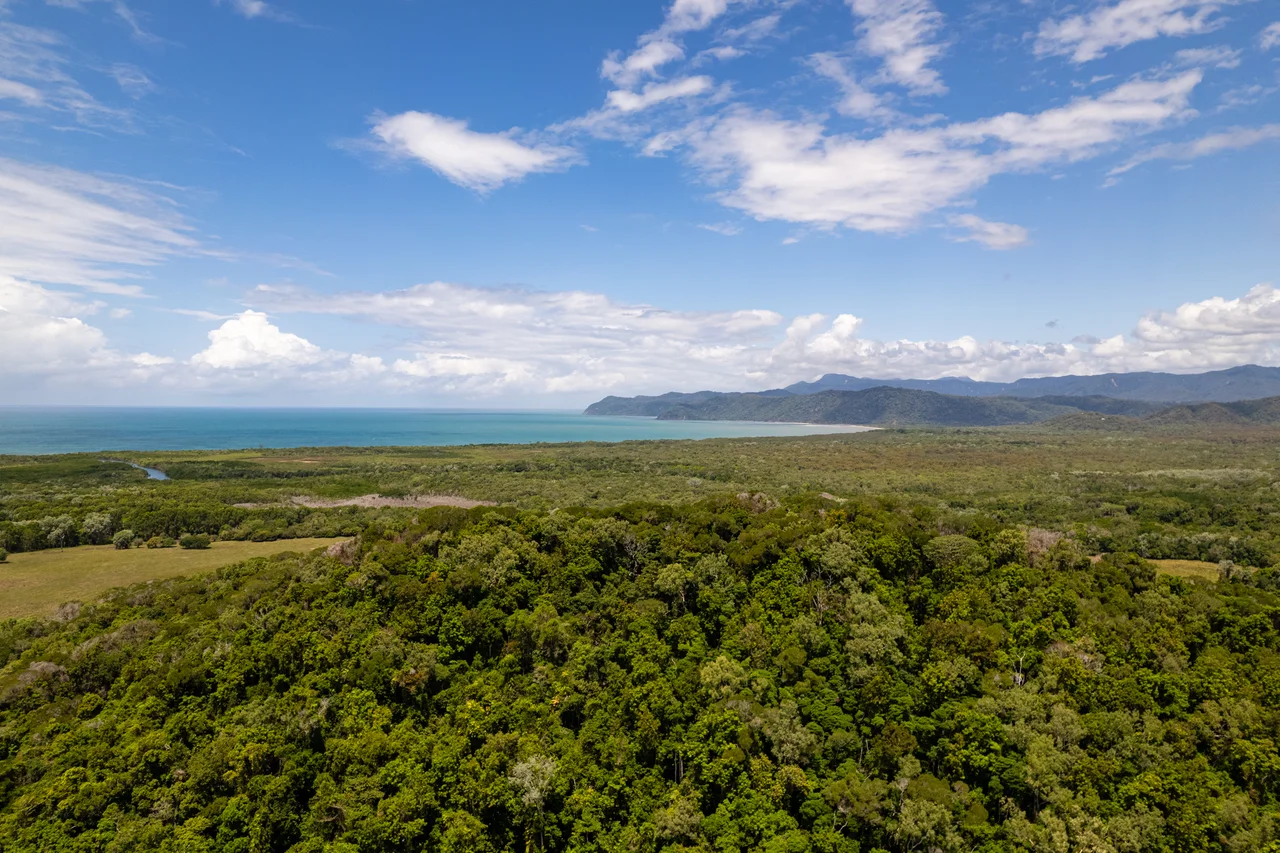
The Daintree Rainforest stretches roughly from the settlement of Mossman north toward Bloomfield, centred near 16.20 degrees south, 145.40 degrees east, along the Coral Sea coast about 100 km north of Cairns and an hour or two north of Port Douglas. The gateway airport is Cairns International (ICAO YBCS), a base for scenic helicopter and small-plane flights; Mareeba (ICAO YMBA) sits inland to the southwest. From the air it is one of the great sights of the tropics: an unbroken carpet of dark-green rainforest cloaking steep ranges that plunge straight into reef-fringed turquoise sea, the Daintree River threading through the lowlands. The dry season, May to September, gives clear skies and the best visibility; the wet season, November to March, means heavy cloud, drenching rain and cyclone risk.
Nearby Stories
- Wujal Wujal Aboriginal Shire 7.8 km away
- James Venture Mulligan's Grave 19 km away
- Green Island (Queensland) 28 km away
- Byerstown 29 km away
- Ngarrabullgan 39 km away
- Quinkan Rock Art 50 km away
- HMS Mermaid (1817) 112 km away
- Kapa Kapa Trail 711 km away