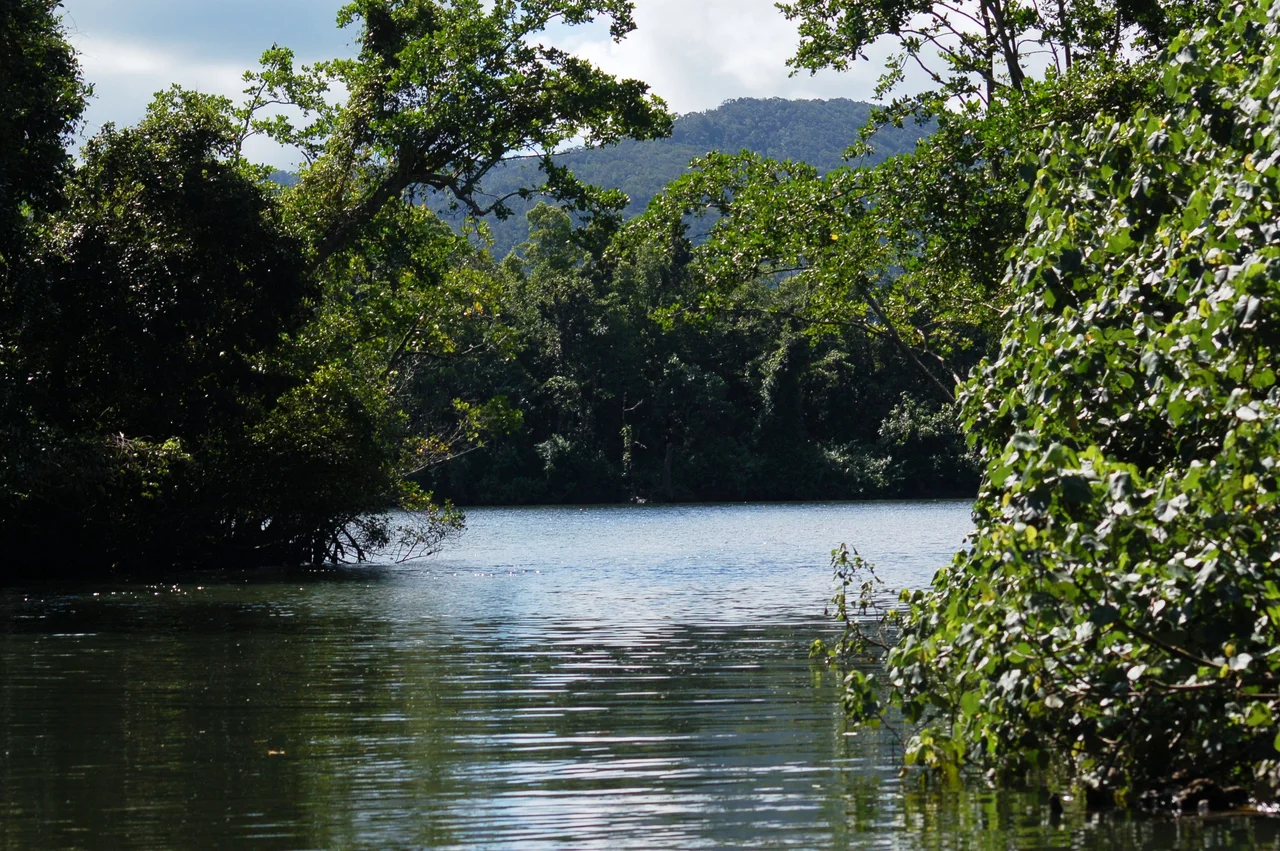

Daintree River
There is no bridge. To cross into the northern Daintree, you wait at the riverbank for a small cable ferry to haul itself back across the tea-coloured water, and while you wait, you watch the surface. Something the size of a log might be exactly that - or it might lift its eyes and slide under. This is one of the few rivers in Australia where the warning signs are not precautionary but earned: do not approach the bank, stay inside the boat, never swim. The Daintree rises 1,270 metres up in the rainforest near Black Mountain in the Great Dividing Range and pours 127 kilometres down to the Coral Sea, and along the way it threads through a forest so ancient that the trees on its banks were here before the Amazon existed.
Older Than the Idea of a River
The Daintree drains a forest that predates almost every other rainforest on Earth - a surviving fragment of Gondwana, the supercontinent that began breaking apart more than 100 million years ago. As the climate shifted and dried, the steep valleys and high ridges around the river became refuges, sheltering plants that vanished everywhere else. The most famous survivor grows in isolated pockets just north of the river: the she-oak Gymnostoma australianum, the last of its genus in Australia and a living relic of the Gondwanan world. Its relatives now grow scattered across the Pacific and Southeast Asia, but here, on these particular slopes, the original line never died out. To walk this catchment is to move through deep time, where the green is not scenery but inheritance.
Kuku Yalanji Country
Long before the river had a European name, it had custodians. The Eastern Kuku Yalanji people have lived along these banks for thousands of years, reading the rainforest as a larder and a map. They camped beside the water in small family groups, harvesting bush tucker from a forest that gives generously to those who know it - fruits, fish, and plants that the uninitiated would pass without a glance. Their connection to this Country was never broken by the centuries that followed, and today Kuku Yalanji guides share that knowledge with visitors on the river, naming what the rainforest holds and what it means. The Daintree is not a wilderness in their telling. It is home, and it has been home for longer than almost any human story attached to it.
The Naming and the Gold
Europeans came late and came for gold. The shifting sandbar at the mouth had turned ships away for generations - even Captain Cook missed the river entirely as he sailed north in 1770, on the same voyage that wrecked his ship on the Great Barrier Reef. It was not until 1873, when prospectors swarmed the region chasing gold, that a European reached the river. George Elphinstone Dalrymple, the colony's Gold Commissioner, named it for Richard Daintree, an English geologist serving as Queensland's Agent-General in London. The man whose name now means rainforest and crocodiles to the world never saw the river himself. Between 2000 and 2012, the Daintree ranked second only to the Proserpine as the Queensland river where you were most likely to spot a saltwater crocodile - 145 sightings in twelve years.
When the Sky Falls
The Daintree floods the way few rivers can. Hemmed by mountains that climb past 1,000 metres and fed by the cyclones spinning off the Coral Sea, it can rise from calm to catastrophe in hours. In March 1996, more than 600 millimetres of rain fell in a single day and swept across roads and homes throughout the region. In January 2019, the river crested at 12.6 metres, breaking a record that had stood since 1901. Then came ex-Cyclone Jasper in December 2023, dumping as much as two metres of rain across the catchment in less than a week and driving the river to a staggering 14.85-metre peak - two metres above the old mark. The same rainfall that drowns the lowlands is what keeps the rainforest impossibly green.
A River Full of Life
For all its danger, the Daintree teems. Saltwater crocodiles, once hunted toward collapse, have rebounded under legal protection until they are again the river's apex residents. In the canopy above the water live creatures found almost nowhere else: the cinereus ringtail possum, confined to this catchment and the upland forests of Thornton Peak, only recognised as its own species in 1989; the striped possum, prising grubs from rotting wood in the dark; flying foxes hanging like fruit. Mangroves crowd the saline lower reaches where the freshwater finally surrenders to the sea. The forest's protection under the Wet Tropics of Queensland World Heritage listing recognises exactly this - a place that records the major stages of life's evolution and still shelters species found nowhere else on the planet.
From the Air
The Daintree River lies at roughly 16.28°S, 145.45°E, reaching the Coral Sea about 100 km north-northwest of Cairns. From the air it appears as a dark, tightly meandering ribbon cutting through unbroken rainforest, with a wide shifting sandbar marking its mouth and dense mangrove deltas at the estuary. Best appreciated at 2,000-4,000 ft AGL for the contrast between green canopy and tea-brown water. The nearest major airport is Cairns (YBCS / CNS), about 70 km south; Port Douglas's airfield lies closer to the southeast. Expect rapid build-up of cloud and heavy rain in the wet season (roughly November to April), when visibility over the ranges can collapse without warning.
Nearby Stories
- Wujal Wujal Aboriginal Shire 7.8 km away
- James Venture Mulligan's Grave 19 km away
- Green Island (Queensland) 28 km away
- Byerstown 29 km away
- Ngarrabullgan 39 km away
- Quinkan Rock Art 50 km away
- HMS Mermaid (1817) 112 km away
- Kapa Kapa Trail 711 km away