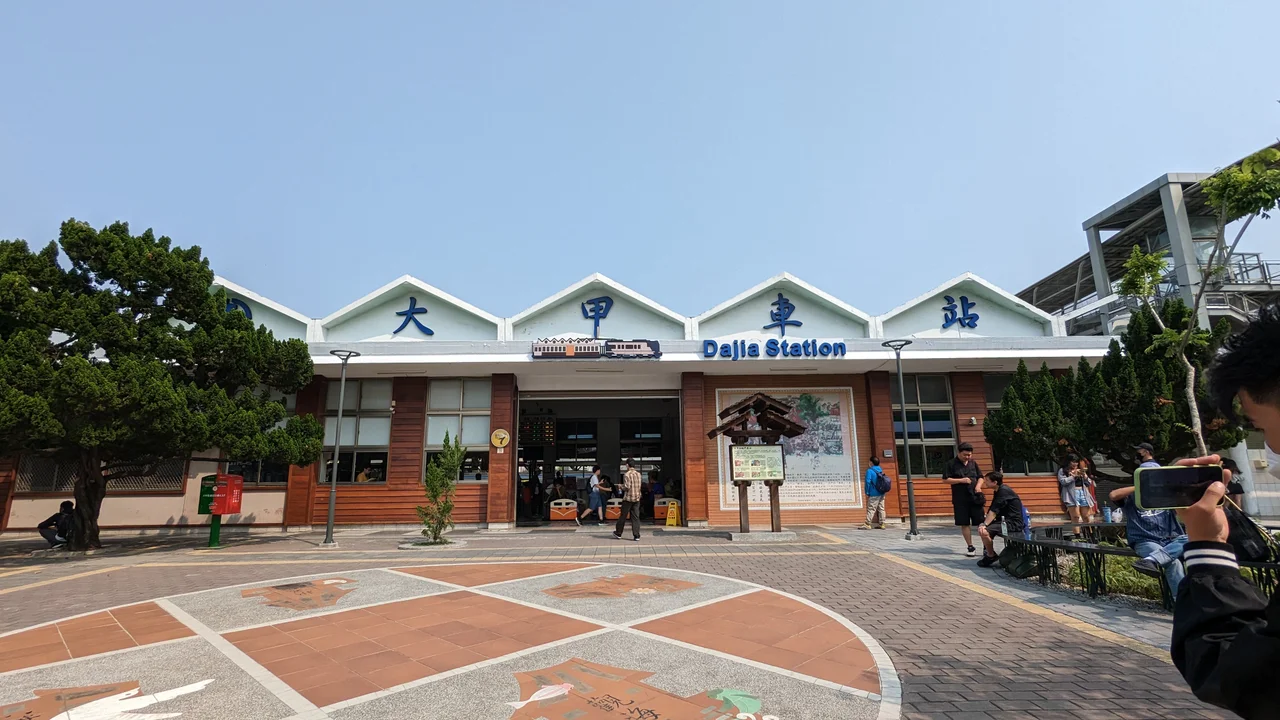

Dajia District
Once a year, the goddess leaves her temple. Carried on a litter by devotees, accompanied by drums and firecrackers and thousands of people on foot, Mazu departs the Jenn Lann Temple in Dajia and begins a journey of 340 kilometers through four counties, visiting more than eighty temples over the course of nine days and eight nights. The Dajia Mazu pilgrimage is one of the largest religious events in the world, drawing hundreds of thousands of participants. It begins and ends here, on the coast of northwestern Taichung, in a district that the Tourism Bureau named one of Taiwan's Top 10 Small Tourist Towns in 2012. Dajia is many things. But it is above all the place where the great pilgrimage starts.
Before the Han Arrived
The Taokas people lived in this coastal area before Han Chinese migration reached the northwestern corner of Taiwan. They farmed and hunted the land that now makes up Dajia District. Han settlers began arriving around 1669, during the late Ming dynasty, most of them originating from Fujian Province — particularly from Quanzhou. The migrants brought their religious traditions with them, including devotion to Mazu, the sea goddess who protects sailors and fishermen.
Under the Qing Dynasty and then under Japanese colonial administration, the area was known as Taikō. When Nationalist governance replaced colonial rule, the name reverted to Chinese: Dajia, meaning roughly "big armor" — a name that traces back to the indigenous Taokas language, though the characters assigned to it are Chinese. On 25 December 2010, Dajia was elevated from a township within Taichung County to a district within the new special municipality of Taichung.
The Great Pilgrimage
The Dajia Mazu pilgrimage leaves in spring each year, the exact date determined by the lunar calendar. Mazu — goddess of the sea, protector of those who cross water — has been worshipped at the Jenn Lann Temple in Dajia for generations. The pilgrimage circuit takes her statue through Taichung City, Changhua County, Yunlin County, and Chiayi County before returning home, a route of roughly 340 kilometers covered entirely on foot by the most devoted participants.
The procession is not solemn. Traditional folk arts companies join it. Performance troupes of every kind — contemporary, historical, local, international — stage their acts along the route. Pilgrims form friendships with strangers walking beside them. Those who cannot walk the full route join for sections, driving ahead to wait at temple gates, offering incense and food to the goddess and the marchers. In 2010, more than 2,000 worshippers from about 40 Mazu temples in mainland China joined the pilgrimage, a sign of the cross-strait religious connections that the political border has never fully severed.
What Else Dajia Makes
The pilgrimage is Dajia's most famous export, but not its only one. Giant Manufacturing — now one of the world's largest bicycle companies, a brand recognized by cyclists everywhere — was established in Dajia in 1972. The company has grown far beyond its hometown origins, with production and sales global, but it began here, in this coastal district, as part of the Taiwanese manufacturing surge that transformed the island's economy in the latter half of the twentieth century.
Dajia East Pottery is another local specialty. The district's traditional ceramics tradition produced earthenware with regional characteristics. Alongside the pottery, Dajia is known for Nǎiyóu sū bǐng — a buttery, flaky pastry in a thin round shape that functions as a local souvenir confection — and for taro products, including a purple jade dessert made from local taro. Straw hats and woven products round out the traditional craft economy.
The Town Itself
Dajia sits at the northwestern corner of Taichung, bordered to the north by the Dajia River — one of the major rivers of central Taiwan — and facing the Taiwan Strait to the west. The climate is subtropical, averaging around 24 degrees Celsius through the year. The Jenn Lann Temple dominates the town's religious geography and draws visitors throughout the year, not only during pilgrimage season.
Other temples cluster nearby: Wenchang Temple, Kuo Xing Temple. Parks, including Chenggong Park and Zhongzheng Park, offer green space within the district. The Sword Well is among the historical curiosities that draw the history-minded visitor. Two Taiwan Railway stations serve the district — Dajia Station and Rinan Station — and the Taiwan High Speed Rail passes through the eastern edge of the district, though no stop is planned there. From downtown Taichung, Dajia is accessible by train in under an hour: close enough to visit easily, distinct enough to feel like somewhere else.
From the Air
Dajia District lies at approximately 24.35°N, 120.62°E at the northwestern edge of Taichung, where the coastal plain meets the Dajia River delta. From the air at 4,000–6,000 feet, the river's course forms a clear boundary to the north before widening into the Taiwan Strait, and the district's coastal position on the broad flat plain is obvious. The Jenn Lann Temple's red and gold roofline is visible on low passes over the town. Giant Manufacturing's facilities are identifiable by their industrial scale east of the temple district. Nearest major airport: RCMQ (Taichung International Airport), approximately 20 km to the southeast. Coastal haze from the strait is common, especially in summer.
Nearby Stories
- Wufeng Lin Family Mansion and Garden 6.5 km away
- Tapung Old Fort 9.4 km away
- 1991 Miaoli Train Collision 9.7 km away
- Taroko National Park 20 km away
- China Airlines Flight 204 21 km away
- Taiwan Strait 38 km away
- Taixi, Yunlin 43 km away
- China Airlines Flight 611 69 km away