.jpg)
Wufeng Lin Family Mansion and Garden
The garden was built so a son could make his mother laugh. In 1863, Lin Wenqin, having just passed the county civil service examination, constructed the Lai Garden on the foothills of Wufeng and staged theatrical performances there for the amusement of his mother, Madame Luo. He named it after the legendary Old Master Lai, who at seventy years of age still dressed in colorful clothing to entertain his elderly parents. That gesture of filial devotion set the tone for everything the Lin family built in Wufeng over the next century and a half: sprawling, theatrical, and deeply personal.
Two Houses, One Dynasty
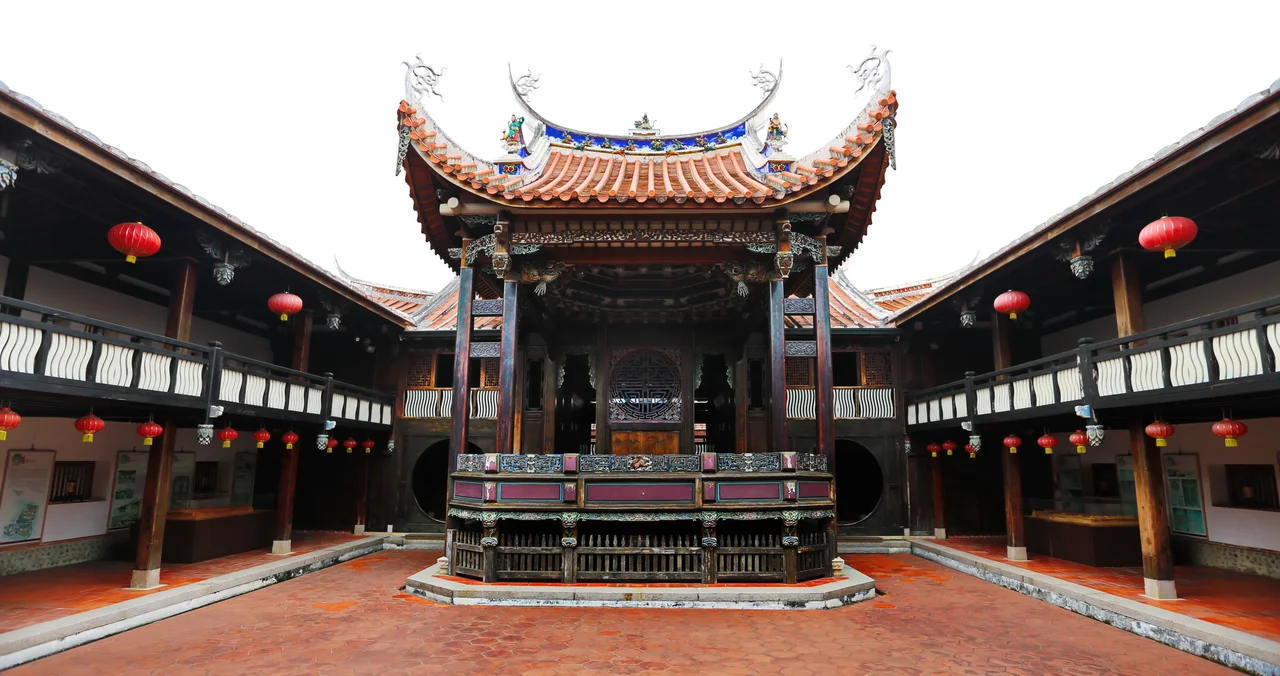
The Wufeng Lin Family Mansion is divided into Upper and Lower compounds, reflecting the branching of the clan over generations. The earliest structure, Caocuo, was a simple thatched sanheyuan courtyard house built in 1837. Within two decades, the family's military and political fortunes had transformed their home into something far grander. The Lower Mansion's central courtyard, Gongbaodi, was begun in 1858 and expanded continuously until the 1880s. After Lin Wencha was killed in battle at Zhangzhou, the Qing court posthumously conferred upon him the title Junior Guardian of the Crown Prince, and the compound's name honors that distinction. The Great Flower Hall, completed around 1894, features an exquisite theatrical stage and outdoor seating designed for public banquets, a building conceived as much for spectacle as for shelter.
The Tower and the Studio
The Upper Mansion tells its own story in brick and tile. Work on the Tower of Prospective Fragrance building group began before 1864, with the facade and gatehouse completed in 1867. The second courtyard followed around 1883, and the rear tower was finished in 1899. Nearby, the Hibiscus-Mirror Studio, a sanheyuan of red kiln-baked bricks, was rebuilt around 1887 as a private school. Its front courtyard contains a semicircular panchi pool modeled after those found in Confucian temples, a detail that signals the family's scholarly ambitions as clearly as the Gongbaodi signals their military honors. The Nourishment Orchard, originally an earthen granary and guesthouse, was refitted in 1906 as a pleasure ground.
Ten Scenes of Laiyuan
The Lai Garden, commonly known as the Lin Family Garden, is counted among the Four Great Gardens of Taiwan alongside the Wu Garden in Tainan, the Beiguo Garden in Hsinchu, and the Lin Family Mansion and Garden in Banqiao. Its ten famous scenes read like lines from classical poetry: the Cotton-tree Bridge spanning Washerwoman's Stream, the Five-Cassia Tower where Liang Qichao stayed during his 1911 visit to Taiwan, the Lychee Isle with its stage built in the middle of the Pool of Small Habits so Madame Luo could watch opera from the water's edge. The Moon-viewing Peak is reached by the Thousand-Step Trail, also called the Cloud-Traversing Trail. Liang Qichao, the influential Chinese reformer, composed twenty quatrains praising Laiyuan's scenery during his stay, poems that became part of the garden's identity.
Shaken and Restored
The 1999 Jiji earthquake devastated the compound. In the Upper House, the Hibiscus-Mirror Studio sustained 80 percent damage, and the New House was completely destroyed. The Lower House fared no better: the Grass House and the Great Flower Hall were both obliterated, and the Residence of the Palace Guard lost 80 percent of its structure. Restoration, funded by the Executive Yuan's 921 Rebuilding Committee in partnership with the Taichung Cultural Bureau, has been painstaking and ongoing. The Tower of Prospective Fragrance, the Nourishment Orchard, the Great Flower Hall, the Palace Guard residence, and the Two-Roomed House have all been completed. Work continues on the Hibiscus-Mirror Studio, the Grass House, and the Five-Cassia Tower. The garden now serves as the campus of Taichung Ming Tai High School, where students walk daily through a landscape that Liang Qichao once celebrated in verse.
From the Air
Located at 24.06N, 120.70E in Wufeng District, Taichung, central Taiwan. The sprawling compound and garden are set against foothills southeast of Taichung's urban core. Nearest airport: Taichung Airport (RCLG/RMQ), approximately 20 km northwest. The compound's large footprint and garden areas distinguish it from surrounding residential development when viewed from lower altitudes.
Nearby Stories
- Shigang Dam 2.7 km away
- Taixi, Yunlin 4.9 km away
- Xitou Nature Education Area 7.2 km away
- Lintianshan Forestry Culture Park 11 km away
- Taroko National Park 20 km away
- Smangus 36 km away
- China Airlines Flight 611 56 km away
- Taiwan Strait 69 km away