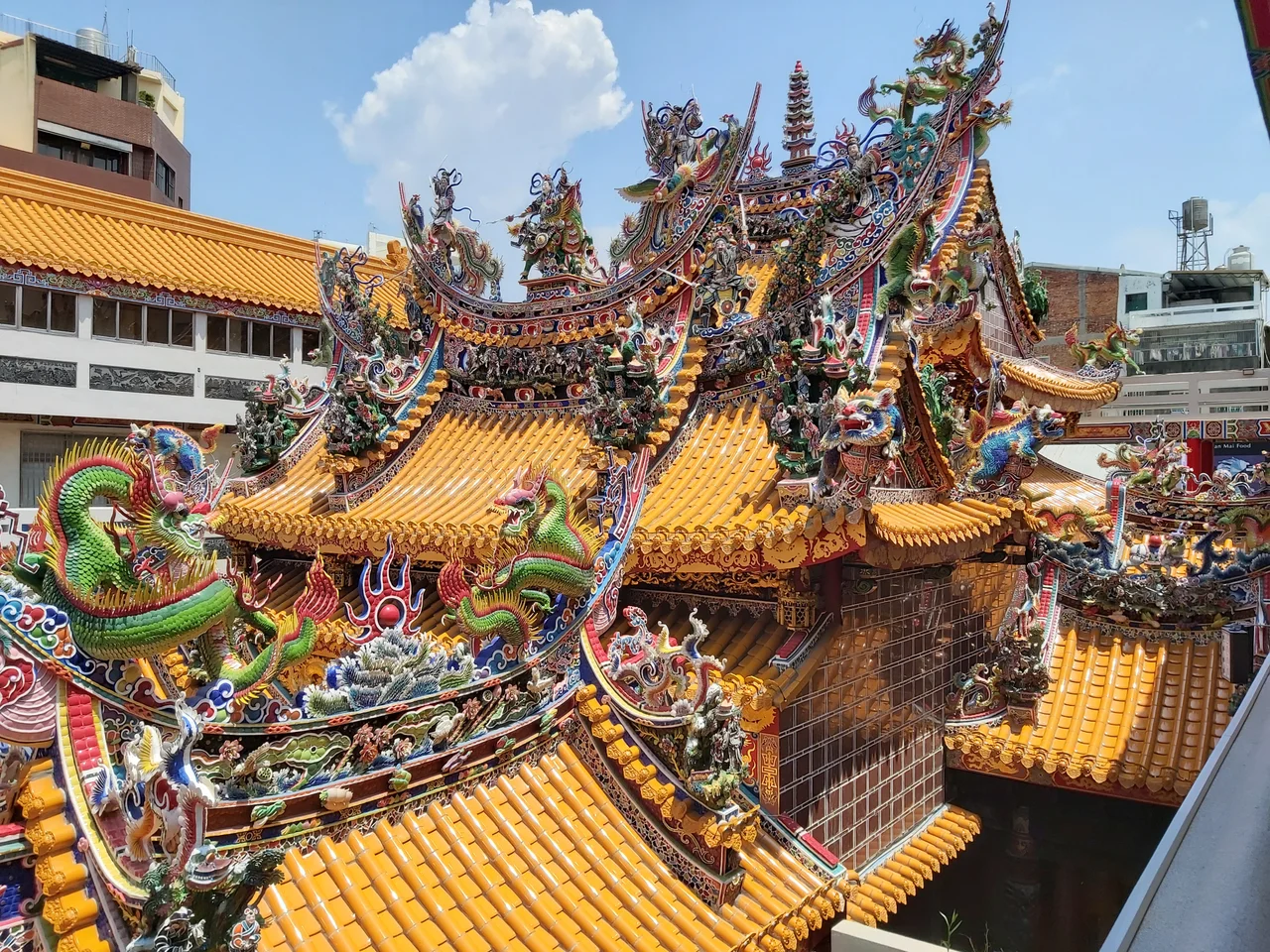

Dajia Jenn Lann Temple
Every spring, something extraordinary unfolds from a temple courtyard in Dajia. Firecrackers split the pre-dawn air. A gilded palanquin rises onto the shoulders of devotees. And then the crowd — hundreds of thousands on the first day alone — pours into the streets of central Taiwan on a journey that will last nine days, cover roughly 340 kilometers, and wind through cities, villages, and rice paddies before returning to where it began. The Dajia Jenn Lann Temple has been sending Mazu into the world since 1730, and the annual pilgrimage it launches has become one of the largest religious processions on earth.
A Goddess Born from the Sea
Mazu — whose name means 'Grandmother of the Sea' — began as a historical figure: a young woman named Lin Mo, said to have been born in 960 CE on Meizhou Island off the Fujian coast and to have died young, perhaps at 28. Legend transformed her into a deity who calmed storms and guided fishermen home. When Fujian migrants crossed the Taiwan Strait in the early 18th century, they brought Mazu with them. In 1730, during the 8th year of the Qing emperor Yongzheng's reign, a settler named Lin Yongxing founded the original Dajia temple to enshrine a Mazu statue he had carried from Meizhou. That small shrine near the coast of Dajia District became the seed of what stands today: a richly ornamented temple complex with layered rooflines, gilded dragon columns, and incense smoke that never seems to thin.
Nine Days, 340 Kilometers
The Dajia Mazu Pilgrimage typically departs in the third lunar month — March or April by the Western calendar. The procession traces a long oval through central and southern Taiwan: south from Dajia through Qingshui and Changhua City, then into Yunlin County and onward to Xingang in Chiayi, where Mazu is welcomed at the Fengtian Temple before the return journey north. The round trip covers approximately 340 kilometers and takes nine days and eight nights. Pilgrims walk the entire distance, sleeping in temple courtyards and community halls along the route; others join for a single leg, or simply wait on the roadside to bow as the palanquin passes. Over the course of the nine days, millions of worshippers participate in some form — through walking, through offerings, or through the simple act of kneeling as the goddess goes by.
The Politics of Faith
Taiwan has thousands of Mazu temples, and competition among them is spirited — both spiritually and politically. In the late 1980s, the Dajia Temple organized the Taiwan Mazu Fellowship (台灣媽祖聯誼會), the first formal association of Mazu temples on the island. By 2010 it included sixty member temples. A rival organization, the Taiwan Golden Orchid Association of Temples, had grown to seventy by the same year. Scholar Hsun Chang has observed that the two associations map loosely onto Taiwan's political landscape: the Mazu Fellowship has tended to align with the Kuomintang and take a warmer stance toward mainland China, while the Golden Orchid Association has drawn temples closer to the Democratic Progressive Party. That a sea goddess's devotional network should carry such political weight says something about how deeply Mazu is woven into Taiwanese identity.
The Temple Itself
The Dajia Jenn Lann Temple sits in the heart of Dajia District, a short walk west of the Taiwan Railway station. Its architecture follows the southern Fujian style common to Taiwanese folk-religion temples: curving eaves with ceramic ridge sculptures depicting mythological scenes, stone lions guarding the entrance, and interior halls layered in lacquer and gold leaf. The main shrine houses the presiding Mazu statue, flanked by her legendary attendants Qianliyan (Eyes That See a Thousand Miles) and Shunfeng'er (Ears That Hear on the Wind) — the divine pair who, according to legend, once served the forces of darkness before Mazu subdued and converted them. In drought years, the temple has coordinated island-wide appeals to Mazu for rain; in 2021, such a ritual drew national media attention as Taiwan faced one of its worst water shortages in decades.
Why This Temple, Why This Pilgrimage
Dozens of Taiwanese temples hold Mazu statues. Many hold annual pilgrimages. The Dajia pilgrimage has grown into something singular — recognized by Taiwan's Ministry of Culture as an important folk custom, and cited by the Discovery Channel as one of the world's three largest religious festivals. What distinguishes it is not doctrine but scale, duration, and the sheer intensity of collective will. People take unpaid leave, walk through blisters, sleep on temple floors, and weep when the palanquin finally comes into view. What they are carrying, each person walking that 340-kilometer circuit, is not just devotion to a goddess. It is continuity — the same route, the same prayers, the same smoke and sound that migrants from Fujian brought across the strait three centuries ago and have refused, through every political upheaval since, to let go.
From the Air
The Dajia Jenn Lann Temple is located at 24.345°N, 120.624°E in Dajia District, northern Taichung. From the air at 3,000 feet, the dense urban grid of Dajia is visible just inland from the western coastal plain. The temple's multi-tiered roofline stands out against the surrounding low-rise neighborhood. Nearest major airport: RCMQ (Taichung International), approximately 25 km to the southeast. The coastal flatlands between Dajia and the sea provide clear visual navigation reference. During the annual pilgrimage in spring, the route south through Changhua and into Yunlin can be traced as a chain of communities along Provincial Highway 1.
Nearby Stories
- Wufeng Lin Family Mansion and Garden 6.5 km away
- Tapung Old Fort 9.4 km away
- 1991 Miaoli Train Collision 9.7 km away
- Taroko National Park 20 km away
- China Airlines Flight 204 21 km away
- Taiwan Strait 38 km away
- Taixi, Yunlin 43 km away
- China Airlines Flight 611 69 km away