.jpg)
Davelis Cave
The marble that built the Parthenon came out of this mountainside, and you can still see exactly how. On the rock faces around the cave mouth, the chisel marks and wedge slots survive in crisp parallel rows, as if the quarrymen stepped away for lunch twenty-five centuries ago and never came back. A paved ancient path, worn smooth, runs down the slope below, the very track along which sledges hauled enormous white blocks toward the workshops of classical Athens. The cave above it has carried three different names across three different eras, and each one tells you something about how Greece remembers.
The Mountain That Built Athens
Mount Penteli, the ancients called it Pentelikon, gave the city its finest stone. Pentelic marble, fine-grained and faintly golden when the sun strikes it, faced the Parthenon and a dozen other monuments on the Acropolis. The Davelis Cave sits inside the old Spilia quarry, roughly 700 meters up the southwestern slope, where workers cut into a natural fault and followed the marble inward. Stand at the entrance and the engineering is plain: the smoothed extraction faces, the slots where iron wedges were driven and soaked to split the rock, the dragway descending toward the plain. This was industry on an imperial scale, executed entirely by hand and muscle, and the mountain still wears the evidence.
A Chapel Cut Into Stone
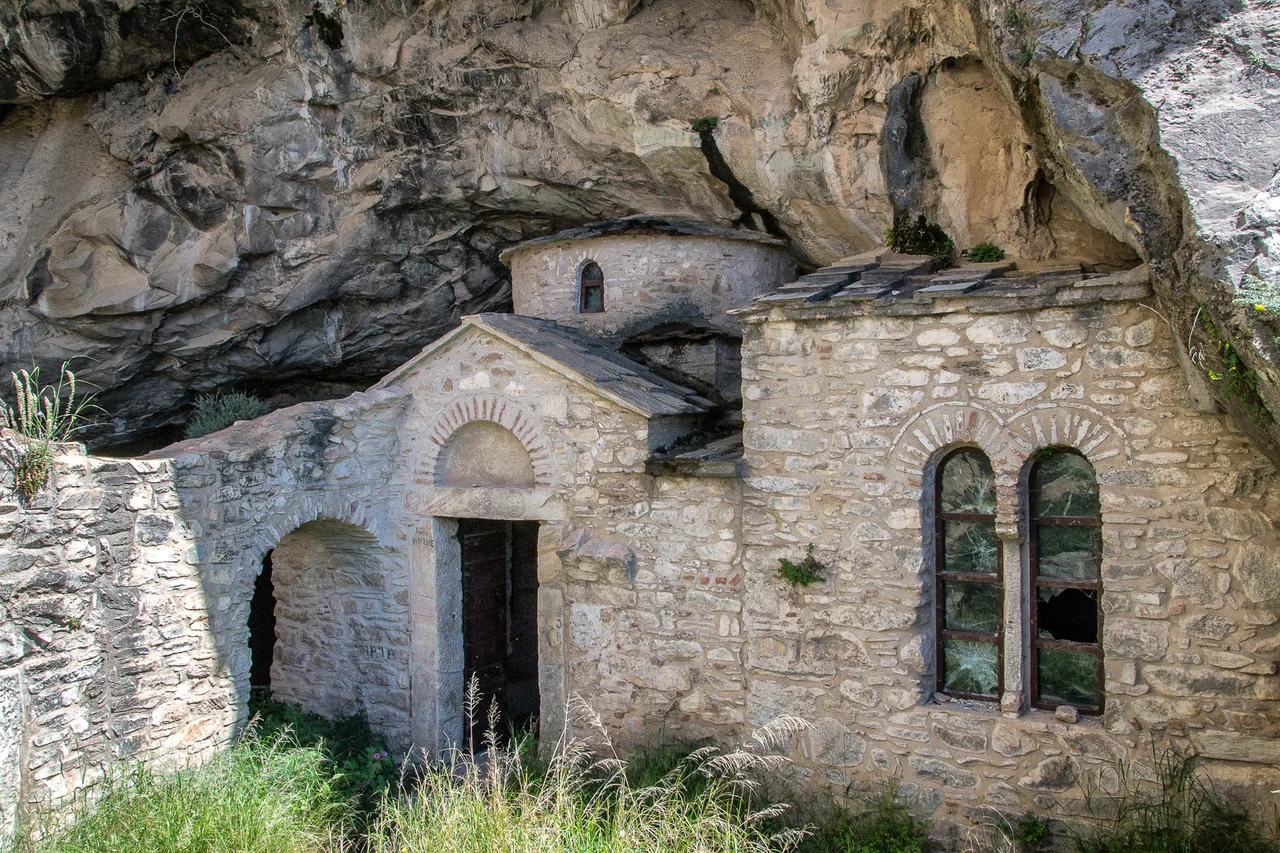
Christians came later. From Late Roman or Early Byzantine times, worshippers scratched crosses, angels, and eagles into the cave walls. Then, in two stages between the 10th and 12th centuries, builders raised a small double church right at the mouth. The southern chapel, dedicated to Saint Spiridon, was carved back into the living rock of the cave itself; the northern one, dedicated to Saint Nicholas, was added in masonry and crowned with a modest dome. Frescoes from the first half of the 13th century once covered the interior, kin in style to the church of Saint Peter at Kalyvia Thorikou across Attica. Some of those paintings were removed for safekeeping to the Byzantine and Christian Museum in Athens after the church was damaged in the late 1970s and early 1980s, and the building took further minor harm in the forest fires of August 2024.
The Brigand Who Lent His Name
The cave owes its modern nickname to Christos Davelis, born Christos Natsios around 1832, a brigand who roamed Attica and Boeotia until soldiers cut him down on 12 July 1856. He was a thief and a kidnapper, not a folk hero, yet Greek memory has a habit of romanticizing its outlaws. During the Crimean War he seized a French officer off an Athens street and extracted a ransom in gold. Local lore made the Penteli cave his hideout, a refuge where the mountain swallowed him whenever the gendarmes drew close. There is little hard evidence he ever used it, but the name stuck, and a quarry that had served kings and saints became, in the popular imagination, a bandit's lair.
The Legends Take Over
The strangest chapter is the most recent, and it belongs firmly to legend rather than history. In 1977 a Greek magazine reported that the military had sealed the cave and begun secret work inside, and through the early 1980s crews did use explosives and heavy machinery to bore new tunnels into the mountain. The official explanation was prosaic: stabilization and safety work. Then the digging stopped abruptly, some passages dead-ended, others were sealed, and the equipment was simply abandoned. Into that vacuum poured every kind of theory. Writers spun tales of NATO bunkers, mind-control experiments, and ancient portals; one 1982 paranormal book made the cave a fixture of Greek conspiracy culture. What is verifiable is small and human: an old quarry, a ruined chapel, some unfinished tunnels. The rest is the story a mysterious place inevitably attracts.
What Remains
Tourists have climbed to this spot since the 18th century. English travelers Richard Chandler and Edward Dodwell both recorded it, Dodwell on 22 June 1805, drawn by the same combination of ruin and view that pulls hikers up from the Athens suburbs today. From the cave mouth the city sprawls across the Attic basin toward the sea, the same panorama those quarrymen saw when they paused to wipe the marble dust from their eyes. Up the slope, a smaller cave once held a shrine to the god Pan and the nymphs, its votive figurines now in the National Archaeological Museum. The Davelis Cave gathers all of it, antiquity, faith, banditry, and modern myth, into one weathered opening in the white stone.
From the Air
Located at 38.07°N, 23.88°E on the southwestern slope of Mount Penteli, roughly 700 m above sea level and about 15 km northeast of central Athens. The pale scar of the ancient quarry stands out against the forested mountainside. Nearest major airport is Athens International (LGAV), about 25 km to the southeast. Best viewed in clear daytime conditions; summer haze and wildfire smoke can reduce visibility over Attica.
Nearby Stories
- Great Sand Beach 5 km away
- Battle of Delium 7.7 km away
- Tower of Aliartos 9 km away
- HMHS Britannic 10 km away
- Saronic Gulf 15 km away
- Sousaki Volcano 17 km away
- Sanctuary of Apollo Maleatas 24 km away
- Skyros 66 km away