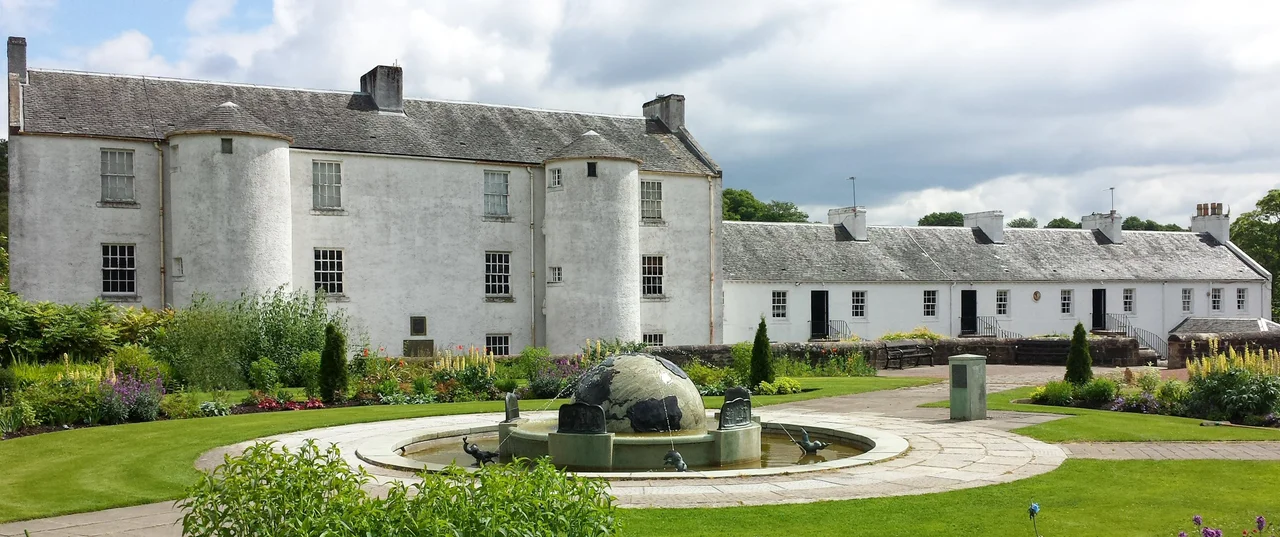

David Livingstone Birthplace Museum
Shuttle Row was condemned as unfit for human habitation in 1913. The same year, Scotland was preparing to celebrate the centenary of the birth of one of its most famous sons, who had been born in 1813 in one of those very tenement rooms - a single chamber, ten feet by fourteen, shared with his parents and brothers. The contradiction was not lost on anyone. By 1929 the rescued building had become a museum, and Elizabeth Bowes-Lyon, the future Queen Mother, opened it in front of a crowd of twelve thousand. This is where David Livingstone began.
Born in a Cotton Mill
David Livingstone was born on 19 March 1813 in Shuttle Row, a three-storey workers' tenement attached to the Blantyre Cotton Spinning Works on the south bank of the River Clyde. The mill housed 24 families in single-room tenancies. Children were employed from the age of ten as piecers, scrambling between the spinning machines to tie broken threads; Livingstone went to work in the mill at that age and continued for years, attending the night school the mill ran for its workers. He taught himself Latin between shifts. He read theology books propped on the spinning frames. He became a doctor and a missionary, and in 1840 he sailed for southern Africa - a journey that would, eventually, define what nineteenth-century Britain understood about the interior of the African continent and would shape, for better and worse, the colonial century that followed.
An Honest Reckoning
Livingstone is a complicated figure to memorialise. He campaigned hard and at real personal cost against the East African slave trade, which by the 1860s was still flourishing in regions Atlantic abolition had not touched. His journals, read in Britain after his death, became one of the most effective pieces of anti-slavery propaganda of the century. At the same time, his maps and reports opened the African interior to European missionaries, traders and eventually colonisers - a process that ended in the partition of Africa by European empires, with consequences whose violence the people of the continent are still living with. He believed Africans deserved Christianity and commerce; he did not always see that those who would follow him would bring conquest. The museum today tells the story honestly, with input from Southern African scholars and communities, holding both sides of the man together rather than choosing one.
The Trust and Its Rescue
The campaign to save Shuttle Row began in 1925 with a committee, accelerated under the architect Sir Frank Mears and the Reverend James I. MacNair in 1926, and culminated on Whitsunday 1927 with the Executive Committee's purchase of the site. An international appeal funded the restoration. The opening on 5 October 1929 was a major Scottish public event - twelve thousand people gathered on the mill grounds while the Duchess of York (later Queen Elizabeth the Queen Mother) declared the memorial open. The Scottish National Memorial to David Livingstone Trust was formally constituted in October 1930. From 1999 the National Trust for Scotland operated the centre under a tripartite agreement; today the David Livingstone Trust runs it directly, funded by the Heritage Lottery Fund, Historic Environment Scotland and the Scottish Government.
Bobbins, Spears and a Last Diary
The collection at the museum is dense with the small specific things that make a biographical museum work. There is a spinning jenny of the kind Livingstone would have known as a child. A working bell from the Blantyre mill. Bobbins, a hand-spun handkerchief dyed at the works. The Blantyre Works Library - the 19th-century books that mill workers could borrow, the same shelves Livingstone read his way through. Beside these are objects from his African expeditions: navigational equipment, medical instruments, artefacts from the communities he encountered. There is the inventory written by Jacob Wainwright, one of the Africans who had travelled with Livingstone and was present at his death in 1873 - Wainwright wrote it into Livingstone's own last field diary, the last words in the explorer's notebook being not Livingstone's but those of the man who buried his heart in African soil and carried his body home. Charles Pilkington Jackson sculpted bronze tableaux for the 1929 opening; Archibald Haswell Miller painted nineteen murals across the museum walls between 1929 and the years that followed, telling Livingstone's life story to children, school groups, and any of the twelve thousand who returned.
From the Air
The David Livingstone Birthplace Museum sits at 55.80N, 4.08W, on the south bank of the River Clyde in Blantyre, South Lanarkshire, about 8 nm southeast of Glasgow city centre. The museum lies on the river just opposite Bothwell, with a pedestrian footbridge crossing the Clyde to connect the two villages. From the air, look for the river bend and the green grounds of the museum on the south side; Bothwell Castle's ruined donjon stands less than a mile upriver on the same south bank. Glasgow International (EGPF) is 12 nm northwest, Glasgow Prestwick (EGPK) 25 nm southwest, Edinburgh (EGPH) 35 nm east. Best viewed from 2,000 to 5,000 feet.
Nearby Stories
- HMS Gannet 3.6 km away
- Luss 5.3 km away
- Oliver Castle 6.8 km away
- Battle of Bannockburn 6.9 km away
- Beith 7.9 km away
- Pentland Hills 7.9 km away
- Lochleven Castle 16 km away
- Cumnock 17 km away