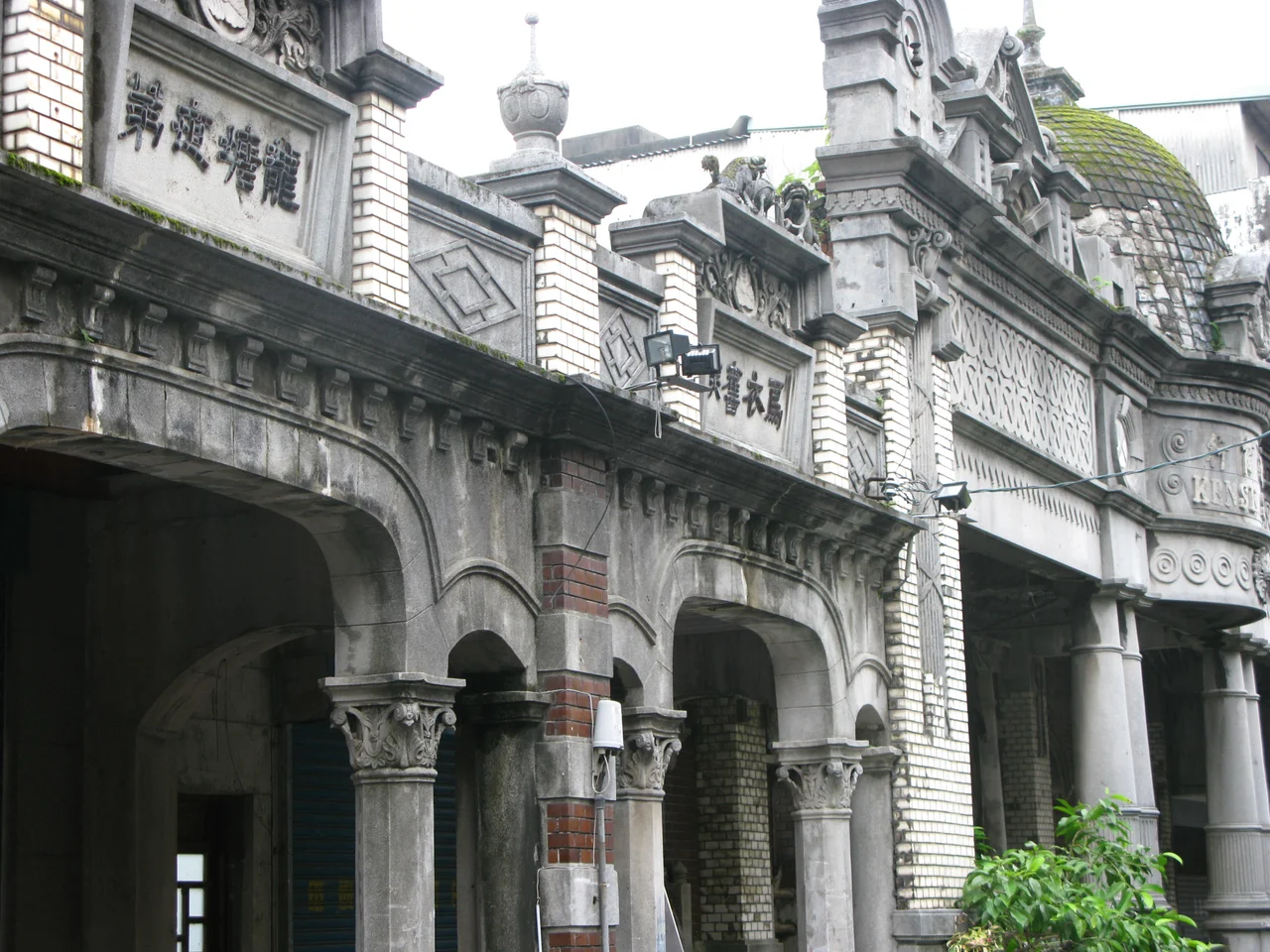

Daxi Old Street
The shopfronts on Heping Road do not look like Taiwan. They look, improbably, like a compressed version of a European street — Roman columns, Greek lintels, arched facades detailed with carvings of fish and bats that shift the idiom sideways into something Chinese. Baroque style arrived in Daxi during the Japanese colonial period, when merchants who had grown prosperous from camphor and tea trade invested in storefronts that announced their success in the architectural language of ambition. They built well. More than a century later, those facades still stand along Heping, Zhongshan, and Zhongyang Roads, and the street they front remains one of the best-preserved commercial strips from Taiwan's Japanese era.
Camphor, Tea, and the Street That Served Them
Daxi's prosperity in the late 19th and early 20th centuries came from two commodities that the world wanted badly. Camphor, extracted from the forests of the Central Mountain Range, was essential for manufacturing celluloid film and smokeless gunpowder. Tea from the surrounding hills was exported across Asia and to Europe. Daxi Old Street developed as a commercial artery during this boom, built initially to give workers a shortcut for moving goods without taking the longer route around. As trade volumes grew during Japanese colonial rule, merchants rebuilt their shopfronts in the prevailing architectural fashion — Baroque facades with Western structural elements and Chinese decorative motifs layered on top. The result is an aesthetic that belongs fully to neither tradition and is entirely native to this particular moment in Taiwanese history.
The Facades Up Close
Walking Heping Old Street — the oldest and most intact section — is an exercise in noticing detail. The facade columns are classical in proportion but bear carvings of bats (a Chinese symbol of good fortune) and fish alongside more conventional Baroque ornament. Chinese characters frame doorways beneath Western pediments. The buildings were commercial from the start and remain so: the ground floors have always been shops, and the residential quarters above are still occupied. Because Heping Old Street developed later than some other areas and saw less pressure to modernise, the buildings are in unusually good condition. A few facades are repaired or restored, but the street scale and the continuity of the architectural language are genuine. The Furen Temple, established in 1813 and dedicated primarily to Kai Zhang Sheng Wang, anchors the religious life of the neighbourhood from within the street's fabric.
The Tofu That Made Daxi Famous
Ask anyone in Taiwan what comes from Daxi and the answer is likely the same word: tofu. Specifically, dried tofu — 豆干 (dòugān) — braised in sweet soy sauce and dried to a firm, glossy finish that is nothing like the soft white block found elsewhere. Daxi's dried tofu has a distinctive dark colour, a concentrated savoury-sweet flavour, and a texture that holds its shape whether eaten alone or sliced into salads and stir-fries. The tradition runs deep: Ta Fang Foods, one of the area's most renowned producers, was founded in 1923 and still uses methods passed down through five generations. Along Old Street, shop after shop sells variations — plain, spiced, pressed with sesame, layered into packaged gifts for visitors to carry home to Taipei. It is the kind of local product that has become so associated with its place that buying it anywhere else feels like a substitution.
Festivals and Living Tradition
Daxi's cultural life is not purely historical. The Puji Temple, a few minutes' walk from Old Street and dedicated to Guan Yu, hosts one of the most elaborate birthday processions in northern Taiwan on the twenty-fourth day of the sixth lunar month — a tradition that dates to 1917 and involves around 31 professional and community associations parading through the streets. The procession has grown large enough to draw visitors from across the island. It is the kind of living celebration that gives Daxi Old Street a context beyond tourism: the buildings are preserved because people still live and worship and celebrate here, not because a heritage authority decided they should be. The street's survival is not incidental. It is the result of continuous use.
Afternoon in Daxi
The practical experience of visiting Old Street is unhurried and rewarding. The area is compact enough to cover on foot in a morning, with time left to eat well and browse the wooden-product shops — furniture, chopsticks, decorative items — that have been part of Daxi's commercial mix for generations. Snack vendors along the street sell fresh and packaged foods; the smell of braised tofu is present at almost every turn. Daxi is also adjacent to the Dahan River, where a riverside park and the Daxi Bridge offer views of the valley that the colonial-era merchants looked out over when they built their ambitious facades. Whether you come for the architecture, the tofu, the festival, or simply the quality of the light on old stone in the late afternoon, Daxi Old Street delivers something genuinely particular to this corner of Taoyuan.
From the Air
Daxi Old Street is located at 24.885°N, 121.288°E in Daxi District, Taoyuan City, in northern Taiwan. The area sits in the Dahan River valley, approximately 30 kilometres southeast of Taoyuan International Airport (RCTP), which is the nearest major airport. From the air at 3,000–5,000 feet, the Dahan River is the primary navigational landmark — a wide river curving through hilly terrain, with Daxi town visible on its eastern bank. The Shimen Reservoir, one of Taiwan's major reservoirs, is visible to the southeast. The urban grid of Taoyuan City proper lies to the northwest on the coastal plain.
Nearby Stories
- Former Residence of Chang Hsueh-liang (Hsinchu County) 3.8 km away
- Dawulun Fort 7.3 km away
- Cherry Orchard Cemetery 8.4 km away
- 2022 Chinese Military Exercises Around Taiwan 17 km away
- Suao 21 km away
- 2015 New Taipei Water Park Fire 28 km away
- Gaomei Lighthouse 33 km away
- Gaomei Wetlands 63 km away