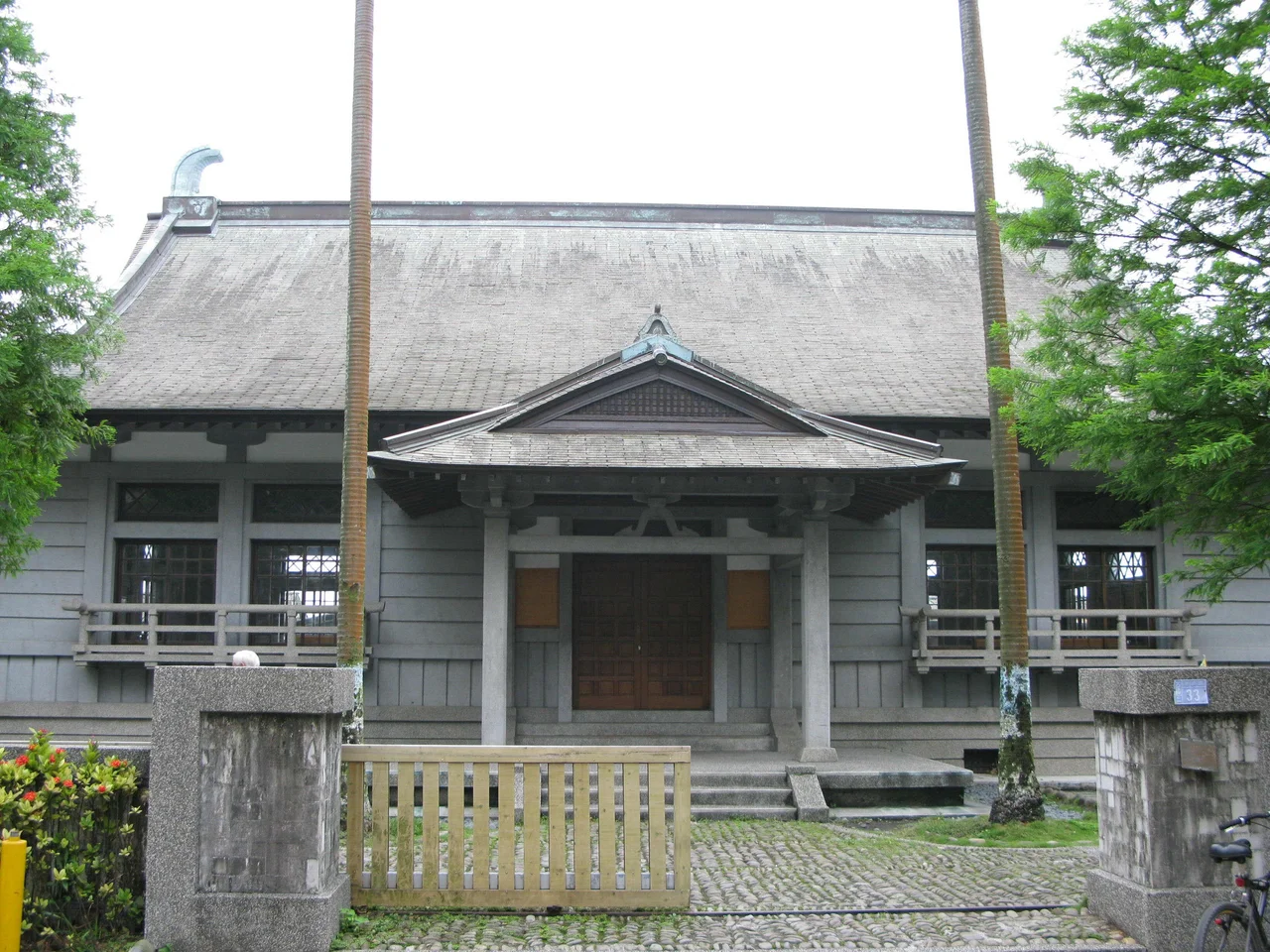

Daxi Wude Hall
The building was supposed to open in February 1935. It was finished on schedule - a handsome martial arts hall built for the Japanese colonial police force in Daxi, a prosperous town in what is now Taoyuan City. But in April, an earthquake struck Taiwan, and the opening ceremony was delayed until May 20. The hall that opened its doors that day would outlast the colonial government that built it, the Chinese Nationalist government that repurposed it, the military police who guarded it, and the Cold War tensions that made a presidential residence necessary in a small riverside town.
Daxi Wude Hall still stands in Daxi District, its hip-and-gable roof intact, its tatami floor still divided - half for judo, half for kendo - as it was designed nearly a century ago. It is now part of the Daxi Wood Art Ecomuseum, a network of heritage buildings that together tell the story of a town shaped by timber, tea, and the politics of successive occupying powers.
Dragon Heads on a Concrete Temple
The architecture of Daxi Wude Hall is a study in cultural layering. Built of reinforced concrete, the structure mimics the appearance of a traditional Japanese wooden temple. The hip-and-gable roof features barge boards on the gable end in the Shinto architectural style, while the internal structure uses a Western roof truss system. The floor divides cleanly into two practice areas: tatami matting for judo on one side, hardwood boards for kendo on the other.
The decorative details reveal the ambitions of the builders. Dragon-headed creatures with fish tails perch along the roof ridges - mythological guardians drawn from both Japanese and Chinese traditions. The roof itself is covered with asbestos shingles shaped and colored to imitate red copper tiles, a cost-saving measure that nonetheless achieves the intended effect of dignified permanence. The exterior walls wear a coating of pebbledash - small stones pressed into plaster - with molded accents that give the concrete the texture and visual weight of stone masonry.
From Police Dojo to Presidential Retreat
Under Japanese rule, the hall served its original purpose: a training center where colonial police officers practiced martial arts. Japan's colonial administration built wude halls across Taiwan as part of a broader effort to promote martial discipline among its security forces, and Daxi's version included a convention center alongside the main training space.
When the Japanese departed in 1945 and the Nationalist government took control of Taiwan, the building's function shifted dramatically. In 1950, the convention center was converted into a Presidential Residence - one of several locations across the island designated for use by Chiang Kai-shek's government. The Military Police Corps established a presence to provide security, transforming a martial arts hall into a site of political and military significance during the tense early decades of Nationalist rule on Taiwan.
Three Lives of a Small Building
The military police occupied the Wude Hall complex for nearly half a century. When they relocated to Touliao Mausoleum in 1998, the army transferred the building and its grounds to the Daxi Township Administration Office, beginning the hall's third career. The administration office renovated the old dormitory on the building's north side and converted it into an activity center for parents and children - a transformation that would have baffled the Japanese police who once practiced sword strikes in the same space.
Renovation of the main hall began on November 10, 2000, and was completed in December 2001. The work preserved the building's essential character while making it safe for public use. Three-level sleeping quarters were added to the south side during the same period. Today the hall hosts occasional exhibitions and cultural events, its doors open to visitors who come to see a building that has been, in sequence, a dojo, a presidential annex, a military installation, and a community center.
Daxi's Wooden Memory
Daxi Wude Hall does not stand alone. It belongs to the Daxi Wood Art Ecomuseum, a network of heritage buildings in Daxi District that together preserve the town's identity as a center of woodworking and craftsmanship. Daxi grew wealthy on camphor and timber during the Japanese colonial period, and its old streets are lined with baroque-influenced shophouse facades built by prosperous merchants - a visual style unique in Taiwan, blending Japanese colonial architecture, Chinese commercial traditions, and European decorative motifs.
The Wude Hall is the network's martial counterpoint to the commercial elegance of the shophouses. Where the old street celebrates trade and prosperity, the hall speaks to the power structures that governed the town. Standing inside the main room, with its split floor of tatami and hardwood, its concrete walls pretending to be a wooden temple, and its dragon-fish guardians watching from the roof above, visitors encounter a building that has absorbed nearly a century of Taiwanese history without losing its original shape. The earthquakes, the regime changes, the soldiers and the children who followed them - the hall has outlasted them all.
From the Air
Located at 24.88°N, 121.29°E in Daxi District, Taoyuan City, northwestern Taiwan. Daxi is a small town on the Dahan River, identifiable from the air by the river's winding course and the town's compact historic center. The Wude Hall is a small heritage building within the urban area and not individually distinguishable from altitude; look for the Daxi old street district near the river. Taiwan Taoyuan International Airport (RCTP/TPE) is approximately 25km to the northwest. Hsinchu Air Base (RCPO) is about 40km to the southwest. The terrain is gently rolling hills transitioning from the Taoyuan Plateau to the foothills of the Central Mountain Range. Good visibility year-round except during typhoon season and winter rain events.
Nearby Stories
- Former Residence of Chang Hsueh-liang (Hsinchu County) 3.8 km away
- Dawulun Fort 7.3 km away
- Cherry Orchard Cemetery 8.4 km away
- 2022 Chinese Military Exercises Around Taiwan 17 km away
- Suao 21 km away
- 2015 New Taipei Water Park Fire 28 km away
- Gaomei Lighthouse 33 km away
- Gaomei Wetlands 63 km away