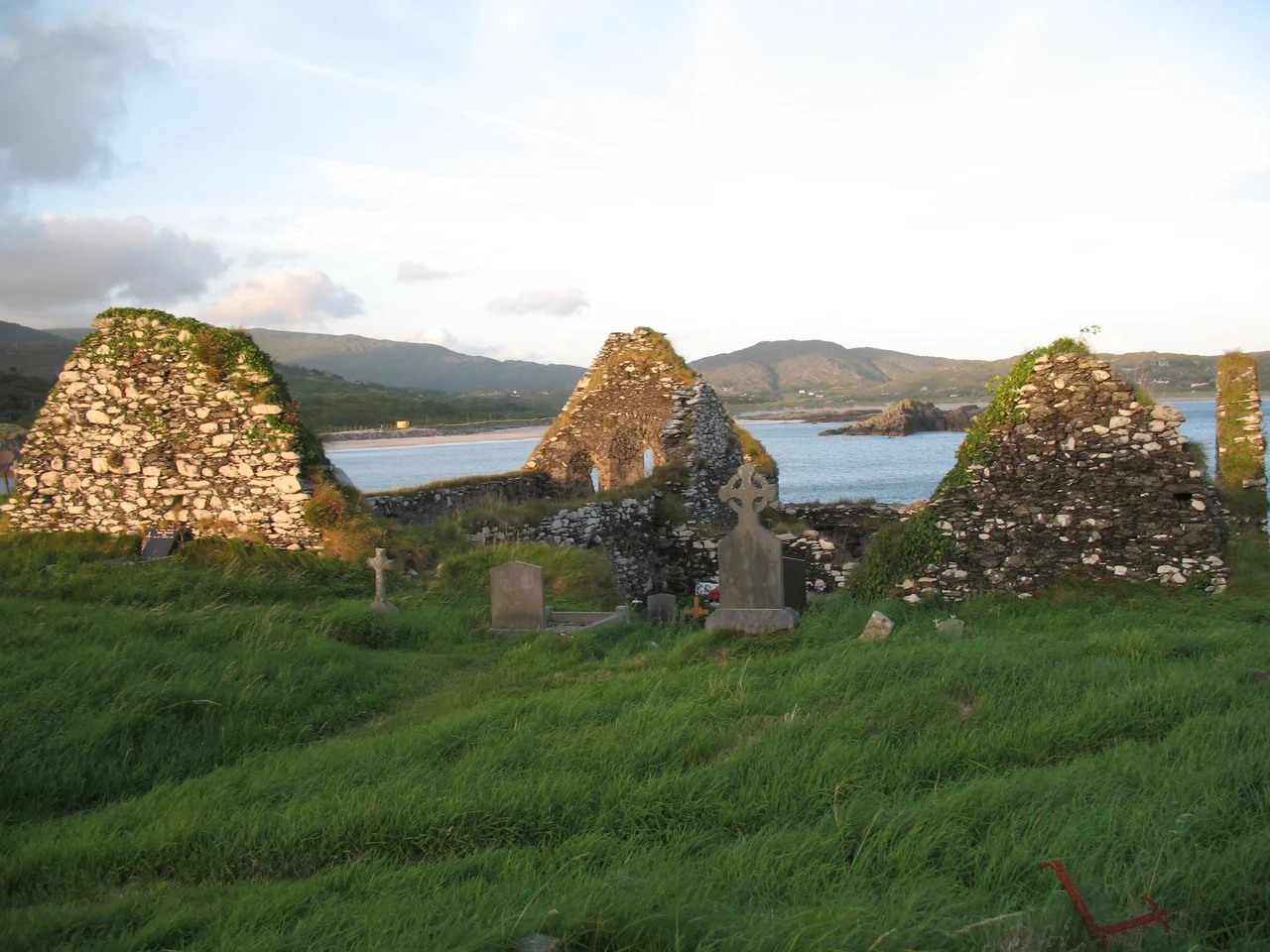

Derrynane Abbey
Twice a day the tide pulls back and Abbey Island becomes part of the mainland. A strand of pale sand emerges between Derrynane Beach and the dark hump of the island, and you can walk dry-shod to a ruined sixth-century monastery whose three arched windows still face the open sea. Twice a day the Atlantic returns and the abbey is an island again. Mary O'Connell has been resting on the seaward side of this rhythm since 1836.
Reached by Tide
Derrynane Abbey - also known as Ahamore Abbey - sits on Abbey Island, just off Derrynane Strand on the south-western edge of the Iveragh Peninsula. Tradition dates the original foundation to the sixth century, the same era when Saint Finan was establishing his church a few kilometres away on Church Island in Lough Currane. The Atlantic-facing site was typical for early Irish monasticism: remote, exposed, calibrated to remove its inhabitants from worldly distraction. Three roofless interconnecting buildings still stand. The main church has lost its roof entirely, but its three eastern arched windows survive, gazing across the bay. The walls are overgrown, the floor a tangle of grasses and graves. Salt mist rolls in. The buildings have endured because the local stone is hard and because the community kept burying its dead here for centuries after the monastery itself had gone.
Mary O'Connell's Grave
Daniel O'Connell married his cousin Mary O'Connell in 1802. By all accounts they were devoted to each other: in a public life crammed with elections, court cases and mass political meetings, Mary was the steady centre. She bore eleven children, lost four young, ran the household at Derrynane while Daniel was in Dublin or London, and reportedly never lost her belief in his capacity to do enormous things. She died in 1836, several years before her husband's greatest triumphs were fully secured. He had her buried in the graveyard at Derrynane Abbey, looking out at the sea they both loved. He never remarried. When he later added a chapel to Derrynane House in 1844, he had its design modelled on the ruined chapel here on Abbey Island. The architectural echo was a love letter.
The Poet of Aghamore
Also buried in the abbey graveyard is Tomas Rua O Suilleabhain - Red-Haired Thomas O'Sullivan, the great nineteenth-century Gaelic poet of the Iveragh. Born nearby around 1785, he composed in Irish through a period when the Gaelic literary tradition was under severe pressure from English, from famine, and from emigration. His best-known song, Amhran na Leabhar, the Song of the Books, lamented the loss of his beloved library when the boat carrying it sank off the Kerry coast. He died in 1848 during the worst years of the Great Famine, and was carried out to Abbey Island for burial. Today his grave shares the sea-spray with that of Mary O'Connell - the literary memory of Gaelic Kerry beside the personal memory of Catholic Emancipation. Among the other markers is a white-tiled tomb, its tiles chipped away in places by wind and salt and pilgrim hands.
A Place Worth Crossing For
What strikes visitors most is the silence. The N70 traffic is a distant hum back on the mainland; the dominant sounds are wind across the dune grass and surf hitting the seaward side of the island. The three arched windows of the church frame the open Atlantic perfectly, as though their builders knew that even after the roof was gone, the view would do the work of a stained-glass nave. Check the tide tables before you go: the strand floods rapidly, and the path to Abbey Island is best crossed an hour or so either side of low tide. There is no railway here, no entrance fee, no interpretive centre - only fifteen centuries of Irish faith, lapsing slowly back into the seabed it was raised from.
From the Air
Derrynane Abbey sits at 51.7575 deg N, 10.1428 deg W on Abbey Island, just off the Derrynane Strand. From 1500-2500 feet AGL on a clear day the island appears as a small dark hump joined to the mainland by a pale crescent of sand. Derrynane House is 1 km inland; Caherdaniel sits 2 km north-east. Nearest airport is Kerry (EIKY), 75 km north-east. Atlantic weather and tide both shift fast on this coast.
Nearby Stories
- Farranfore–Valentia Harbour line 3.3 km away
- Heir Island 4.1 km away
- Inishvickillane 4.4 km away
- Kealkill stone circle 8.7 km away
- Headford Ambush 10 km away
- Dunlough Castle 13 km away
- SM U-68 27 km away
- Sao Miguel 1923 km away