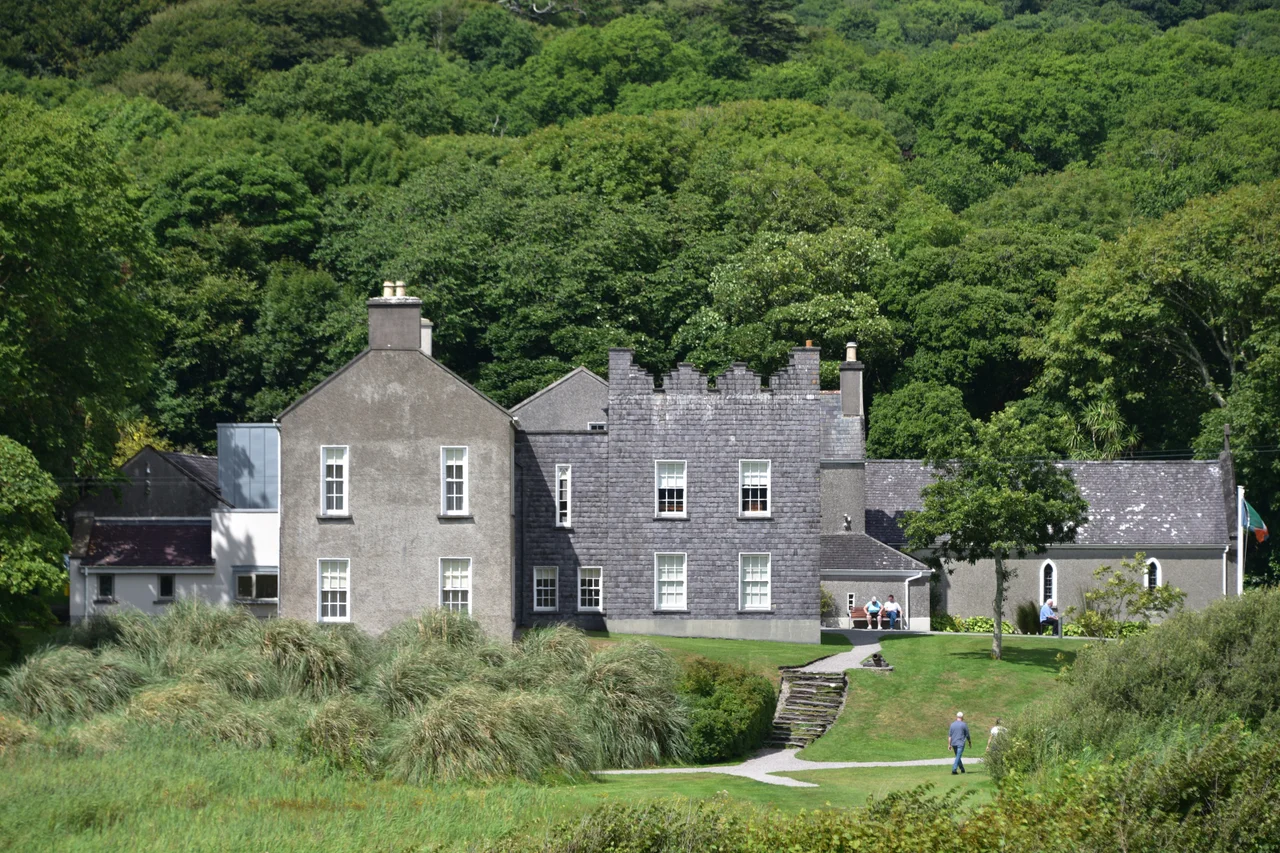

Derrynane House
When the most powerful Irish politician of the nineteenth century needed to think, he came here - to a salt-scoured house tucked behind dunes at the very edge of the Atlantic. Daniel O'Connell could pack a hundred thousand people into a Dublin field. He could face down a British prime minister. But the work of reshaping a nation was done partly here, in the library wing he added in 1825, with the sound of Derrynane Bay rolling in through the windows.
The Liberator's Refuge
O'Connell's grandparents Domhnall Mor O Conaill and Maire Ni Dhonnchadha Dhuibh built or extended the original house in the 1700s, and the oldest section dated to 1702. The family's wealth came partly from smuggling - the cove was perfect for it, hidden and deep, where French wine and brandy slipped past Crown officers. That illegal trade paid for the education that would eventually make Daniel O'Connell into the most consequential Irish politician of his age. He never forgot it. Long after he became known across Europe as The Liberator, Derrynane remained the place he came home to. The two-storey south wing he added in 1825 faces directly out to sea, library shelves heavy with the texts he marshalled into his arguments for emancipation.
Emancipation, Won on a Kerry Shore
In April 1829, the Roman Catholic Relief Act passed at Westminster, allowing Catholics to sit in Parliament for the first time in nearly a century and a half. O'Connell had built the campaign that made it impossible to refuse - a mass movement of the Irish poor, organized through parish networks, funded by the penny-a-month "Catholic rent." He had personally won the County Clare by-election the previous July, forcing Wellington and Peel to choose between letting him take his seat or facing revolution. They chose the seat. The chapel O'Connell added at Derrynane in 1844 was modelled on the ruined chapel of Ahamore Abbey on nearby Abbey Island, where his beloved wife Mary was buried. After half a century of public battle, his deepest gravity always pulled him back to this corner of Kerry.
A Park, A Museum, A President's Blessing
The house sits within a 320-acre national historic park, one of the most lavish settings any Irish hero has been granted in death. Restoration work in the 1960s required the demolition of the original 1702 section for safety reasons. When the house reopened to the public as a museum in 1967, it was Eamon de Valera who performed the ceremony - a president dedicating the home of the man who, more than any other, had invented Irish democratic politics. Visitors today walk through rooms still hung with O'Connell's portraits, his furniture, the gilded triumphal chariot in which he was paraded through Dublin after his release from prison in 1844. Outside, ogham stones and a mass-rock chapel mark a landscape layered with belief and resistance long before Daniel O'Connell drew breath.
Why This Coast
The Iveragh Peninsula is one of the windward edges of Europe - storm-blown, treeless in places, beautiful with a hardness that flatters no one. O'Connell's enemies in London never quite understood why he kept coming back. They saw a remote, poor corner of Ireland. He saw the place that had made him. The Gaelic-speaking household his uncle Maurice Hunting Cap ran here taught the boy who would later argue cases in English law courts that the Irish were not a footnote but a nation. Caherdaniel sits three and a half kilometres up the road. Caherdaniel - Cathair Donaill - Donal's stone fort. Even the place names whisper O'Connell, generations of them, back to the bronze-age cathair perched on the hill above his ancestors' shore.
From the Air
Derrynane House sits at 51.7636 deg N, 10.129 deg W on the south-western tip of the Iveragh Peninsula. Approach from the north along the Ring of Kerry (N70) at 1500-2500 feet AGL for the most dramatic angle - Derrynane Bay opens beneath you with Abbey Island to the west, the long Derrynane Strand curving south, and the Kenmare River out to the east. Nearest airport is Kerry (EIKY) at Farranfore, 70 km north-east. Cork (EICK) lies 110 km east-north-east. Coastal weather changes fast; expect Atlantic squalls and reduced visibility from south-westerly fronts.
Nearby Stories
- Farranfore–Valentia Harbour line 3.3 km away
- Heir Island 4.1 km away
- Inishvickillane 4.4 km away
- Kealkill stone circle 8.7 km away
- Headford Ambush 10 km away
- Dunlough Castle 13 km away
- SM U-68 27 km away
- Sao Miguel 1923 km away