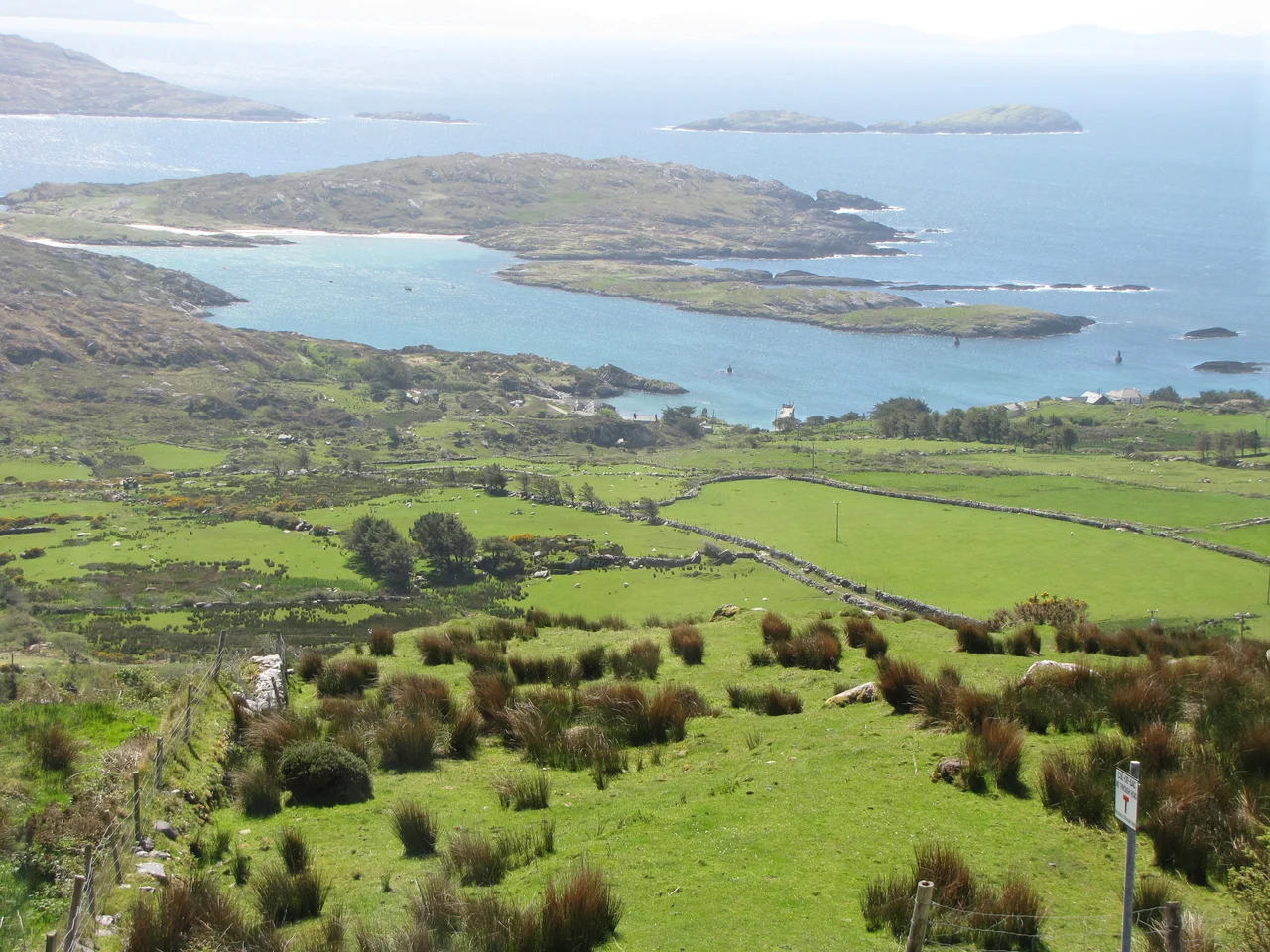

Derrynane
Derrynane is barely a village. A scatter of houses, a single road dropping toward the sea, and a strand of sand white enough to catch the light from kilometres away - that is the whole of it. But this small place, tucked into the south-western corner of the Iveragh Peninsula, has been catching attention for five thousand years. Bronze Age copper miners noticed it first. Then a saint. Then a Liberator. Then, in 1988, a French president, dropping in for tea.
Stone Age, Bronze Age, Cathair
Officially Darrynane, in the civil parish of Kilcrohane, the village sits just off the N70 near Caherdaniel on the shore of Derrynane Bay. The name comes from the Irish Doire Fhionain - Fionan's Oak-wood - tying the place to the same Saint Finan who founded the monastery on Church Island in Lough Currane and reportedly also at Skellig Michael. But the human story here runs much deeper than Christianity. A dolmen (a Stone Age passage grave) in the area may date from around 3000 BC. Sites near Derrynane from around 2000 BC are linked to the Beaker people, who were mining copper in the surrounding hills. Staigue Fort, one of Ireland's finest stone ringforts, lies seven kilometres east; Loher Cashel, another fine cathair, sits four kilometres to the north-west. The landscape is dense with the marks of people who chose this exposed coast over and over again.
The O'Connells of Doire Fhionain
The O'Connell family had been in this corner of Kerry for centuries before any of them became internationally famous. They were among the few Catholic gentry families to keep substantial property through the penal era, partly because of where they were - so remote, so coastal, so useful to a king who needed a quiet stretch of shore where contraband could come ashore without too many questions. The family's wealth came partly from smuggling French wine and brandy through Derrynane's deep cove. That income paid for the European education of one Daniel O'Connell, born just up the coast in 1775, who would become the most consequential Irish politician of the nineteenth century. Derrynane was always his anchor. He returned each summer from the political theatres of Dublin and London, and is commemorated today by Derrynane House (now a museum) and the broader Derrynane National Historic Park.
A French Feminist on Kerry Sand
Among the village's more unexpected modern residents was Benoite Groult (1920-2016), the French journalist, novelist and feminist activist whose books - notably Ainsi soit-elle (So Be She) in 1975 - made her one of the leading voices of post-war French feminism. Groult bought a holiday home in Derrynane and spent every summer here from 1977 until 2003. She wrote, swam, walked the strand, hosted friends. In 1988, the French president Francois Mitterrand visited her at the Kerry house - a small diplomatic curiosity that locals still remember. Another writer claimed by Derrynane was Eibhlin Dubh Ni Chonaill, the eighteenth-century O'Connell-clan poet (and aunt of Daniel) who composed Caoineadh Airt Ui Laoghaire, the Lament for Art O'Leary - one of the greatest poems in the Irish language, mourning her husband murdered for refusing to sell his horse to a Protestant magistrate.
Boats to the Skelligs
From Bunavalla pier, just east of the village, small boats run summer day-trips out to the Skellig Islands - the two needle-like rocks twelve kilometres offshore, where sixth-century monks built beehive cells on a vertical pitch above the Atlantic and where, more recently, Luke Skywalker hid in exile. The crossing is weather-dependent. The Atlantic decides. Back on the mainland, Caherdaniel village shares a Gaelic Athletic Association club with Derrynane. The two settlements function as one community spread along a few kilometres of coast. What Derrynane offers is not a destination so much as a posture: a place small enough to walk in twenty minutes, layered enough to spend years untangling, and beautiful enough that people from the Bronze Age to a French president have decided it was worth the journey.
From the Air
Derrynane sits at 51.7654 deg N, 10.1209 deg W on the south-western coast of the Iveragh Peninsula. From 1500-3000 feet AGL the village is a cluster of buildings just inland from Derrynane Bay; Derrynane Strand and Abbey Island lie to the south, Caherdaniel and Staigue Fort to the east. Nearest airport is Kerry (EIKY), 75 km north-east. Atlantic weather, frequent low cloud and rapid visibility changes are typical.
Nearby Stories
- Farranfore–Valentia Harbour line 3.3 km away
- Heir Island 4.1 km away
- Inishvickillane 4.4 km away
- Kealkill stone circle 8.7 km away
- Headford Ambush 10 km away
- Dunlough Castle 13 km away
- SM U-68 27 km away
- Sao Miguel 1923 km away