.JPG)
Derryquin Castle
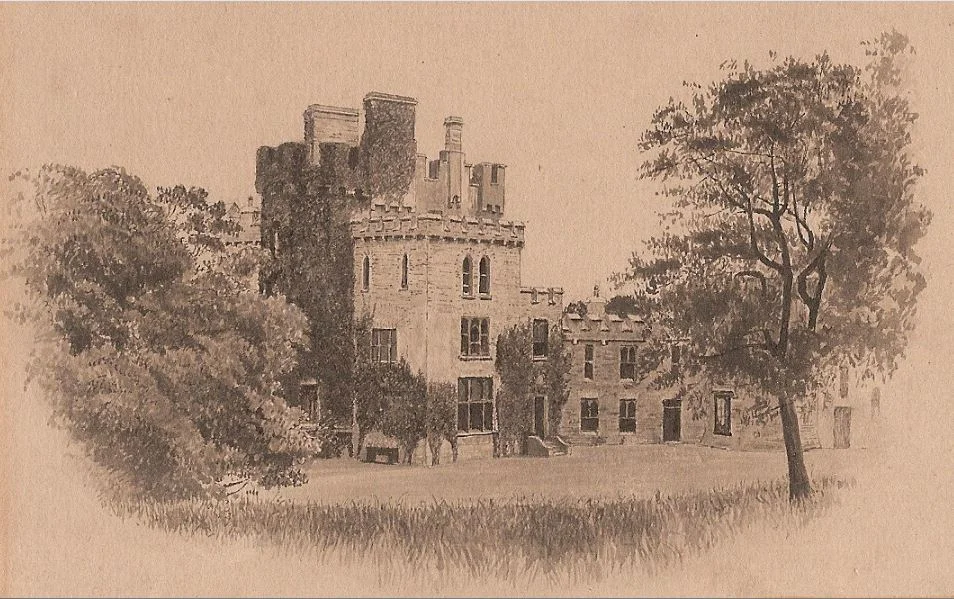
The castle was never quite as old as it looked. Battlements, machicolations, a four-storey octagonal tower rising through the centre, a building that could play backdrop in a Gothic novel - the architect James Franklin Fuller, working for the Bland family, knew exactly the aesthetic he was after. Derryquin Castle was the Victorian idea of a castle, raised on an estate already in Bland hands for nearly two centuries. Then in 1922 the Irish Republican Army came up the drive with petrol, and the building's days were numbered.
The Bland Inheritance
The Parknasilla estate, in which Derryquin sat, came into Bland hands in the late seventeenth century. The Very Reverend James Bland, an Englishman, moved to Ireland in 1692 as chaplain to Henry Sydney, 1st Earl of Romney, the newly appointed Lord Lieutenant. Bland had been educated at St John's College, Cambridge; he became Archdeacon of Limerick in 1693, Archdeacon of Aghadoe in 1705, Treasurer of Ardfert in 1711, and finally Dean of Ardfert in 1728. He sold his Yorkshire property in 1717 and committed fully to County Kerry. The estate passed down the male line for nearly two centuries: Judge Nathaniel Bland (1695-1760), the Reverend James Bland (1727-1786), Francis Christopher Bland (1770-1838, High Sheriff of Kerry in 1806), and onward through three more Blands - James Franklin, Francis Christopher, and James Franklin again - each serving as High Sheriff of Kerry at one time or another.
A Castle Designed to Look Old
James Franklin Fuller (1835-1924) was one of the most prolific Irish architects of his generation, a designer of churches and country houses with a particular flair for what we would now call historicism - new buildings that look as though they have stood for centuries. His three-storey main block at Derryquin was crowned by a four-storey octagonal tower rising through the centre, with a two-storey partly curved wing extending off to one side. Battlements crowned the parapets. Machicolations - the openings through which boiling oil could theoretically have been poured on attackers - decorated the corners. There was, of course, no need to pour boiling oil. The Blands were not under siege; they were country gentry hosting house parties on the Ring of Kerry. The castle was a stage set for a particular kind of nineteenth-century Anglo-Irish life: hunting, fishing, formal dinners, the rituals of a landowning class living on borrowed time.
Burned in 1922
In 1891, James Franklin Bland sold the castle to the Warden family, who held it for the next three decades. Colonel Charles Wallace Warden owned it in 1922 when the Irish Republican Army came up the drive during the Irish Civil War and set the house alight. Derryquin was one of around three hundred big houses destroyed in the early 1920s - the buildings symbolised the Anglo-Irish landlord class, and burning them was a tactic of both the War of Independence and the bitter Civil War that followed. The Times of London reported the destruction on 9 October 1922 under the headline 'Rebels' Campaign of Destruction.' The Wardens never rebuilt. The shell stood as a ruin for nearly half a century, slowly collapsing into itself, before being demolished entirely in 1969.
A Resort Built on the Ruins
Today the site lies within the grounds of the Parknasilla Resort and Spa Hotel. The Blands themselves had built the original Parknasilla Hotel in the 1890s, on the same estate, capitalising on the Victorian appetite for west-of-Ireland luxury. The hotel survived where the castle did not, and continues today as one of the great country-house hotels of the Ring of Kerry - frequented over the years by George Bernard Shaw, Charles de Gaulle, Princess Grace of Monaco, and General Charles de Gaulle. Visitors stroll the lawns where the Bland castle once stood, mostly unaware that the smooth grass and clipped hedges cover the foundations of a Victorian castle, the long inheritance of an Anglo-Irish family, and the burning shadow of the events that finally swept the landlord class out of Ireland. Sir (Francis) Christopher Bland later used Derryquin as one of the backgrounds for his novel Ashes in the Wind - an apt title for a building that ended in flames.
From the Air
The Derryquin Castle site lies at 51.822 deg N, 9.873 deg W within the Parknasilla Resort grounds near Sneem, about 40 km south-west of Killarney. From 1500-2500 feet AGL on a clear day the resort appears as wooded grounds along the Kenmare River; the castle's footprint is not now visible from the air. Nearest airport is Kerry (EIKY), 50 km north-east, with Cork (EICK) 90 km east. Atlantic weather and frequent low cloud are typical in the area.
Nearby Stories
- Farranfore–Valentia Harbour line 3.3 km away
- Heir Island 4.1 km away
- Inishvickillane 4.4 km away
- Kealkill stone circle 8.7 km away
- Headford Ambush 10 km away
- Dunlough Castle 13 km away
- SM U-68 27 km away
- Sao Miguel 1923 km away