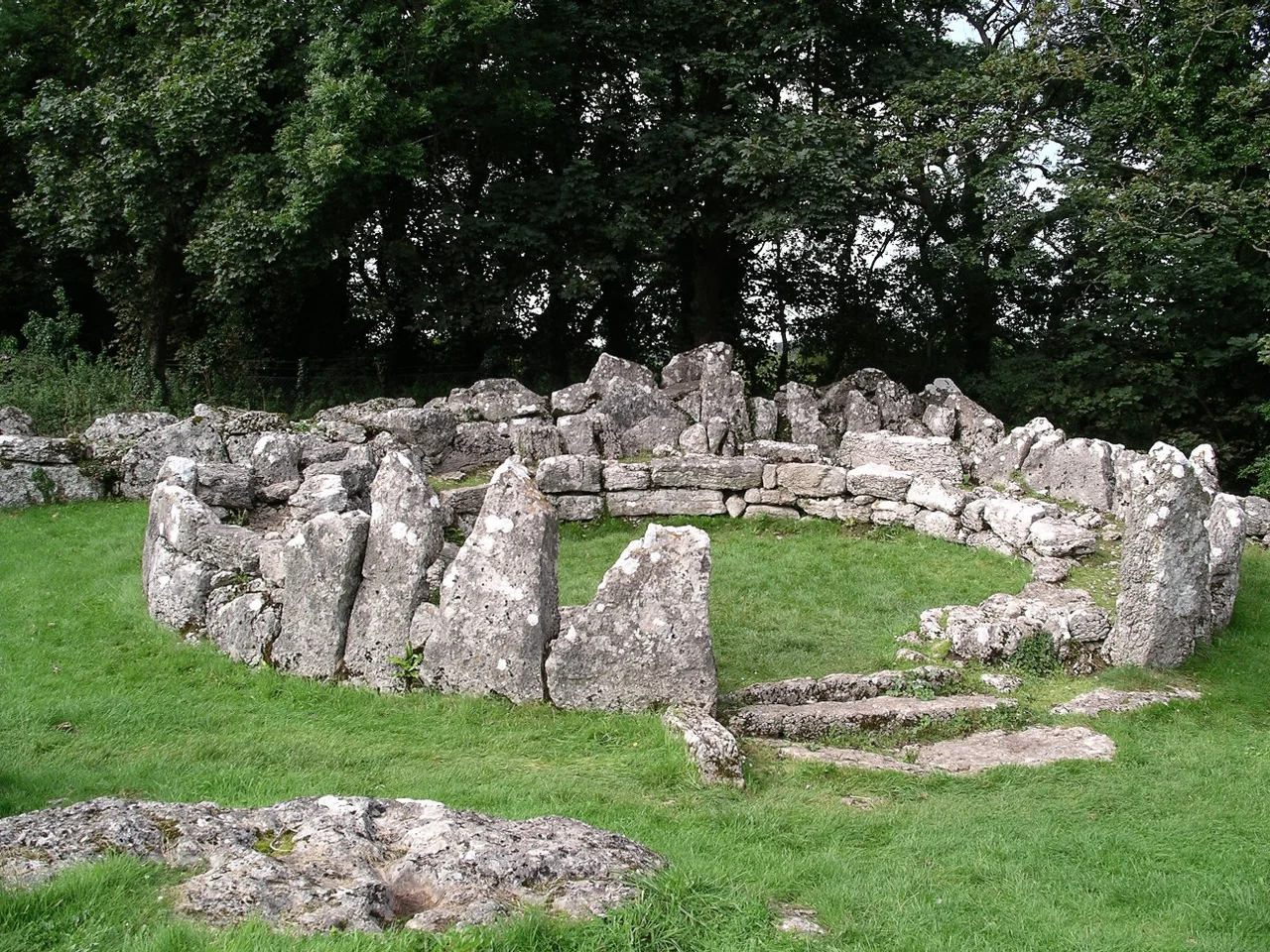

Din Lligwy
Sometime in the early 4th century, while the Roman Empire was still nominally running Britain, a small community on the east coast of Anglesey built itself a defended settlement of stone houses, sturdy enough that you can still walk through its doorways today. Din Lligwy is the kind of site that should not survive: a small late-Roman British village far from any great city, on land that has been farmed continuously for sixteen centuries. Almost everywhere else, sites like this have been ploughed flat. Here the outer wall is still substantially intact - reduced in height, but in plan unchanged. The foundations of the roundhouses still stand. The rectangular buildings beside them - barns, workshops, almost certainly an iron-smithing forge - are visible enough that you can see exactly how the village was organised.
Excavated, Not Cleared
The site was excavated between 1905 and 1907 by archaeologists who knew enough to leave its visible structures standing. Their finds tell the story: hundreds of fragments of Roman-period pottery from the 3rd and 4th centuries CE, many of them mended in antiquity with little iron clamps - a sign that good pots were expensive enough to be worth repairing. Animal bones, some of them carved into tools and one into what was identified as a musical instrument. Iron slag and worked iron, suggesting that the village's main economic activity was metalworking. The houses were stone-built in the local limestone, with walls thick enough that some sections still rise to head height. The plan - circular dwellings, rectangular ancillary buildings, all enclosed within a pentagonal stone wall - is typical of late Romano-British defended sites in upland Britain.
Older Than the Pottery
Despite the dominance of 3rd and 4th century finds, the site is almost certainly older than its Roman-period material suggests. The basic layout - a defended enclosure on a hill with good visibility and a reliable freshwater source - belongs to the Iron Age tradition that long predates Roman influence in Britain. It is likely that Din Lligwy was originally an Iron Age farming community that adopted Roman-style pottery, ironmongery and architecture in the same way that rural communities across Britain did, while remaining culturally Welsh in everything that mattered. When Roman authority in Britain collapsed in the early 5th century, life at Din Lligwy probably did not change overnight. The pottery imports stopped. The iron forge kept going. The cattle still grazed.
What You See Now
Cadw, the Welsh historical monuments service, looks after the site and visiting is free. A short footpath leads up from the road through a small wood - the hill is overgrown today with sycamore and ash, though when the village was occupied the slopes would have been cleared for sightlines and grazing. The first thing you see is the outer wall, with its narrow original gate. Inside, eight or nine building foundations are arranged around a small open central area. The largest of the rectangular buildings is interpreted as the iron-working barn; iron slag and burned earth were found in its floor. Within a few minutes' walk are the Lligwy Burial Chamber - a Neolithic dolmen built around 3000 BCE with a 25-ton capstone - and the ruined 12th-century Capel Lligwy. Three sites, three completely different periods, all within a half-mile walk.
From the Air
Din Lligwy at 53.35°N, 4.26°W, on the gentle eastern slope above Moelfre and Lligwy Bay on eastern Anglesey. The site is on a low hill now wooded in sycamore and ash, partially screening the stone foundations from the air. Nearest airports: Anglesey/Valley (EGOV) 18 nm west, Caernarfon (EGCK) 16 nm south. The Snowdonia massif rises directly to the south on clear days, providing the same view the 4th-century villagers would have known. The Lligwy area concentrates three distinct ancient sites - the Neolithic burial chamber, the Iron Age/Roman village, and the medieval chapel - within a half-mile area unusual in Britain.
Nearby Stories
- Llandudno Lifeboat Station 3.8 km away
- Glynllifon 6.1 km away
- German submarine U-1024 9.4 km away
- Irish Sea Bridge 11 km away
- Ysbyty Ifan 12 km away
- Irish Sea 18 km away
- Celtic Array 18 km away
- Birkdale Palace Hotel 56 km away