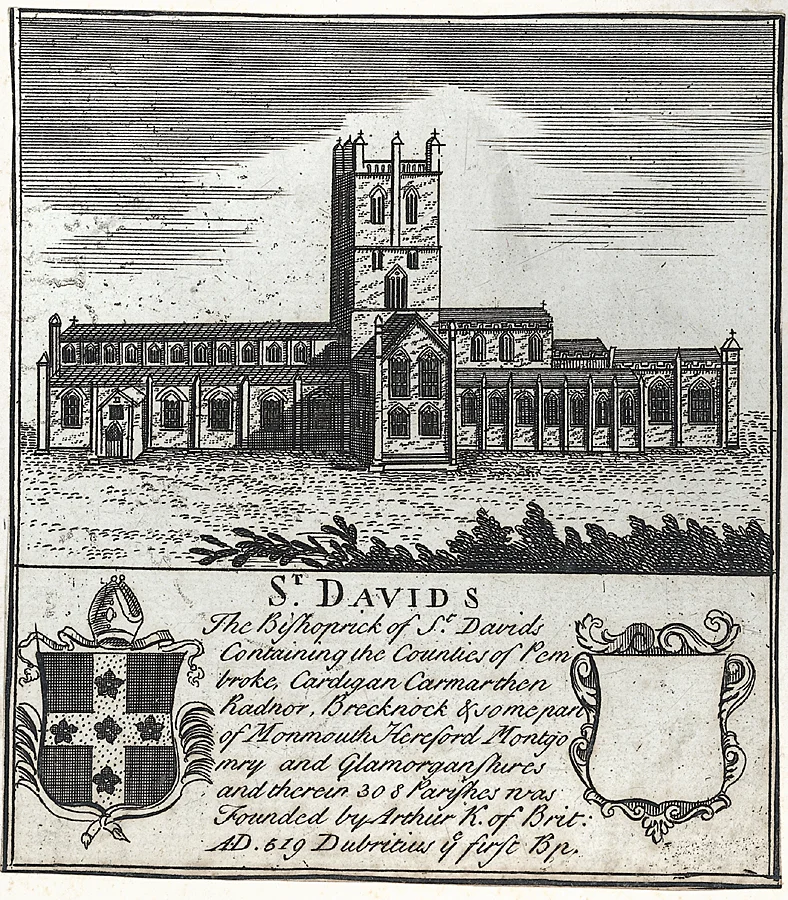

Diocese of St Davids
St Davids has 1,772 people in it, which makes it the smallest city in the United Kingdom by population. It is a city all the same, because in 1995 Queen Elizabeth II said it was. What pushed it into city status, despite the missing thousands of inhabitants, is the building at the bottom of the valley: a cathedral begun in 1181 on the site of a monastery founded six hundred years earlier by Dewi Sant himself, the patron saint of Wales. The diocese this cathedral anchors stretches across most of southwest Wales, and the see has existed in unbroken succession since the saint's lifetime.
Dewi's Mountain
The history of the diocese traditionally traces to Dewi, known in English as David, in the second half of the sixth century. The records before the Normans are fragmentary, surviving only as scattered references in the Annales Cambriae and the Brut y Tywysogion. What we know is that Dewi founded a monastic community on a marshy site by the River Alun, that pilgrims came from across the Celtic world to visit it, and that his successors built and rebuilt the church on the same ground until the present cathedral rose in the late twelfth century. The diocese originally corresponded with the boundaries of Dyfed, the old kingdom of Demetia, and at its largest covered around 3,500 square miles, all of Wales south of the Dyfi and west of the English border, minus most of Glamorgan.
Boundaries and Reshapings
Until 1852 the diocese even extended into Herefordshire, holding parishes in what is now England. Its current shape was settled in 1923, when the eastern third was carved off to form the new Diocese of Swansea and Brecon, leaving St Davids with Pembrokeshire, Carmarthenshire, Ceredigion, and a small western strip of Glamorgan. In 2019 the diocese began a quieter but more sweeping reorganisation: its scattered rural parishes were grouped into twenty-three Ministry Areas, each large enough to support a small team of clergy. The process finished in 2021. A parish in Pembrokeshire that once felt distinct now belongs to something called West Cemaes or Greater Dewisland or Roose, names that reach back into the Welsh kingdoms the diocese once served.
Bishops, Old and New
The office of Bishop of St Davids is one of the oldest in the British Isles, reaching back to Dewi's own monastic foundation. In 2017 the see made a different kind of history when Joanna Penberthy was consecrated as the first woman ordained a bishop in the Church in Wales, having been elected in November 2016. She served until 2023. Her successor, Dorrien Davies, was elected in October that year, confirmed in November, and consecrated at Bangor Cathedral on 27 January 2024. The bishop's residence, Llys Esgob, sits not in St Davids itself but at Abergwili near Carmarthen, fifty miles east. The diocese has three archdeaconries named for St Davids, Carmarthen, and Cardigan, plus an Archdeacon Missioner, Mones Farah, born in Palestine and ordained in the Church in Wales in 1988.
A City That Is a Village
Stand in the centre of St Davids today and the city does not feel like a city. The streets are narrow, the shops few, the houses low. You can walk across the whole of it in fifteen minutes. The cathedral, though, hides in a hollow below street level, and the moment you crest the wall and look down at it, you understand: the city is the cathedral, and the cathedral is the city. Pilgrims have walked these last miles from St Non's Bay or down the road from Mathry for more than a thousand years. The Cathedral Ministry Area today serves a population of 1,772, supported by a Dean, a Sub-Dean, and a Canon Pastor. The wind comes off the Atlantic the same way it did when Dewi was alive.
From the Air
The Cathedral and diocesan see sit in St Davids at approximately 51.88 degrees north, 5.27 degrees west, on the western tip of the Pembrokeshire peninsula. From altitude the city itself is barely distinguishable from the surrounding farmland, but the cathedral close, set in a green hollow, shows clearly. Haverfordwest (EGFE) lies sixteen miles east; Swansea (EGFH) sixty miles east. The diocese stretches across three counties, with Cardigan to the north and Llanelli to the southeast bracketing its eastern edge.
Nearby Stories
- RAF Angle 0.9 km away
- Cardigan Bay Special Area of Conservation 5.4 km away
- Abercych 11 km away
- Cantre'r Gwaelod 12 km away
- Burry Port Lifeboat Station 22 km away
- Johnstown Castle 61 km away
- Hook Lighthouse 92 km away
- 1979 Fastnet Race 157 km away