
Dipylon
Every year the procession formed here. Priests, magistrates, young women carrying sacred baskets, herds of sacrificial animals, the whole city assembled at this gate and then moved off through it toward the Acropolis, climbing to honor Athena at the festival of the Great Panathenaea. The Dipylon was where Athens began its most important march, and the Athenians built it to match the occasion: a gate so vast, covering some 1,800 square meters, that ancient writers called it simply the largest gate of the ancient world.
Two Gates, One Threshold
The name means "Two-Gated," and the design earned it. Themistocles raised the structure in 478 BC, part of the rushed fortification of Athens after the Persians had sacked and burned the city. Rather than a single opening, the Dipylon set a pair of gates back from the wall line, creating an enclosed courtyard ringed by four corner towers. To an attacker who forced the outer gates, that courtyard became a trap, a killing ground swept by defenders on every side. For ordinary traffic it was simply the city's grand front door, opening onto the roads that ran north to Boeotia and south to the Peloponnese. Before the 3rd century BC it carried an older name, the Thriasian Gates, after the plain its road crossed.
Built From the Dead
There was a cost to building so fast. Themistocles' new circuit ran wider than the old one, and it cut straight through the existing Kerameikos cemetery. Workers tore up graves and monuments and packed them into the rising walls as raw material, and many Athenians never forgave him for it, watching their relatives' tombs vanish into the fortifications. Centuries later, archaeologists would recover those Archaic-period funeral markers intact, hidden inside the towers where they had been reused as spolia. The cemetery outside the gate held the Demosion Sema, the state burial ground where Athens laid its most honored citizens, the war dead and the great. The boundary between the living city and its dead ran right through this gate.
The Wine Jug That Speaks
In 1871, excavators working the cemetery outside the gate lifted a wine jug from the ground, an oinochoe dated to around 740 BC. Scratched along its shoulder ran a line of letters, written right to left, the characters mirror-reversed from the shapes we know. Thirty-five of them resolve into a verse of poetry: a prize, it seems, promised to whichever dancer performed most gracefully. This is the Dipylon inscription, and it is one of the two oldest known examples of the Greek alphabet, sharing that distinction with the so-called Nestor's Cup. A casual scratch on a party vessel turned out to be a foundation stone of European literacy. It rests today in the National Archaeological Museum in Athens, a few kilometers from where it was buried.
Sieges and Survival
The gate stood at the edge of empire after empire. Demolished after Athens lost the Peloponnesian War in 404 BC, it was rebuilt in 394 BC with Persian money under the statesman Conon, then strengthened again under Demetrios Poliorketes. In 200 BC its towers helped the Athenians repel Philip V of Macedon. In 86 BC the walls could not stop the Roman general Sulla, whose sack was so savage that Plutarch wrote blood flowed through the gate and flooded the suburb beyond. Repaired yet again, the Dipylon endured the Roman peace, the barbarian raids of the 3rd century, and the brutal Herulian sack of 267. The Emperor Justinian restored the old wall one last time before Slavic invasions emptied the district, and the great gate slipped under the soil.
Unearthed Again
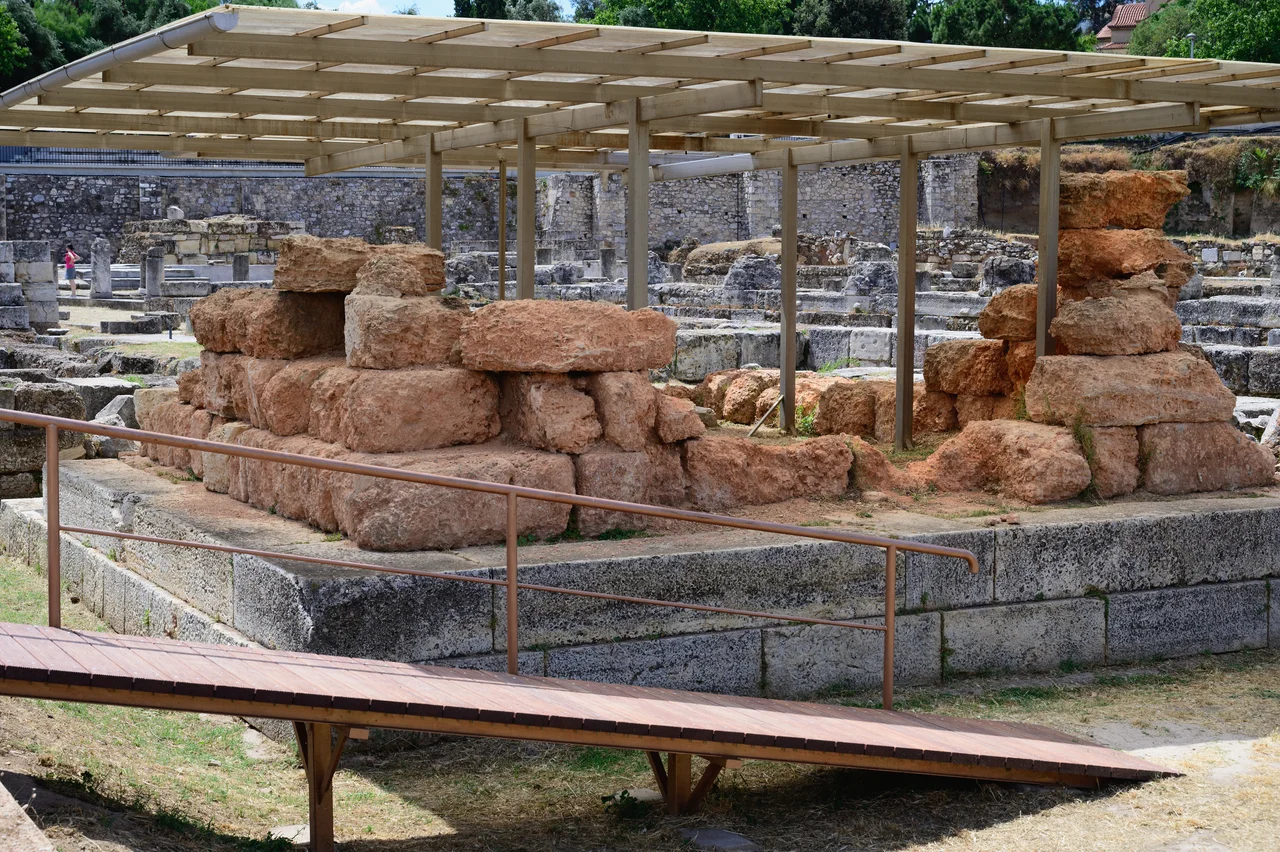
When Greek archaeologists returned to the Kerameikos in 1870, up to eight meters of earth lay over everything, the whole monument simply buried and forgotten. Since 1913 the German Archaeological Institute has worked the site, and what they uncovered still reads as a fortress: the cores of the towers standing to some height, a curtain wall once nine meters tall and four meters thick, a surviving staircase, the marble floor of a small well house fed by underground aqueducts. Beyond the wall, traces of the proteichisma survive, even the 4th-century BC pitfall traps, great storage jars sunk into the ground to swallow enemy siege engines. Walk the ruins now and the courtyard is open to the sky, the towers reduced to their footings, but the scale still tells you what kind of city once marched out through here.
From the Air
Located at 37.98°N, 23.72°E in the Kerameikos district, just northwest of central Athens and the Acropolis. The archaeological site sits in an open green clearing amid dense urban fabric, with the Acropolis hill rising a short distance to the southeast as the dominant visual landmark. Nearest major airport is Athens International (LGAV), about 30 km to the east. Best viewed in clear daylight; the Attic basin can hold summer haze.
Nearby Stories
- Great Sand Beach 5 km away
- Battle of Delium 7.7 km away
- Tower of Aliartos 9 km away
- HMHS Britannic 10 km away
- Saronic Gulf 15 km away
- Sousaki Volcano 17 km away
- Sanctuary of Apollo Maleatas 24 km away
- Skyros 66 km away