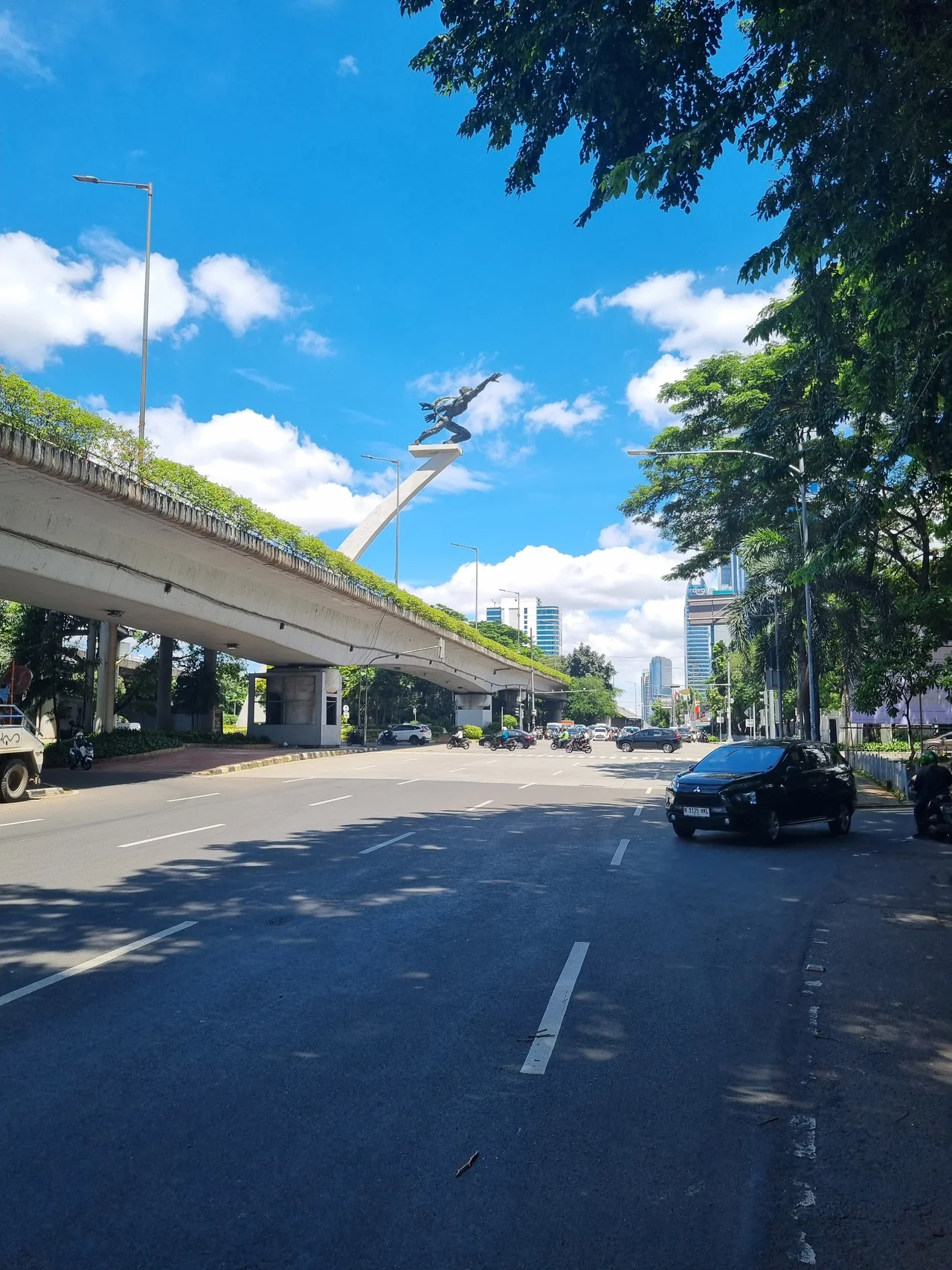

Dirgantara Monument
Jakartans call it the Truper, a mangled version of "trooper." The Dutch who once lived in the city called it "Ard Schenk," because the outstretched arms reminded them of a Dutch speed skater. Officially, it is the Dirgantara Monument -- also known as Tugu Pancoran, after the South Jakarta subdistrict where it stands at one of the city's busiest junctions. But the nickname that captures it best may be the "Seven-up Man," a reference to the arch-shaped plinth that, from certain angles, looks like the number seven. Eleven tons of bronze, balanced on a 27-meter pedestal, arms flung wide as if leaping into flight. President Sukarno commissioned it in 1964 as a tribute to the Indonesian Air Force and the aviators who flew against the Dutch during the independence struggle. What he got was a monument that nearly became a casualty of the very political violence that defines modern Indonesian history.
Sukarno's Space Man
The monument depicts a manusia angkasa -- a "space man" -- symbolizing Indonesia's ambition to conquer the sky and beyond. Sukarno chose the site carefully: the junction of Jalan Gatot Subroto and Jalan M.T. Haryono sat directly in front of the Indonesian Air Force headquarters, which had been designed by the prominent architect Friedrich Silaban. The location also served as the gateway to Jakarta for anyone arriving from Halim Perdanakusuma Airport, then the city's primary air terminal. Every visitor from abroad would pass the monument on their way into the capital. The sculptor was Edhi Sunarso, one of Indonesia's most accomplished monumental artists, who worked alongside the Arca family of Yogyakarta to design the figure between 1964 and 1965. The casting was carried out by the Decorative Bronze Art Bronze Sculpture workshop in Yogyakarta, led by I Gardono. Sukarno's commitment to the project was personal enough that he partly funded the construction from the sale of his own private car.
A Monument Interrupted
Construction of the arch and pedestal proceeded through 1965, overseen by PN Hutama Karya with architect Ir. Sutami. Then, on 30 September 1965, a group of military officers attempted a coup. The 30 September Movement and the political bloodshed that followed plunged Indonesia into chaos, toppled Sukarno's hold on power, and left the Dirgantara Monument stranded -- an empty pedestal with no statue on top. For more than a year, the arch stood bare against the Jakarta sky. Rumors, dark and politically charged, filled the void. Some claimed the monument depicted a device used to extract the eyes of the generals murdered during the coup attempt, an allegation tied to lurid anti-communist propaganda of the era. Sukarno repeatedly denied these claims, but the damage to public perception was done. The bronze figure was eventually assembled in sections, each weighing roughly one ton, hoisted piece by piece until the 11-meter sculpture was finally completed at the end of 1966.
Hemmed In by Progress
The monument was designed to dominate its intersection, and for three decades it did. Approaching from any direction, drivers would see the bronze figure soaring above the traffic, arms extended in a gesture that reads equally as flight, triumph, or benediction. Then, in the late 1990s, Jakarta's relentless growth caught up with it. Two elevated toll roads were constructed as part of the Jakarta Inner Ring Road project, flanking the monument on both sides. The Dirgantara figure, once the commanding centerpiece of a grand junction, found itself boxed in by concrete flyovers, visible now mostly in fragments through gaps between lanes of overhead traffic. The experience of encountering it shifted from dramatic arrival to accidental glimpse -- a flash of bronze between highway pillars. It is a fate shared by many of Jakarta's monuments from the Sukarno era, works of public art designed for a city that no longer exists, swallowed by the infrastructure of the city that replaced it.
The Sculptor's Other Giants
Edhi Sunarso left his mark across Jakarta in the 1960s. The Selamat Datang Monument in the Bundaran Hotel Indonesia roundabout -- two figures waving in welcome -- is his work, as is the West Irian Liberation Monument near Lapangan Banteng, commemorating Indonesia's campaign to incorporate western New Guinea. Together with the Dirgantara Monument, these sculptures form a scattered trilogy of Sukarno-era ambition cast in bronze, each one a statement about what the young republic wanted to become. Sunarso's style favored heroic scale and kinetic poses: figures in motion, reaching upward, gesturing outward. The Dirgantara figure, at 11 meters and 11 tons, remains among the largest bronze sculptures in Southeast Asia. It gazes southeast along Jalan Dr. Supomo toward Tebet, a suburb developed in the early 1960s to rehouse families displaced by the construction of the Gelora Bung Karno sports complex. The space man looks over a neighborhood that exists because another of Sukarno's grand projects needed room.
From the Air
The Dirgantara Monument stands at the junction of Jalan Gatot Subroto and Jalan M.T. Haryono in the Pancoran subdistrict of South Jakarta, at approximately 6.243S, 106.844E. The 27-meter arch topped by the 11-meter bronze figure is visible from lower altitudes, though the surrounding elevated toll roads partially obscure it from certain angles. Halim Perdanakusuma Airport (WIIH) is approximately 8 km to the east. Soekarno-Hatta International (WIII) is roughly 30 km northwest. The monument sits at a major traffic interchange that is identifiable from the air by the distinctive Y-shaped convergence of elevated highways.
Nearby Stories
- The King's Footprints in the River 2.8 km away
- Rawagede Massacre 6.4 km away
- The Cruiser That Wouldn't Stop Fighting 14 km away
- Four Minutes Over the Java Sea 14 km away
- The Scholar's Mosque 21 km away
- Through the Cidepong Hills 37 km away
- Ujung Kulon National Park 97 km away
- The Islands That Vanished from Sight 352 km away