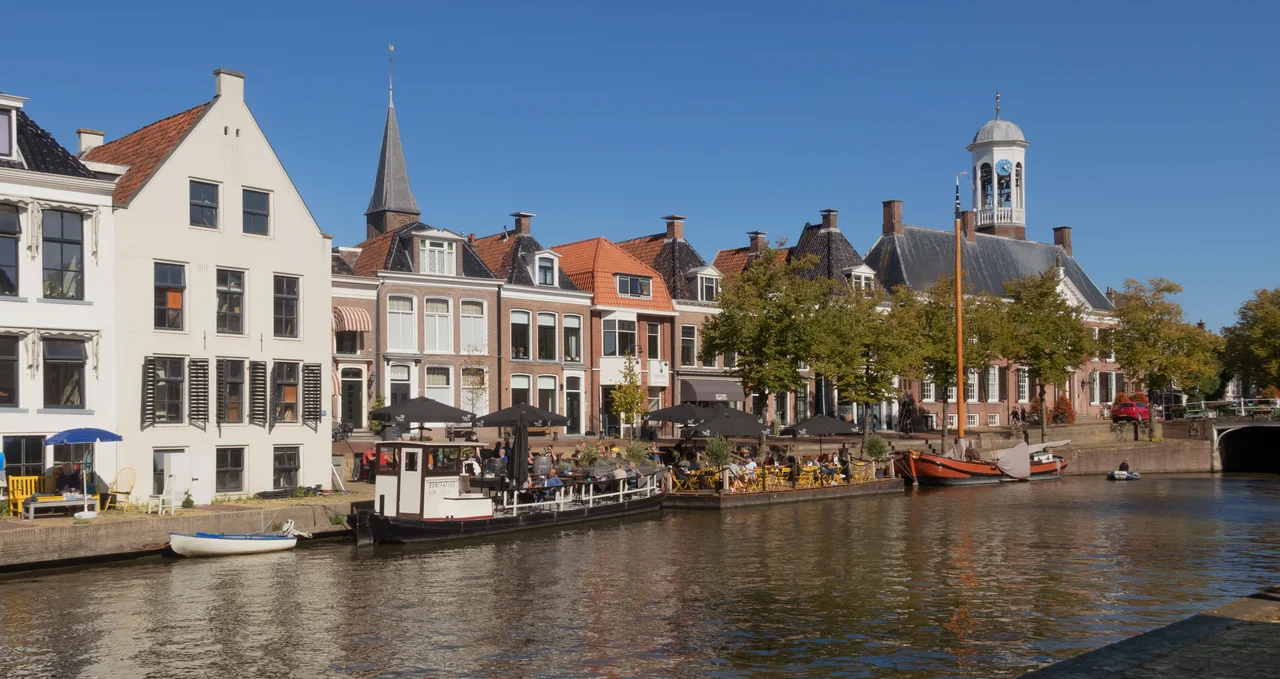

Dokkum
In June 754, an elderly Anglo-Saxon missionary named Boniface was waiting at Dokkum with a group of converts who had come to be confirmed. He had carried Christianity through Hesse and Thuringia for forty years, founded monasteries, crowned a king. He was somewhere in his late seventies, and he had come back to Frisia - the place where his missionary career began - to finish what he had started there. Instead, an armed band attacked his camp at dawn. Boniface, the story goes, raised a book to shield his head. The blade went through both. Twelve centuries later the well where his body was said to have rested is still pointed out to visitors, the chapel built to him still stands, and a crescent on the city's coat of arms still recalls a crusade preached here in 1214.
Bulwarks and Admirals
Dokkum has been a fortified place for a long time, and unusually for the Netherlands its star-shaped earthen bulwarks - the bolwerken - survive almost intact. The city acquired formal rights in 1298. In 1572 it threw in with the Dutch Revolt and was promptly sacked by Spanish troops; in 1597 it was rewarded with the seat of the new Admiralty of Friesland, a small Frisian navy run from a small Frisian port. The admiralty moved to Harlingen in 1645, the bulwarks stayed, and the wharf of the former Frisian Admiralty is still there at the Zuiderbolwerk, recognizably maritime even though the saltwater is long gone. In 1971 the city was placed on the Dutch national list of protected urban conservation areas, which is the formal way of saying that what you see here is roughly what was here three centuries ago.
A Priest Murdered in Dachau
The Boniface story did not stay in the eighth century. In 1923, when Dutch Catholics were forbidden from public expressions of faith such as processions, a processional park was laid out southeast of the city center. At its heart is the Brouwersbron - the brewers' well - which the Carmelite priest Titus Brandsma and others identified as the spring that supposedly rose where Boniface died. The identification was almost certainly wrong, but the park was real. A chapel went up in 1934. Brandsma also designed the park's Stations of the Cross, which were completed in 1949 - seven years after he himself was murdered by the Nazis in Dachau for refusing to stop publishing what the occupation called subversion. The park is now a layered memorial: an eighth-century saint, a twentieth-century martyr, and a community that survived to build for both.
The Turning Point
Once or twice in a generation, when the canals of Friesland freeze hard enough to bear weight, Dutch skaters attempt the Elfstedentocht - a brutal 200-kilometer race along eleven Frisian cities. Dokkum is the keerpunt, the turning point. It is the northernmost city on the route, the place where exhausted skaters reach the end of the outward leg, stamp their cards, and turn back toward Leeuwarden. The last race was held in 1997. Many winters since have come close. None has produced ice thick enough. The keerpunt waits anyway. So do the city's two surviving windmills, the cap mills Zeldenrust - 'seldom rest' - and De Hoop, 'the hope.' A third, De Mearmin, was dismantled in 2014 to be restored and rebuilt at the open-air museum in nearby Damwâld.
From the Air
Located at 53.325°N, 5.999°E in Noardeast-Fryslân, northern Friesland. From altitude the star-shaped bolwerken are unmistakable - a distinct geometric outline in green earthworks around a compact historic core, with the Dokkumer Grootdiep canal threading through the center. Nearest airports: Leeuwarden Air Base (EHLW) about 23 km southwest, Groningen Airport Eelde (EHGG) about 35 km southeast. Coastal weather typical: morning fog, afternoon clearing, occasional strong winds off the Wadden Sea.
Nearby Stories
- Eems Canal 9.6 km away
- Gorredijk 11 km away
- Súdwest-Fryslân 11 km away
- Liauckamastate 17 km away
- Veenkoloniën 18 km away
- Schule am Meer 20 km away
- HVDC DolWin1 46 km away
- West Sole Gas Field 295 km away