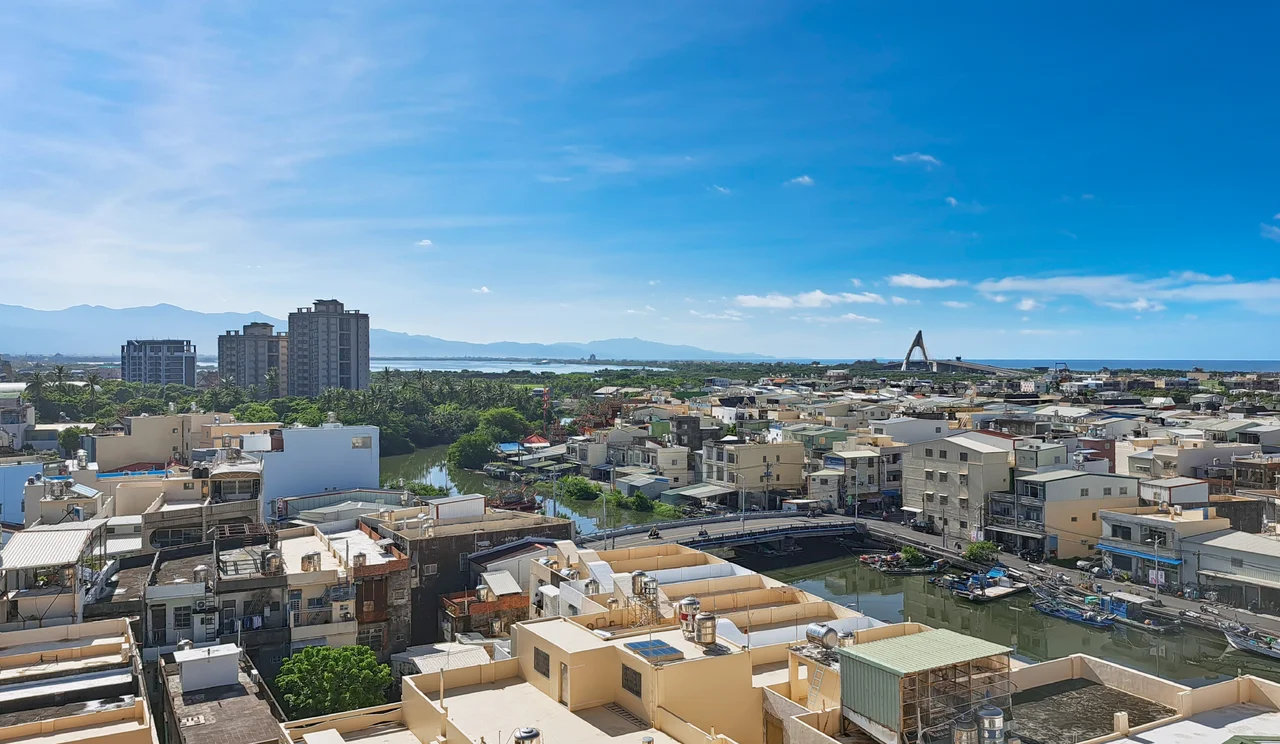

Donggang, Pingtung
Every April, something remarkable happens to the price of bluefin tuna in Donggang. Fishing boats return heavy with southern bluefin — one of the most coveted fish in the world — and the restaurants lining the harbor fill with people who have driven from Taipei, Taichung, and Kaohsiung specifically to eat it here. For a few weeks, this unassuming port town at the southern tip of Taiwan becomes a culinary destination that rivals anywhere on the island. The rest of the year, Donggang simply gets on with being what it has always been: a fishing town that has fed Taiwan for more than three centuries.
Koxinga's Port
Donggang's origins trace to the 17th century, when the Chinese admiral Koxinga — who had just driven the Dutch from Taiwan — opened it as a commercial harbor. For the next two hundred years, it served as one of Taiwan's most important western ports, funneling goods between the island and the mainland across the Taiwan Strait. The strait spans more than two hundred miles here as it opens southward toward the South China Sea, and on clear days the horizon shimmers with the possibility of what lies beyond it. When Japanese colonial administrators took over in 1895, they renamed the town Tōkō and turned Dapeng Bay, just to the south, into a naval facility. The bay's protected waters made it ideal for the purpose. Today Dapeng Bay is a national scenic area, its calm lagoon a striking contrast to the busy working harbor that Donggang's fishermen still use.
Three Treasures of the South
Ask any food writer in Taiwan what defines Donggang's kitchen and you will hear the same three words: bluefin tuna, karasumi, and sakura shrimp. Southern bluefin tuna season runs from April through June, when boats working the deep waters off the southern tip of Taiwan bring in fish that can weigh hundreds of kilograms. Local restaurants serve it as sashimi — thick, deep-red slices that taste nothing like the pale pink tuna found in supermarkets. Karasumi is salted and dried mullet roe, amber-colored and intensely savory, eaten in thin slices with a sliver of white radish. Sakura shrimp — tiny translucent crustaceans named for the cherry blossoms they resemble — are harvested from the strait and dried into fragile pink clouds. Together these three ingredients represent a culinary tradition tied directly to the specific waters around Donggang, a taste of place that cannot be replicated elsewhere.
When the Plague Boat Burns
Every three years, Donggang stages one of Taiwan's most dramatic religious events. The King Boat Ceremony, organized by the Donglong Temple, lasts for eight days and concludes with the burning of a large wooden boat on the beach. The ceremony is dedicated to Lord Wen — whose name in Hokkien and Mandarin sounds identical to the word for plague — and its purpose is to drive evil spirits and disease from the community by loading them onto the boat and sending them away in flames. The vessel itself is a genuine work of craftsmanship: a wooden ship several meters long, built by skilled artisans in the months before the ceremony. Thousands of spectators gather on the beach to watch it burn, the fire visible from across the harbor. The ceremony takes place on the 2nd, 5th, 8th, and 11th year of the Chinese calendar cycle, a rhythm that has structured local life for generations.
Between Sea and Lagoon
Donggang sits in a narrow zone between two bodies of water. To the west, the Taiwan Strait stretches toward mainland China. To the south, Dapeng Bay's enclosed lagoon offers calmer water and a different kind of life — windsurfing, cycling along the bay's perimeter road, looking for waterbirds in the mangroves. The Jinde Bridge, one of the landmark structures in the area, connects the township to Xiaoliuqiu, a small coral island accessible by ferry from Donggang's harbor. The island is known for its sea turtles and snorkeling. Closer to town, an unusual presence: the Tongkang Mosque, one of the few mosques in rural southern Taiwan, serving the community of Muslim migrant fishermen who have settled here over the decades. Donggang's 23 villages each have their own texture, but the harbor pulls everything together — the smell of fish in the early morning, the growl of engines, the practical beauty of a town that has always known exactly what it is.
From the Air
Donggang sits at approximately 22.47°N, 120.45°E on Taiwan's southwestern coast, where the flat coastal plain meets the Taiwan Strait. Flying south from Kaohsiung at 2,000 feet, the harbor is clearly visible — a working port with fishing boats rafted side by side, the enclosed waters of Dapeng Bay shimmering to the south. Lamay Island (Xiaoliuqiu) is visible offshore, a low green shape about 14 kilometers southwest. The nearest major airport is RCKH (Kaohsiung International), approximately 25 kilometers to the north. Low-level coastal flying offers excellent visibility of the harbor, the bay, and the patchwork of fish farms and fields that characterize this part of Pingtung County.
Nearby Stories
- Zhiben Hot Spring 8.7 km away
- Fo Guang Shan 8.8 km away
- Duoliang Station 11 km away
- Checheng Fu'an Temple 32 km away
- Orchid Island 62 km away
- Dongji Island 68 km away
- South Penghu Marine National Park 96 km away
- Hong Kong 12 548 km away