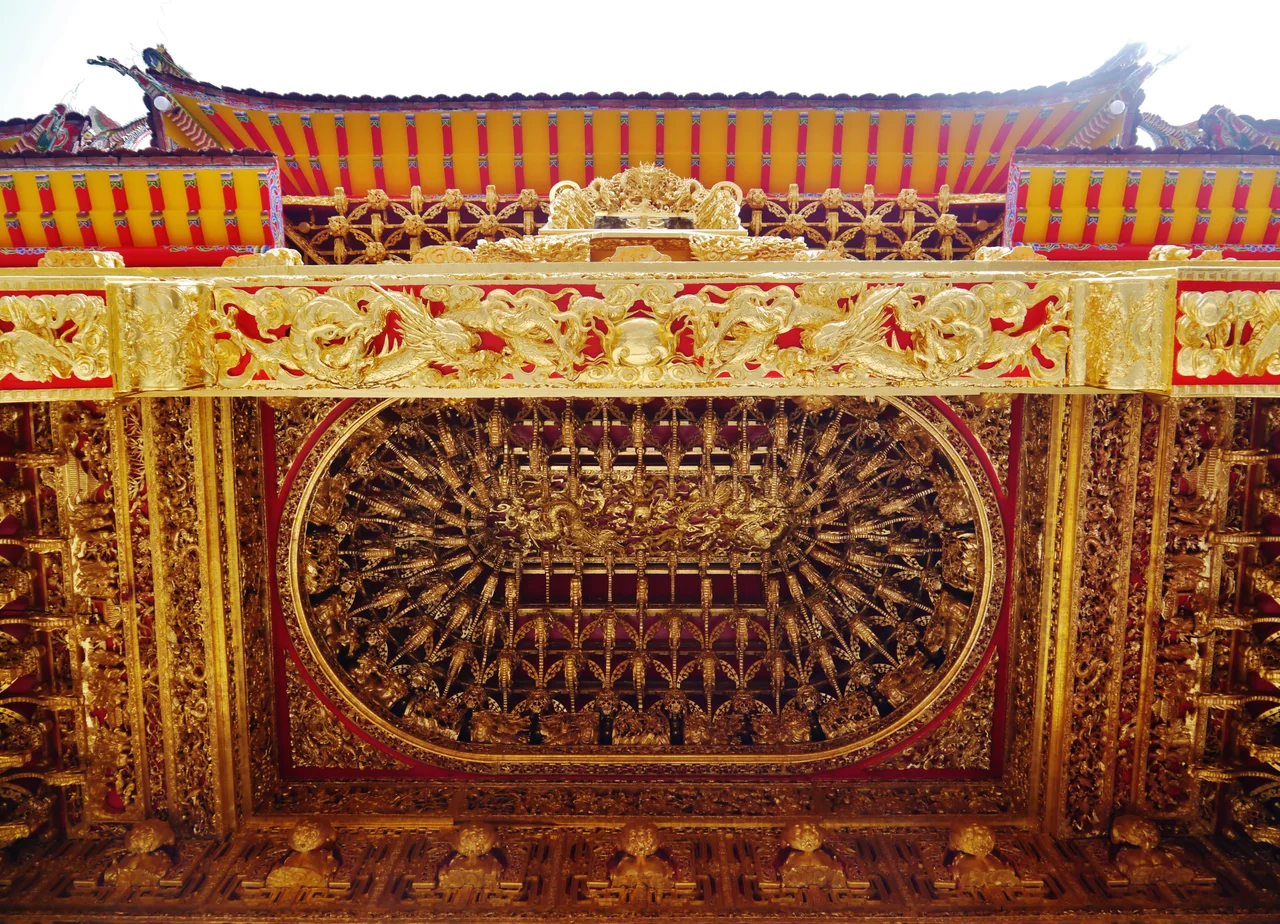

Donglong Temple
The deity worshipped at Donglong Temple carries a name that makes a linguistic joke of danger. In Hokkien and Mandarin, Wen — Lord Wen, the temple's presiding spirit — sounds identical to the word for plague. Whether the founders intended the irony or simply inherited it from the folk religion traditions they brought from Fujian, the result is a temple whose entire ritual life revolves around turning disease and evil away from the community. Every three years, that intention becomes a bonfire.
Three Centuries of Flood and Faith
The temple's history is inseparable from the geography of its surroundings. Donglong Temple was originally built in 1706 in Yanpu, a fishing village across the river from Donggang — a location that made it vulnerable to the flooding that plagued the low-lying coastal plain. In 1790, a major flood damaged the structure badly enough that the congregation relocated the temple to Donggang. It was not the last time water would challenge the community's devotion. Another flood struck in 1877, again damaging the temple. Reconstruction at the current site began in 1884 and was completed in 1887. Three locations, two floods, nearly two centuries — the fact that the institution survived all of it says something about how central it was to the life of the people who kept rebuilding it. The current structure reflects the accumulated labor and investment of that long persistence.
Lord Wen and the Wang Ye Tradition
Lord Wen is one of the Wang Ye — a class of deified figures in Taiwanese folk religion who serve as divine magistrates, protecting communities from plague, misfortune, and malevolent spirits. The Wang Ye tradition arrived in Taiwan with Fujian immigrants during the 17th and 18th centuries and took firm root in the fishing communities along the western coast, where disease and the dangers of the sea made divine protection feel urgently necessary. Donglong Temple became one of the most prominent Wang Ye temples on the island. The deity's connection to plague is not merely nominal: the ritual logic of the King Boat Ceremony depends on it. The boat is a vessel for carrying evil away, and Lord Wen is the authority whose power makes that transfer possible. Worshippers come to the temple not just to pray but to participate in a cosmology where the boundary between the human world and the spirit world is actively managed.
Eight Days, One Fire
The Donggang King Boat Ceremony unfolds over eight days, organized by the temple on the 2nd, 5th, 8th, and 11th year of the Chinese calendar — meaning the community marks time not just by the Western calendar but by a three-year liturgical rhythm unique to this place. The preparation alone is a feat: craftsmen spend months building the King Boat, a wooden vessel traditionally constructed according to specifications believed to be divinely revealed. During the ceremony days, the streets around the temple fill with processions, opera performances, and ritual activities. Then, on the final night, the boat is carried to the beach. Thousands gather. The structure that took months to build is set alight, and the flames carry the accumulated illness and misfortune of the community — symbolically loaded onto the vessel — away into the night sky. The spectacle is immense. The smoke rises over the harbor. What remains in the morning is ash, and the community begins another three-year cycle.
A Living Landmark
The temple today is active, colorful, and unmistakably the center of Donggang's communal identity. Its architecture follows the southern Taiwanese temple tradition: layered rooflines with upturned eaves, ceramic figures along the ridge tiles, the interior thick with incense smoke and the red of hanging lanterns. Outside of ceremony years, the temple draws steady visitors — pilgrims from across Taiwan who come to pay respects to Lord Wen, curious travelers who want to understand the Wang Ye tradition, and local residents who visit as a matter of ordinary life. The King Boat Cultural Museum nearby now provides context and history for those seeking to understand the ceremony's meaning before or after visiting the temple. Together, the temple and museum form the interpretive heart of a ritual tradition that has defined this harbor town for more than three hundred years.
From the Air
Donglong Temple sits at 22.463°N, 120.449°E in the center of Donggang Township, a short distance from the fishing harbor. From the air at 1,500 feet, the temple's ornate rooflines are visible among the lower buildings of the town — the layered, upturned eaves of Taiwanese temple architecture stand out clearly against the flat coastal landscape. The Taiwan Strait lies to the west; Dapeng Bay's lagoon glints to the south. The nearest major airport is RCKH (Kaohsiung International), approximately 25 kilometers north. In the ceremony years, the beach south of town may be visible as a gathering point after dark.
Nearby Stories
- Zhiben Hot Spring 8.7 km away
- Fo Guang Shan 8.8 km away
- Duoliang Station 11 km away
- Checheng Fu'an Temple 32 km away
- Orchid Island 62 km away
- Dongji Island 68 km away
- South Penghu Marine National Park 96 km away
- Hong Kong 12 548 km away