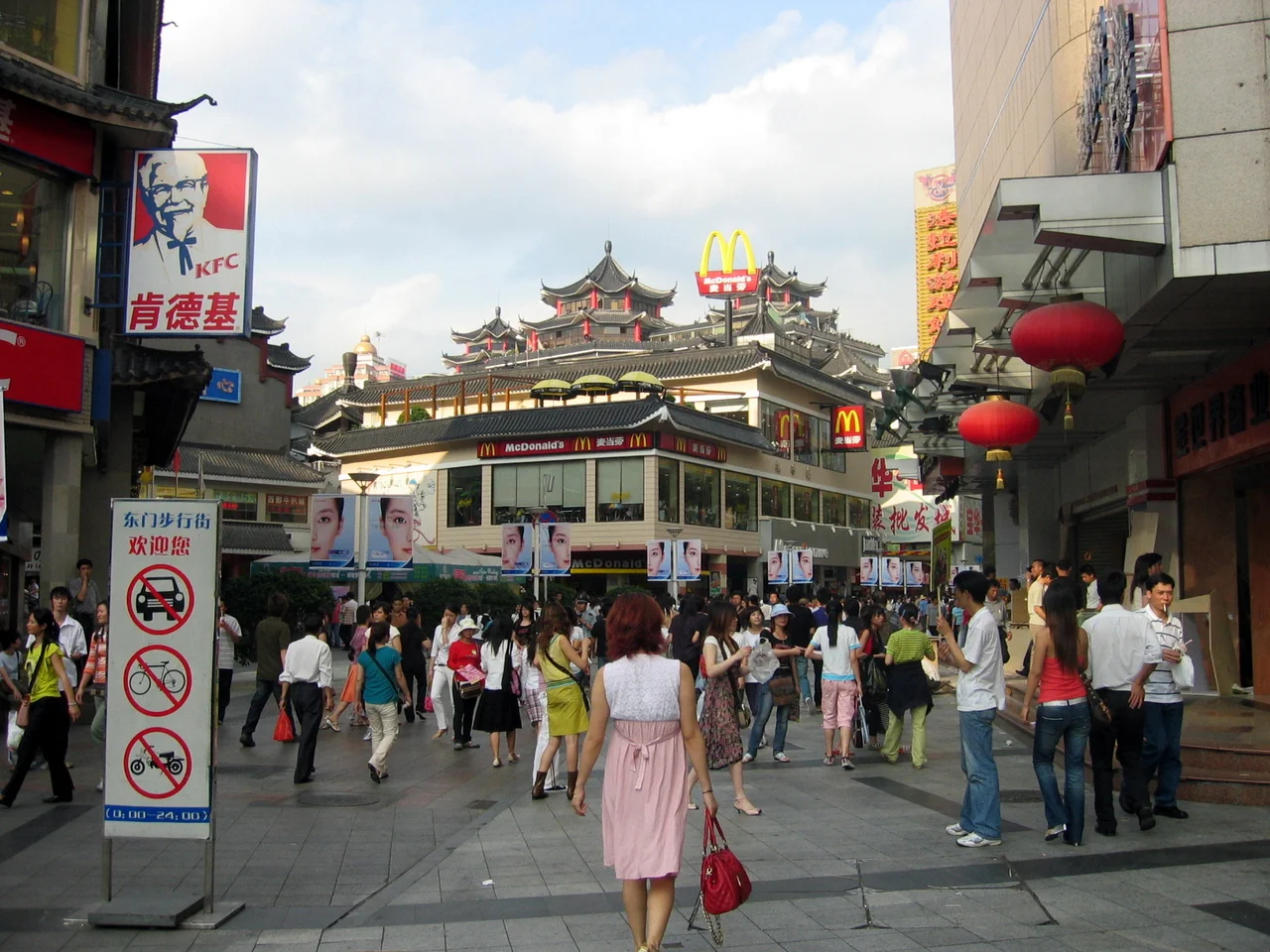

Dongmen, Shenzhen
Long before Shenzhen was a city, it was a market. The town that grew up around that market was called Shenzhen Xu — Shenzhen Market — and its commercial center was Dongmen, the East Gate. Three centuries later, the surrounding city has grown into one of the world's largest, but Dongmen is still there, still trading, still drawing crowds. It is the oldest part of a very young city, which makes it one of the stranger places in the Pearl River Delta.
Old Street in a New City
Dongmen takes its name from a directional designation — East Gate — that predates the Shenzhen Special Economic Zone by roughly 300 years. The area began as the commercial heart of Shenzhen Market, the Qing-era market town that gave the modern city its name. Locals still call it Laojie, which means simply Old Street. When Shenzhen was designated a Special Economic Zone in 1980 and began its transformation from fishing town to global manufacturing hub, Dongmen did not disappear. It adapted. The lanes and shophouses that had served local farmers became retail streets serving factory workers, migrants, and eventually the enormous population of a metropolis. The old street plan survived because commerce needed it to.
A Pedestrian District
In 1999, the connecting streets of the Dongmen area were pedestrianized, removing vehicle traffic and formalizing what the neighborhood had effectively been for decades: a place you walk through rather than drive. Dongmen Pedestrian Street became the main artery, but the district encompasses several connected commercial lanes that spread outward from it. The shops sell clothing, electronics, accessories, and food, with prices that tend to be lower than the newer malls elsewhere in Shenzhen. It draws shoppers who want variety without the premium of a branded retail environment. On weekends, the density of foot traffic makes the lanes feel like a compressed city unto themselves — noise, signage, and the smell of street food competing for attention at every turn.
The First McDonald's in Mainland China
In October 1990, the first McDonald's in mainland China opened in Dongmen. That fact has been commemorated in the restaurant with brass plaques that record this and other "firsts" — among them the first touch-screen ordering system to appear in a mainland Chinese McDonald's location. The plaques are an artifact of a particular historical moment: 1990 Shenzhen was a city in the early stages of its transformation, the Special Economic Zone still finding its shape, and the arrival of an American fast-food chain was a signal of the economic opening that was remaking the Pearl River Delta.
Getting There and What Remains
Dongmen is accessible from Exit A of Laojie Station on the Shenzhen Metro, which is itself named for the Old Street the district has been called for generations. The station name is both a practical address and a small act of preservation — a place named Old Street in a metro system that did not exist until 2004. The district sits just north of Shennan East Road, one of Shenzhen's main east-west arteries, and lies within Luohu District, Shenzhen's original border-adjacent commercial zone. Luohu borders Hong Kong directly to the south; the Lo Wu crossing is less than three kilometers away. Dongmen's combination of age, accessibility, and low prices keeps it busy in a city that has built dozens of newer, larger shopping destinations since 1990. Old Street endures.
From the Air
Dongmen sits at approximately 22.548°N, 114.116°E in Luohu District, Shenzhen, close to the Hong Kong border. From 2,500 feet, the dense commercial streetscape of Dongmen is visible as a concentrated block of signage and foot-traffic infrastructure just north of the broader Shennan East Road corridor. The Shenzhen River — which marks the Hong Kong–Shenzhen boundary — runs roughly 2 km to the south. Shenzhen Bao'an International Airport (ZGSZ) lies approximately 35 km to the northwest. Hong Kong International Airport (VHHH) is roughly 45 km to the southwest.
Nearby Stories
- Hong Kong Disneyland 4.1 km away
- Mount Guanyin (Dongguan) 7 km away
- 2024 Lixinsha Bridge Collapse 7.4 km away
- Portas do Cerco 12 km away
- Lotus Hill 15 km away
- Nanxiong Formation 78 km away
- Heyuan 130 km away
- Checheng Fu'an Temple 629 km away