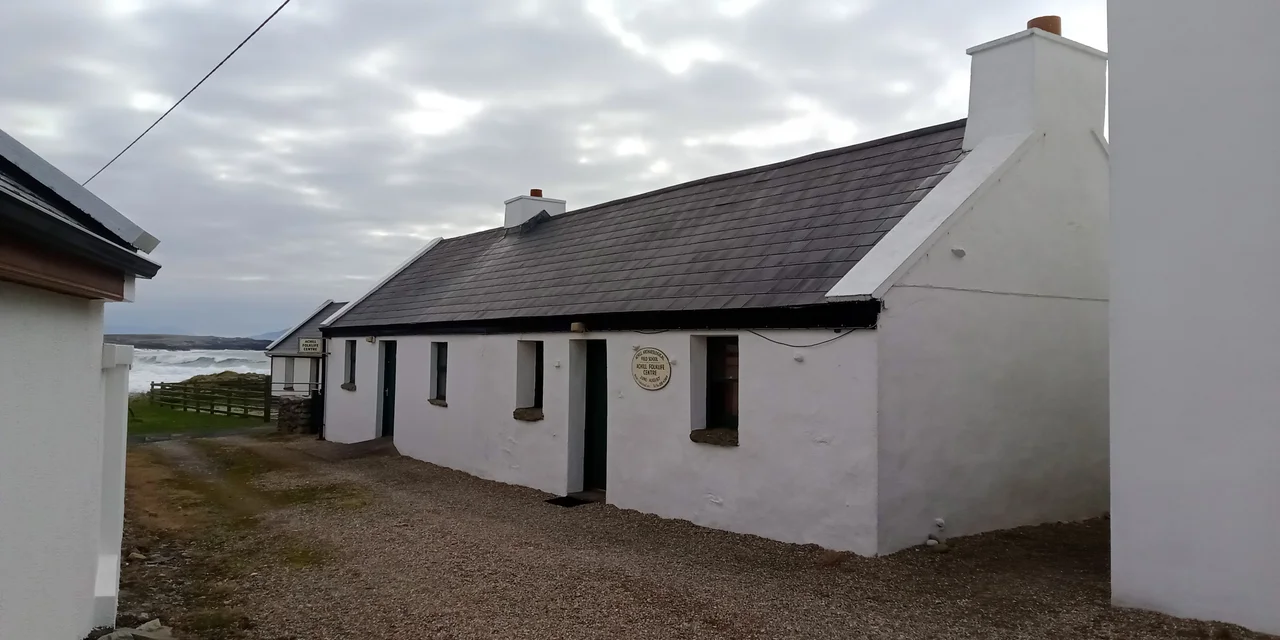

Dooagh
In April 2017, the residents of Dooagh woke up to discover something they had not seen since before many of them were born. Their beach had come back. For 33 years, since a vicious 1984 storm scoured the sand from the cove and left only a rocky foreshore, Dooagh had been a village with no beach to speak of. Then, over the course of a few days in April 2017, an unusually high spring tide deposited 300 metres of golden sand back onto the same patch of shoreline. Tourists arrived. National newspapers ran the story. The local pubs filled up. The beach lasted not quite two years. By early 2019, the sand had washed away again, and Dooagh was back to rock. The Atlantic gives, and the Atlantic takes, and on the western edge of Achill Island the only certainty is that the shoreline will keep changing.
The Beach That Came Back
What happened in 2017 was not magic - it was geomorphology. Beaches are reservoirs of sand that move constantly along the coast under the influence of waves, tides, and storms. A single severe storm can strip a beach in days, as happened in 1984. The right combination of unusually high tides and gentle weather can rebuild one almost as quickly, as happened in 2017. The story made global news partly because of the sheer visual drama - rocks one morning, golden sand the next - and partly because villagers who had grown up on the rocky foreshore suddenly had something to show their grandchildren. Tourism to Dooagh measurably increased that summer. Then early 2019 brought another storm, and the sand began to retreat again. Locals are now philosophical. The beach will return when it returns.
Don Allum's Atlantic
In the centre of Dooagh village stands a small monument to a man named Don Allum. In 1987, Allum rowed solo across the Atlantic Ocean from west to east - completing a feat he had first attempted decades earlier, when he and a companion rowed the western crossing in 1971. He landed his boat, the QE3, at Dooagh in September 1987, becoming the first person ever to row across the Atlantic in both directions. The achievement was extraordinary, the route was brutal, and the choice of Dooagh as his finishing point was partly a matter of where the wind and current carried him. The monument is modest. Most visitors walking past in summer with ice creams do not stop. But for anyone who has ever looked out at the Atlantic from the west of Achill and tried to imagine its scale, the thought of one man with two oars crossing it - twice - is enough to make you reconsider what a human being can endure.
Boycott's House on the Hill
On the road from Dooagh up toward Lough Acorrymore stands Corrymore House. In the 1880s it was the home of a man whose name has since entered the English language. Captain Charles Boycott was a land agent for absentee landlords in this part of Mayo, and in 1880 the local tenants - organised by the Irish Land League founded by Michael Davitt - refused to harvest his crops, refused to do business with him in shops, refused even to deliver his mail. The campaign of social ostracism worked. Boycott eventually fled Ireland in disgrace, and the word 'boycott' - the man's actual name - became a verb meaning exactly the tactic that had driven him out. Decades later, in 1924, the American painter Robert Henri bought the same house on the hill above Dooagh, having fallen in love with Achill on a series of summer visits during which he is said to have painted portraits of most of the children in the village.
Scoil Acla and the Music
Since 1910, the Irish traditional music summer school Scoil Acla has met every August in Dooagh. The painter Paul Henry - one of the most influential Irish artists of the early twentieth century, whose paintings of the Achill landscape helped fix the western seaboard in the national imagination - was an active member, and in 1912 he directed a production here of Casadh an t-Súgáin (The Twisting of the Rope), a play by Douglas Hyde, the Gaelic scholar who would later become Ireland's first president. The school went into decline mid-century but was revived in 1985 and has run continuously since. The Dooagh Pipe Band, founded in March 1947, is one of five pipe bands on Achill Island - a remarkable density for an island of fewer than 3,000 people. On any given summer evening, traditional music drifts out of Gielty's or Lourdie's pubs, and the village that lost its beach for 33 years carries on doing what it has always done.
From the Air
53.97N, 10.12W. Dooagh sits on the western half of Achill Island, recognizable from the air as a small village strung along the R319 between the slopes of Croaghaun Mountain to the west and Lough Acorrymore tucked in a hollow above. Keem Bay's bright sand crescent is visible 2 km to the west. Best viewed at 2,000-4,000 ft. Ireland West Airport Knock (EIKN) lies approximately 75 km east-southeast. The cliffs of Croaghaun on Achill's western edge are among the highest sea cliffs in Europe at 688m; the airspace can produce strong updrafts in southwesterly winds.
Nearby Stories
- Aughagower 3.4 km away
- Caher Island 8 km away
- Enaghbeg 10 km away
- Action of 7 May 1794 21 km away
- Lissadell House 59 km away
- RMS Carinthia (1925) 64 km away
- Glencolmcille 95 km away
- Inishtooskert 214 km away