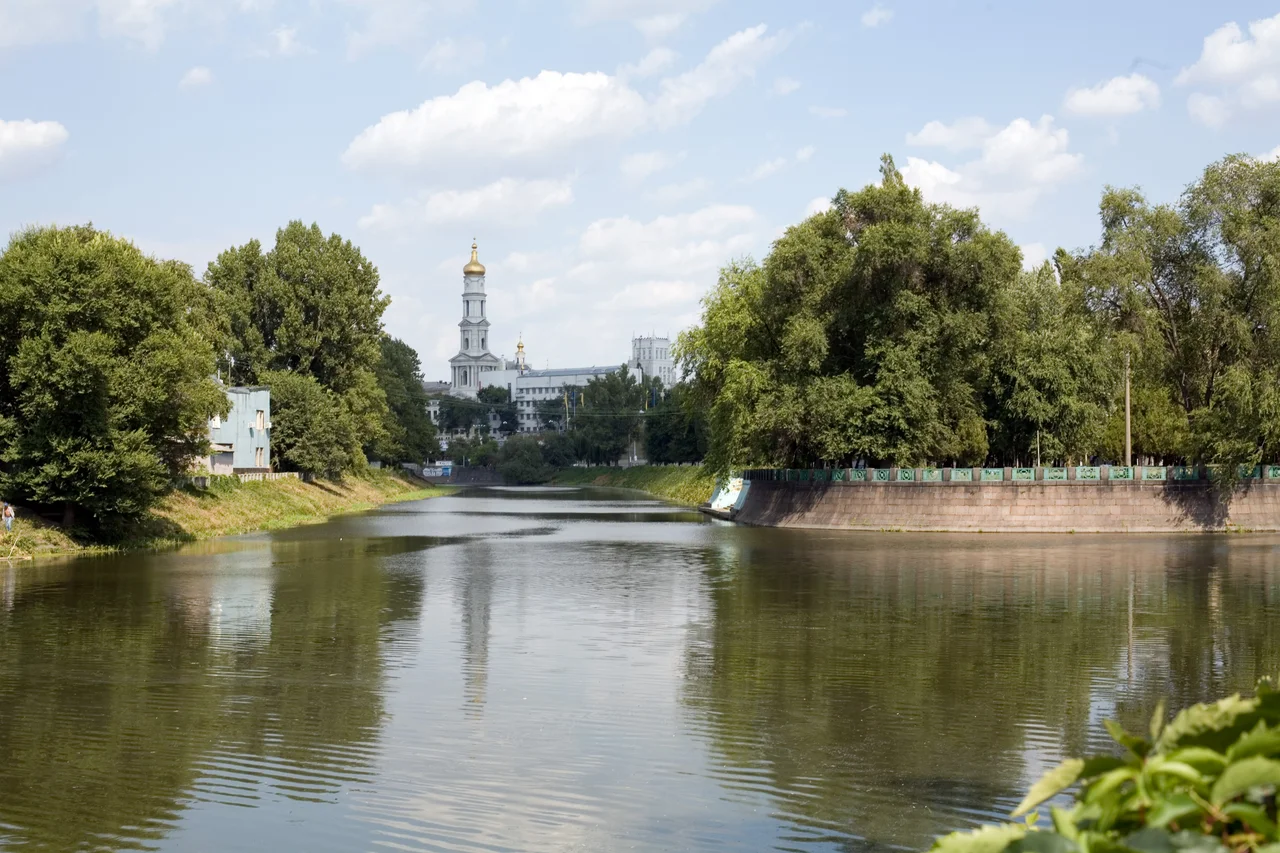

Dormition Cathedral, Kharkiv
For almost two hundred years, the tallest thing in Kharkiv was a prayer of thanks. The bell tower of the Dormition Cathedral, raised in the 1820s and 1830s to a height of ninety meters, was built to express the people's gratitude to Tsar Alexander I after Napoleon's defeat, and until the 21st century nothing in the city rose higher. The cathedral itself stands on University Hill above the bank of the Lopan River, dominating downtown Kharkiv from ground its congregation has occupied since the 1650s. It holds a curious distinction: it is said to be the only building in the city visited by nearly every Russian emperor, from Catherine the Great onward, a witness to three centuries of rulers passing through.
From Paper Icons to Stone
The cathedral's origins are humble and well documented. When the Kharkiv Fortress was rebuilt in 1656, land in the northern part of the district was set aside for a church, first recorded in a 1658 report a local official sent to Moscow about shipments of timber. That earliest church was austere, its walls hung only with paper icons, and it kept a cemetery whose human remains later researchers would uncover nearby. As the city grew, its people wanted something grander. Construction of a stone Assumption church began in 1685 and was finished by 1687, resembling a church in nearby Izium, likely raised by the same crew. Consecrated in 1688, it became one of the first stone buildings Kharkiv ever possessed, a permanent anchor in a young and rapidly expanding town.
Fire, and a Rococo Rebirth
On March 3, 1733, Kharkiv suffered the worst fire in its history. Flames consumed more than 300 households, every shop in the town, the St. Nicholas church, and nearly the Assumption church as well; only its walls survived, the roof, domes, and interiors gutted. It was restored within a year, but by 1770 dangerous cracks had appeared that could not be repaired, and in 1771 the cornerstone of a new cathedral was laid, its design inspired by St. Clement's Church in Moscow. Reconsecrated in 1780 in honor of the Dormition of the Mother of God, the finished cathedral captured a moment of changing taste: its facades were reserved and strict in the emerging classical style, yet inside it boasted a gilded icon screen carved from limewood to a lavish Rococo design attributed to the great Baroque architect Rastrelli.
A Century of Losses
The twentieth century was hard on the cathedral. In 1924 its record-setting bell tower was pressed into service as an antenna mount for the first Soviet radio station; the transmitting equipment, later moved inside, badly damaged the frescoes. The prized wooden altar was carried off to the Kharkiv Art Museum, where it burned during the Second World War. In 1930 the authorities closed the cathedral outright, destroyed all five of its domes, and stripped the bells from the tower, reducing the sacred building to a warehouse and then to city offices. A tornado struck the belfry in 1975. Only in the late 1970s was the cathedral restored, and not until 2006 was it returned to the church, which now shares the space with a philharmonic society whose organ, installed in 1986, fills the old walls with music.
A Refuge Struck
On March 2, 2022, during the invasion, a missile struck the cathedral, and it did so while civilians were sheltering inside from the bombardment of the city, seeking safety in the same walls their ancestors had built and rebuilt across three centuries. It was a bitter turn for a structure that had already outlasted the great fire, Soviet closure, world war, and a tornado. Yet endurance is the cathedral's oldest theme. From paper icons in a wooden shell to a ninety-meter tower that ruled the skyline, from imperial visits to Soviet warehouses to a place of desperate refuge, the Dormition Cathedral has been damaged and diminished many times, and each time it has remained, still standing on University Hill above the Lopan, still watching over the city below.
From the Air
The cathedral stands at roughly 49.99 degrees north, 36.23 degrees east, on University Hill above the Lopan River in central Kharkiv. From the air its tall Neoclassical bell tower and cluster of domes mark the historic downtown; the river and the surrounding old city aid orientation. The nearest major airport is Kharkiv (UKHH) to the south.
Nearby Stories
- Giant Ukrainian Radio Telescope 12 km away
- Hryhorii Skovoroda Literary Memorial Museum 18 km away
- Borki Train Disaster 20 km away
- Hetman National Nature Park 61 km away
- Central Black Earth Nature Reserve 81 km away
- Second Battle of Kharkov 88 km away
- Poltava Governorate Zemstvo Building 95 km away
- Grace Darling 538 km away