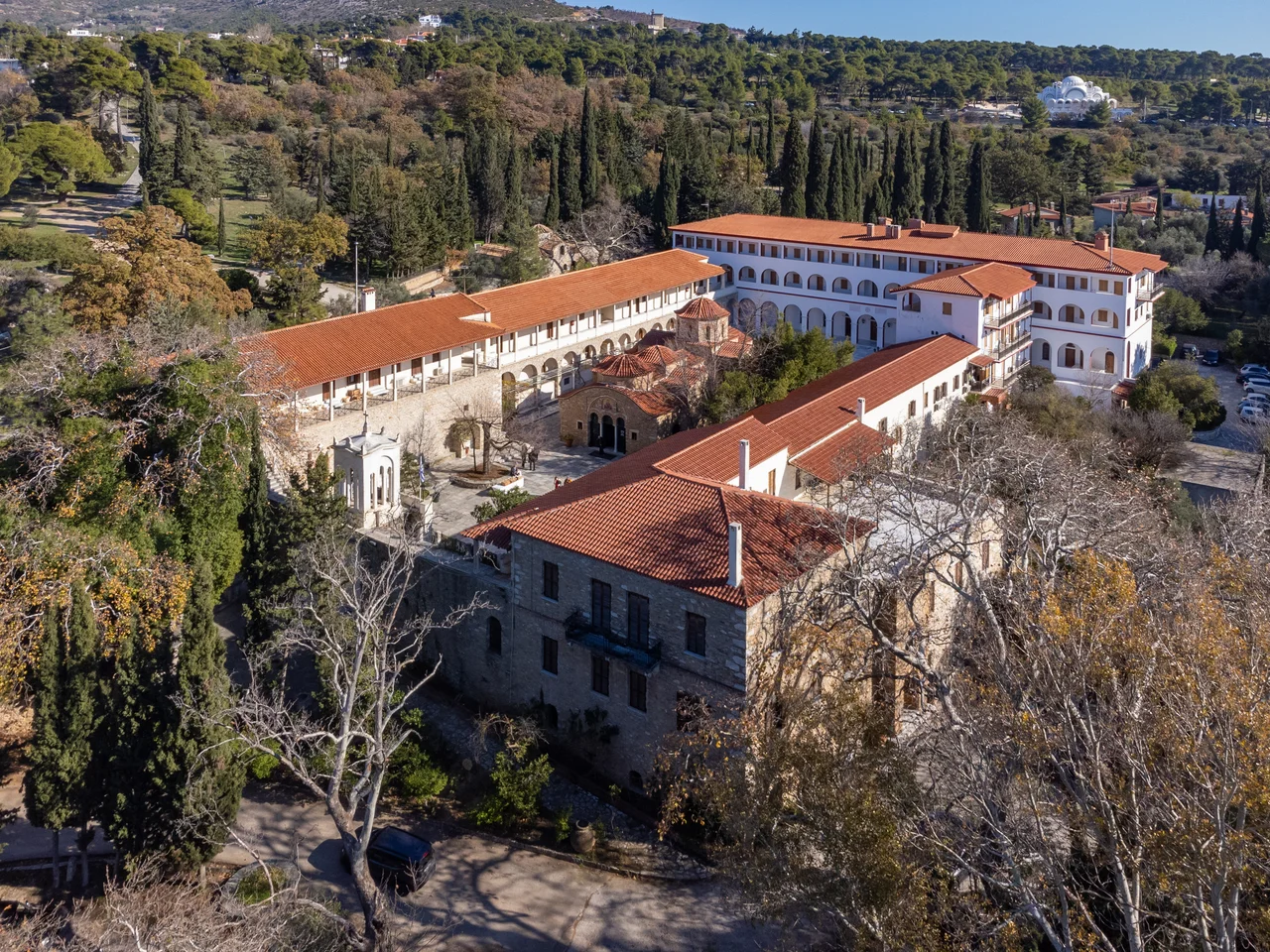

Dormition of the Theotokos Monastery, Penteli
From the outside it reads less like a place of prayer than a place to survive a siege. High blank walls, heavy timber doors, a compact silhouette built to keep the world out: the Penteli Monastery wears the appearance of a fortress because, for most of its history, looking like one was a matter of survival. It stands on the southern flank of Mount Penteli, about 430 meters up, where the forested slopes give way to a view across the Attic plain toward Athens and the distant glint of the sea.
A Foundation Under Empire
The monastery was founded in 1578, when Attica lay deep within the Ottoman Empire and Orthodox Christianity persisted under Muslim rule. Almost from the start it held stauropegic status, a significant distinction: rather than answering to a local bishop, it reported directly to the Ecumenical Patriarch of Constantinople, the spiritual head of the Orthodox world. That direct line to the Patriarchate gave a mountain monastery outside a provincial town an unexpected weight, tying this quiet corner of Attica to the great Christian center on the Bosphorus. Only in 1858, decades after Greece won its independence, did the monastery pass to the jurisdiction of the Archbishopric of Athens, where it remains today.
Land and Endurance
Through the Ottoman centuries the monastery was no mere refuge for contemplation; it was a landholder of real consequence. Its estates spread across Mount Penteli and reached into other regions of Attica, worked and managed by the community to sustain itself and its dependents. In an era when the Orthodox Church functioned as one of the few enduring Greek institutions under foreign rule, a wealthy, well-connected monastery served as something larger than itself, a keeper of faith, language, and continuity. The fortress walls protected not just monks at prayer but a small economy and a thread of identity that the surrounding empire could not easily sever.
Twice Ruined, Twice Raised
Endurance came at a price. The monastery was destroyed in the turmoil that followed the Venetian occupation of Athens in 1688 to 1690, when war swept across Attica and left religious houses in ruins. It rose again, only to be devastated a second time during the Greek War of Independence in the 1820s, the long and bloody struggle that finally tore Greece free of Ottoman rule. To stand here now is to stand on a building rebuilt from its own wreckage more than once. The main church, the Katholikon, survives in post-Byzantine style, and the complex grew to hold as many as 120 monks, a scale that speaks to how often this community insisted on beginning again.
A Living Community
This is not a museum frozen in the past, though it keeps both a museum and a library within its walls. It remains a working men's monastery. In 2010 it counted 58 monks, 17 of them living there permanently, their year shaped by the rhythm of the Orthodox calendar. The great days fall in mid-August: the 15th, the feast of the Dormition of the Theotokos, the falling-asleep of the Virgin Mary that gives the monastery its name, and the 16th, honoring the founder, Saint Timotheos. The Monday of the feast of the Holy Spirit marks another celebration. On these days the fortress doors open and pilgrims climb the mountain, and the building does again what it was built to do.
From the Air
Located at 38.05°N, 23.87°E on the southern slope of Mount Penteli, about 430 m above sea level and roughly 13 km northeast of central Athens. The walled compound sits amid pine forest on the mountainside, with the Attic basin and Athens spread out to the south. Nearest major airport is Athens International (LGAV), about 20 km to the southeast. Best viewed in clear daylight; the forested slopes are vulnerable to summer wildfire haze.
Nearby Stories
- Great Sand Beach 5 km away
- Battle of Delium 7.7 km away
- Tower of Aliartos 9 km away
- HMHS Britannic 10 km away
- Saronic Gulf 15 km away
- Sousaki Volcano 17 km away
- Sanctuary of Apollo Maleatas 24 km away
- Skyros 66 km away