
Double-headed eagles derby
Look at the two crests side by side and you might mistake one for the other. The same double-headed eagle, wings spread, two crowned heads facing opposite directions, the old emblem of the Byzantine Empire. AEK Athens flies it in black and yellow; PAOK in black and white. The colors differ, but the bird is the same, and so is the wound it commemorates. These two clubs were founded by the same people, refugees torn from the same lost city, and their rivalry is really a conversation between two halves of a scattered family.
A City Left Behind
The story begins not on a pitch but in catastrophe. After the Greco-Turkish War ended in 1922, the event Greeks still call the Asia Minor Catastrophe, more than a million Orthodox Christians were uprooted from Anatolia and Eastern Thrace in the population exchange between Greece and Turkey. Among them were the Greeks of Constantinople, heirs to the Byzantine capital their ancestors had held for a thousand years. They arrived in a homeland most had never seen, carrying little but their faith, their memory, and their grief. Some settled in Athens, some in Thessaloniki. In both cities they did what displaced communities so often do: they built clubs, and through them they tried to keep a vanished world alive.
Two Eagles, One Origin
AEK, the Athletic Union of Constantinople, took root in the Athens suburb of Nea Filadelfeia, a neighborhood named for the refugees' lost home. PAOK grew from the same Constantinopolitan stock transplanted to Thessaloniki. Both reached back past their loss to a prouder symbol, the double-headed eagle of Byzantium, the imperial bird that had flown over Constantinople when it was the center of the Christian world. Choosing it was an act of defiance and remembrance at once: we may have lost the city, the emblem said, but we have not lost who we are. Two clubs, hundreds of kilometers apart, settled on the same wings to carry the same heritage forward.
Brothers on the Pitch
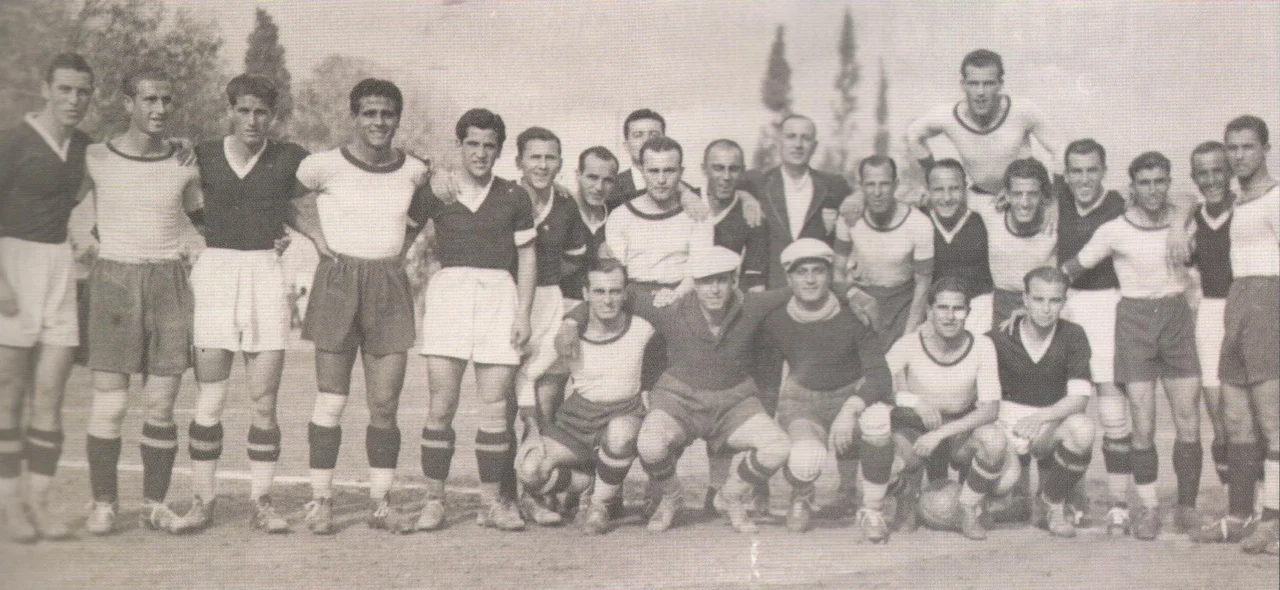
Because they shared a root, the two clubs long treated each other as kin. When they met in the 1939 Greek Cup final, players from both sides walked onto the field arm in arm, embracing before they competed. In 1959, PAOK invited AEK north to christen the new Toumba Stadium with a friendly. Twenty years on, AEK's president Loukas Barlos returned the gesture, bringing PAOK to Nea Filadelfeia for the testimonial of AEK's long-serving captain Mimis Papaioannou. For decades the rivalry was the warm kind, sharpened by the old contest between Athens and Thessaloniki but softened by blood memory; many supporters quietly held the other club as their second team.
A Family Tree of Transfers
The shared ancestry shows up in the rosters. Players have crossed between the two eagles since 1929, when Christoforos Pantermalis moved from PAOK to AEK, and the traffic never really stopped. Theodoros Zagorakis, who would captain Greece to its astonishing Euro 2004 triumph, wore both shirts across his career. Kostas Katsouranis, another of that golden generation, did too. Managers wandered just as freely: Dušan Bajević, Fernando Santos, Oleg Blokhin, and others all stood on both touchlines at different times. For two clubs cast as opponents, the overlap is striking, a reminder that the line between them was always more porous than the chants suggest.
When Warmth Turned Sharp
The first match dates to the 1930-31 Panhellenic Championship, played at the Leoforos Alexandras Stadium in Athens, and across the decades that followed the two sides built a long honors ledger, AEK with more high league finishes, PAOK ahead in cup meetings. But something shifted in the modern era. The 2017 Cup final and a bitterly contested league derby on 11 March 2018 hardened the mood, and the old fraternal rivalry took on a harsher edge. The eagles, it turns out, can still quarrel. Yet the deeper truth holds underneath the noise: AEK and PAOK remain two branches of a single uprooted tree, flying the same ancient bird in memory of the same city they can never go home to.
From the Air
Centered near 38.04°N, 23.74°E, with AEK's home ground in Nea Filadelfeia in the northern Athens suburbs and PAOK based at the Toumba Stadium in Thessaloniki, roughly 300 km to the north. For the Athens half, the dense northern suburbs of the Attic basin are the visual reference. Nearest major airport is Athens International (LGAV), about 25 km to the southeast; Thessaloniki Airport (LGTS) serves PAOK's city. Best viewed in clear daylight over the urban sprawl.
Nearby Stories
- Great Sand Beach 5 km away
- Battle of Delium 7.7 km away
- Tower of Aliartos 9 km away
- HMHS Britannic 10 km away
- Saronic Gulf 15 km away
- Sousaki Volcano 17 km away
- Sanctuary of Apollo Maleatas 24 km away
- Skyros 66 km away