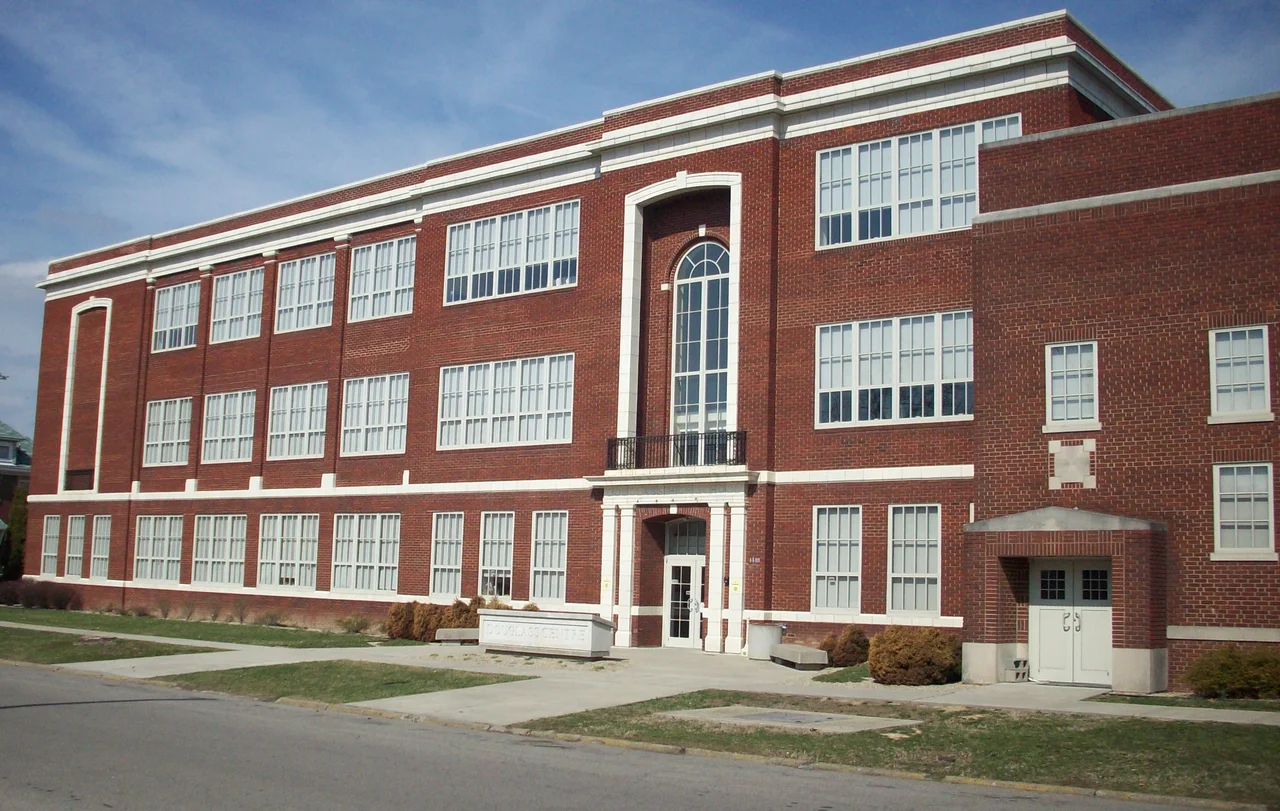

Douglass Junior and Senior High School
Carter G. Woodson graduated from the original Douglass High School in 1896, came back to serve as its principal, and went on to found Black History Month. Hal Greer attended the building that replaced Woodson's school, became the first African American athlete at Marshall University, and spent fifteen years as a star with the Philadelphia 76ers. Both men passed through the same Black educational institution in Huntington, West Virginia, separated by decades but linked by a shared experience: a school named for Frederick Douglass, built by African American teachers and community members under segregation, that produced graduates whose accomplishments outstripped what the larger society of their time was willing to acknowledge.
Two Buildings, One Mission
The first Douglass High School in Huntington was built in 1891, named for the abolitionist Frederick Douglass, and established to educate African American students in a segregated city in a segregated state. The 1924 building that replaced it - the one that survives today - was a three-story red-brick structure measuring 113 feet wide and 230 feet long, with terra cotta trim and a concrete foundation. It was substantial. African American communities across the South built such schools in this period as deliberate statements of seriousness, refusing to accept the second-class facilities that segregation tried to impose. Douglass Huntington made its statement in brick and terra cotta. The building still stands.
Carter G. Woodson
Carter Godwin Woodson (1875-1950) graduated from the original Douglass High School in 1896, became its principal, and went on to receive a doctorate in history from Harvard - only the second African American to do so. In 1915 he founded the Association for the Study of Negro Life and History, which still exists today as the Association for the Study of African American Life and History. In 1926 he established Negro History Week, deliberately placed in February to coincide with the birthdays of Frederick Douglass and Abraham Lincoln. That week eventually expanded into Black History Month, the formal observance recognized across the United States since 1976. Woodson is sometimes called the Father of Black History. His scholarship insisted that African American history was American history, written with the rigor of any other academic discipline. His career started at Douglass.
Hal Greer
Harold Everett Greer (1936-2018) attended the 1924 Douglass building and graduated in the 1950s. He went on to Marshall University, becoming the first African American athlete in the school's history. From there he was drafted by the Syracuse Nationals in 1958. When the franchise moved to Philadelphia in 1963 and became the 76ers, Greer moved with them. He played fifteen NBA seasons, made ten All-Star teams, won an NBA Championship in 1967, and was inducted into the Naismith Memorial Basketball Hall of Fame in 1982. His jersey number 15 hangs in the rafters at the 76ers' arena. In Huntington, the major thoroughfare Hal Greer Boulevard - the road that connects the city to Marshall University and to the interstate - is named for him. He was a hometown kid who became one of basketball's greats.
Ira De Augustine Reid
Among the faculty who taught at Douglass in its prime years was Ira De Augustine Reid (1901-1968), a prominent sociologist who would later lead the Atlanta University department after W. E. B. Du Bois. Reid was one of the foremost African American sociologists of the twentieth century, with major scholarly contributions to the study of African American migration, labor, and community life. His presence on the Douglass faculty is one indication of the caliber of teachers the school was able to attract during segregation - in part because the broader academic world offered limited opportunities to Black scholars, and Black schools like Douglass became gathering places for talent that would have been welcomed at any institution in a fairer system.
After 1961
Douglass closed as a school in 1961, when Cabell County's school system was desegregated and Black students were absorbed into formerly all-white schools. The building continued to be used for special education classes until 1981, then housed school district administrative offices. It is now a community center. Listed on the National Register of Historic Places in 1985, the building is acknowledged as the historic structure it is - an architectural and educational monument to a particular African American community in a particular American place. The school has been gone for over six decades, but its alumni list and the contributions those alumni made are why the building still matters.
From the Air
Located at 38.414 degrees north, 82.431 degrees west, in Huntington, West Virginia. Recommended viewing altitude 3,000 to 4,500 feet AGL for clear views of the school building and surrounding neighborhood. Nearest airport is Tri-State (KHTS), about 5 nautical miles east-northeast. The building sits in west Huntington, within the city's grid pattern, and is identifiable by its substantial three-story red-brick form.
Nearby Stories
- Battle of Scary Creek 6 km away
- Portsmouth 7.2 km away
- Fred M. Vinson Museum and Welcome Center 14 km away
- Staats Mill Covered Bridge 24 km away
- Lake Tight 25 km away
- Battle of Blair Mountain 32 km away
- Lower Shawneetown 35 km away
- The Kentucky Meat Shower: When Flesh Fell From a Clear Sky 68 km away