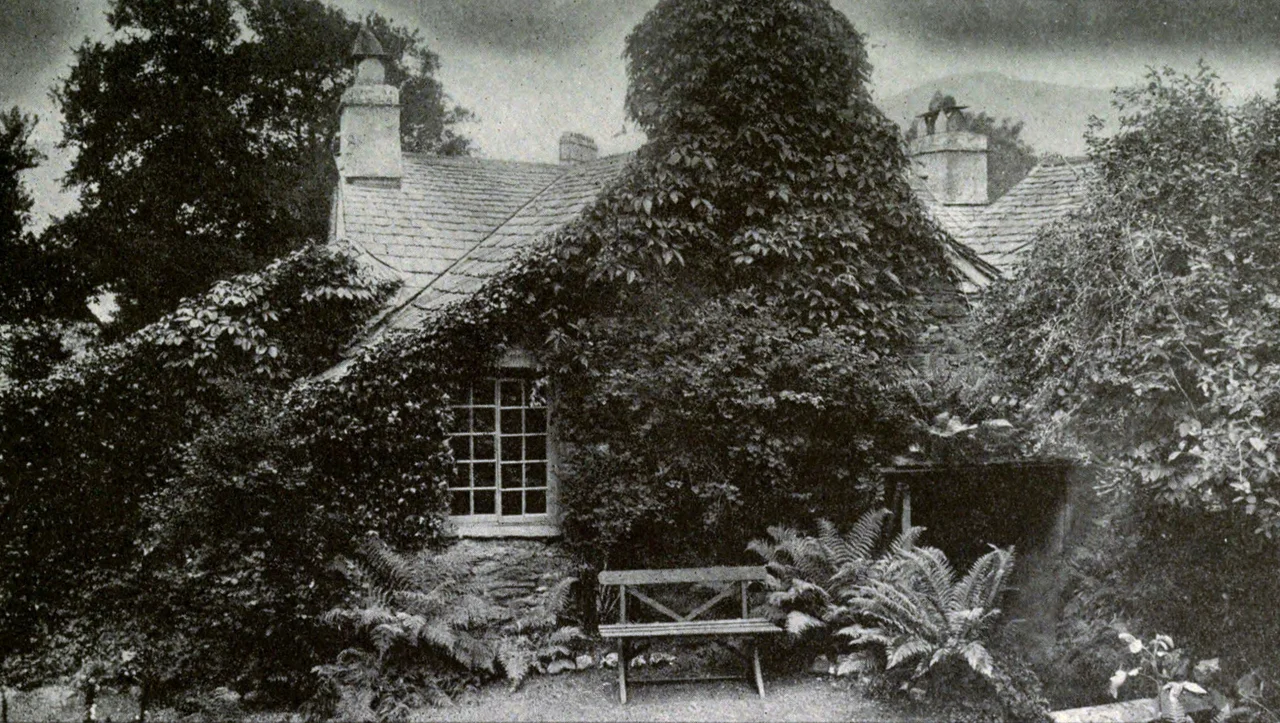

Dove Cottage
Before it became a museum, before it was world-famous, the house at the edge of Grasmere served beer. From 1617 to 1793, the building called itself the Dove and Olive, then later the Dove and Olive Branch - an inn for travellers walking the road between Ambleside and Keswick. It closed in 1793 and stood empty for six years. Then, on 20 December 1799, two siblings in their late twenties, William and Dorothy Wordsworth, paid John Benson of Grasmere five pounds a year and moved in. They would call the next eight and a half years their time of "plain living, but high thinking." By 1808, when they finally outgrew the rooms, William had written some of the most enduring lyrics in the English language inside them.
Plain Rooms, Slate Floors
The cottage is small and frankly low - four rooms downstairs, four upstairs, built of limewashed local stone with a slate roof. The ground-floor "houseplace" had been a drinking room when this was a pub. Its oak panels and slate floors had been chosen to take spilt ale. The Wordsworths used it as their kitchen-parlour. Dorothy's bedroom was the small room next to it. A separate kitchen and a tiny buttery completed the downstairs. Their neighbour Molly Fisher came in to wash and cook. There was no running water; the privy was outside in the garden. Upstairs, William used the room over the houseplace as a study, where he composed at a desk that looked out across meadows toward the lake. In 1800 the Wordsworths papered one small bedroom's walls with newspapers as an attempt at insulation. The garden mattered as much as the house. They called it their "little nook of mountain-ground" and let it grow deliberately wild.
Daffodils and a Journal
Dorothy kept what is now known as the Grasmere Journal during these years, recording the weather, the meals, the visitors, and what she saw on walks. On 15 April 1802, she described daffodils dancing along the shore of Ullswater. Two years later her brother turned that walk into "I Wandered Lonely as a Cloud." The Prelude, the Ode: Intimations of Immortality, Ode to Duty, and My Heart Leaps Up all came together here. So did a steady flow of friends. Samuel Taylor Coleridge moved his family to Keswick in 1800 and walked over to Grasmere often. Robert Southey lived at Greta Hall, and the three poets became known as the Lake Poets. Walter Scott and Humphry Davy came to visit. So did Charles and Mary Lamb. After the Wordsworths married into new families - William to Mary Hutchinson in 1802, her sister Sara joining the household - the cottage held five adults and, within four years, three children: John, Dora, and Thomas.
The Opium Eater Takes Over
Wordsworth left Dove Cottage in May 1808 for the larger Allan Bank in Grasmere, then the Old Rectory, and finally Rydal Mount in 1813. A long-time admirer and houseguest, Thomas De Quincey, moved into the cottage the following year and stayed until 1820. De Quincey would publish Confessions of an English Opium Eater in 1821, a memoir that described relaxing in this very house with a quart of laudanum at his elbow. He married a local farmer's daughter, raised a growing family, and upset the Wordsworths by altering the garden they had loved. Debts eventually drove him out for good in 1835. The cottage drifted through a succession of tenants. The name "Dove Cottage" first appears in the 1851 census, when a coal agent named Christopher Newby lived here with a wife and six children.
The Trust and the Pilgrims
In 1890, the Reverend Stopford Brooke founded the Wordsworth Trust and bought the cottage for £650, specifically to preserve it. It opened to the public in July 1891 as one of the earliest writer's home museums in England. The rooms remain almost untouched from Wordsworth's day. The garden has been restored to the wild state the Wordsworths preferred. About 70,000 visitors a year now walk through the door - a steady pilgrimage that links a Romantic-era poet's daily life to readers two centuries later. The adjacent Wordsworth Museum, opened in 1935 by Poet Laureate John Masefield, holds manuscripts, paintings, and the Trust's archive. The award-winning Jerwood Centre, opened in 2005 by Nobel Laureate Seamus Heaney, holds the collections in climate-controlled rooms next door. A reimagining of the site in 2020-2021 added a new café and outdoor spaces but left the cottage itself essentially as it was.
From the Air
Dove Cottage sits at the eastern edge of Grasmere village at 54.45 N, 3.02 W in the central Lake District. From altitude the village is identifiable by Grasmere lake immediately to its south-west and Rydal Water to its south-east, both small and clear. The A591 runs past the cottage. Helvellyn (950 m) rises north-east. The nearest sizeable airfield is Carlisle Lake District (EGNC), about 50 km north-north-east; Walney Island (EGNL) lies 35 km south-west. Recommended viewing altitude 2,500-4,000 ft AGL for the village and surrounding tarns. Lake District weather changes quickly; cloud often forms on Helvellyn and the adjacent fells.
Nearby Stories
- Morecambe Bay 4.1 km away
- Caldbeck 8 km away
- Pendragon Castle 8.1 km away
- Egremont Castle 8.5 km away
- Upper Teesdale 13 km away
- Solway Firth 13 km away
- Malham Cove 21 km away
- Santon Railway Station 70 km away