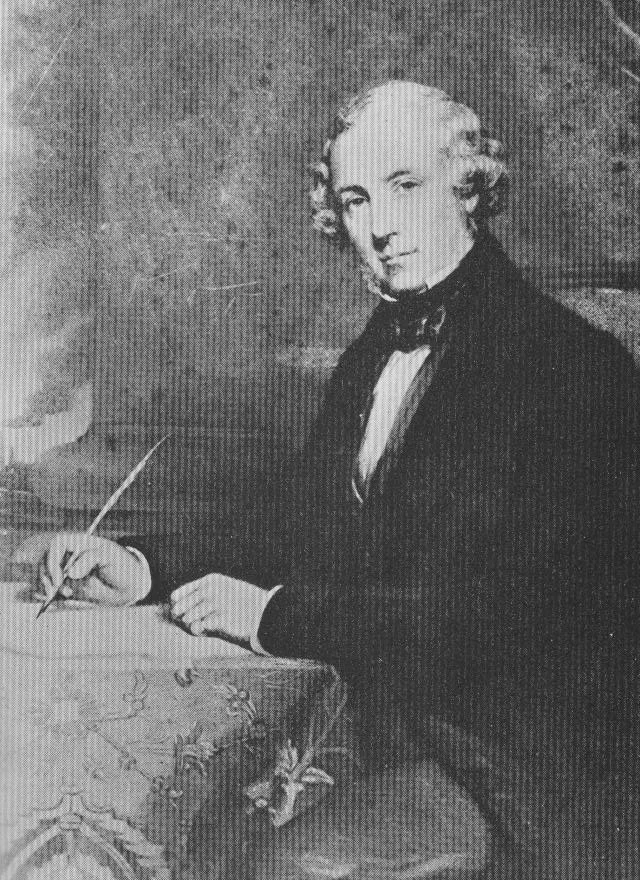

Dowlais Ironworks
In 1821, when George Stephenson and a handful of engineers were beginning to lay track for the world's first passenger railway between Stockton and Darlington, they needed rails. The rails came from Dowlais. Founded sixty-two years earlier as a nine-partner gamble with £4,000 of working capital, the Dowlais Ironworks on the north-eastern edge of Merthyr Tydfil grew into one of the greatest industrial concerns in the world. It supplied the iron tracks that carried trains across England and into Berlin and Saint Petersburg. It was the first business in Britain to license the Bessemer process for making steel. And in 1936, when an English king came to look at its idled furnaces and said the wrong thing, it helped bring down a throne.
Nine Partners and a Furnace
Dowlais was founded on 19 September 1759, before the Industrial Revolution had a name. Nine partners signed the agreement, including Thomas Lewis, who held a complex web of leases granting mining rights, and Isaac Wilkinson, who held a patent on machines for blowing furnaces. £4,000 was put on the table, a furnace was built, and iron began to come out of the Welsh hills. By 1781, John Guest, an iron-shop foreman who had risen by merit and savings, owned seven of the sixteen shares. His son Thomas formed the Dowlais Iron Company in 1786, and by 1815 Thomas's son John Josiah Guest owned nine shares and the works were effectively his. The Guest family would shape Dowlais for the next century.
Sir John, Lady Charlotte, and Michael Faraday
Under John Josiah Guest, who became a baronet in 1838, Dowlais turned itself into one of the laboratories of the early Industrial Revolution. Michael Faraday came to visit in 1819, when he was thirty and still a few years away from inventing the electric motor; he stood in front of the furnaces and took notes. Lady Charlotte Guest, John Josiah's English wife, learned Welsh, helped manage the works, raised ten children and translated the Mabinogion, the great medieval cycle of Welsh tales, into English for the first time. The works supplied iron for the Stockton and Darlington, then for the Berlin and Leipzig, then for the Saint Petersburg-Pauloffsky railways, the first generation of railways in Europe. By the time John Josiah died in 1852 Dowlais was, in the words of one contemporary, "one of the world's great industrial concerns."
Inventing the Cash Flow Statement
Less famous than the iron but quietly important to modern business: in 1863, Dowlais also invented an accounting innovation that you have probably used yourself. The company had recovered from a slump and made a profit, but had no cash to invest in a new blast furnace. To explain the puzzle, the manager produced a new kind of financial statement, a comparison balance sheet, which showed the firm was holding too much stock. That document was the ancestor of the cash flow statement, now required by accounting standards around the world. The work was being managed by William Menelaus, brought in as general manager by trustee G.T. Clark after John Josiah's death. Clark and Menelaus also nine years of planning, made Dowlais the first British works to license and successfully use the Bessemer process. In 1865, Dowlais made steel.
The King Who Spoke Out of Turn
By the 1930s, the old works at Dowlais was idle. A new integrated steel works had been built at East Moors near the Cardiff docks in the late nineteenth century, and the Great Depression had emptied the original site. Thousands of men in the streets around the works had no jobs. On 18 November 1936, King Edward VIII visited the closed Dowlais works as part of a tour of South Wales. He stood among the unemployed men in the cold, looked at the still furnaces, and was reported to have said: "These works brought these men here. Something must be done to get them back to work." In the British constitutional convention of the time, a monarch was not supposed to comment on policy. Edward had. Combined with his determination to marry the twice-divorced Wallis Simpson, the remark contributed to the political crisis that ended with his abdication on 11 December 1936, just twenty-three days after his Dowlais walk.
The Long Decline
The iron foundry at Dowlais, known locally as the Ifor Works after John Josiah's son Ivor, kept going. After 1945 new facilities were added. In 1973 the operation was rolled into the nationalised British Steel Corporation, traded for the Brymbo Steelworks and £20 million in cash. It closed in 1987. Today Dowlais is a quiet northern suburb of Merthyr Tydfil. Visitors can see the gates and walls of the old works, the Guest Memorial Library that the family endowed in the village, and St John's Church, where John Josiah is buried. Walking these streets, it is hard to picture the smoke, the heat, the rail trucks loaded with iron heading for Cardiff and the docks beyond. But for two hundred years Dowlais was where the modern world was being assembled, one bar of metal at a time.
From the Air
Dowlais sits at 51.76 N, 3.35 W on the high ground just east of Merthyr Tydfil, at the head of the Taff valley. Best viewed from 3,000 to 4,000 feet, with the Heads of the Valleys road (A465) crossing immediately north and Merthyr Tydfil filling the basin to the west. Cardiff Airport (EGFF) is roughly 27 nm south; Bristol (EGGD) about 32 nm southeast. The Brecon Beacons rise north of Dowlais; expect rapid weather change on south-westerly flows.
Nearby Stories
- Portishead Point Lighthouse 3 km away
- St Fagans National Museum of History 5 km away
- Museum of Cider 6.5 km away
- Monmouth 8.3 km away
- Carreg Cennen Castle 11 km away
- Builth Castle 14 km away
- Craig Gwrtheyrn 29 km away
- Ilfracombe Lifeboat Station 37 km away