
Downpatrick and County Down Railway
The Belfast and County Down Railway closed for good on a Sunday in January 1950. Track came up. Stations were demolished. The bus company took over the yard, the signal cabin at Kingsbog Junction went silent, the great mainline that had carried Victorian holidaymakers down to Newcastle returned to grass and mud. Then a Downpatrick architect named Gerry Cochrane went for a walk along the old trackbed in the early 1980s and could not stop thinking about what he had seen. By 1985 a small group of volunteers had broken ground on a heritage railway. By December 1987 a train was running again at Downpatrick - and on a gauge no other tourist line in Ireland uses.
The Triangle in the Marsh
The DCDR operates roughly three miles of track in a triangular layout - a shape that did not happen by accident. When the original BCDR opened in 1859, trains had to stop at Downpatrick, uncouple the locomotive, and run it round to continue toward Newcastle. The procedure ate journey time and clogged the station. In 1892, the BCDR opened the Downpatrick Loop Platform on a new connecting curve, letting through trains bypass the main station entirely while local trains still served the town. That triangular wye of tracks - mainline, loop, branch - became the basis of what survives today. Visitors who arrive at Downpatrick now ride out either toward Inch Abbey on the North Line or toward King Magnus' Halt on the South Line, choosing which leg of the triangle they want to follow.
A Gauge No One Else Uses
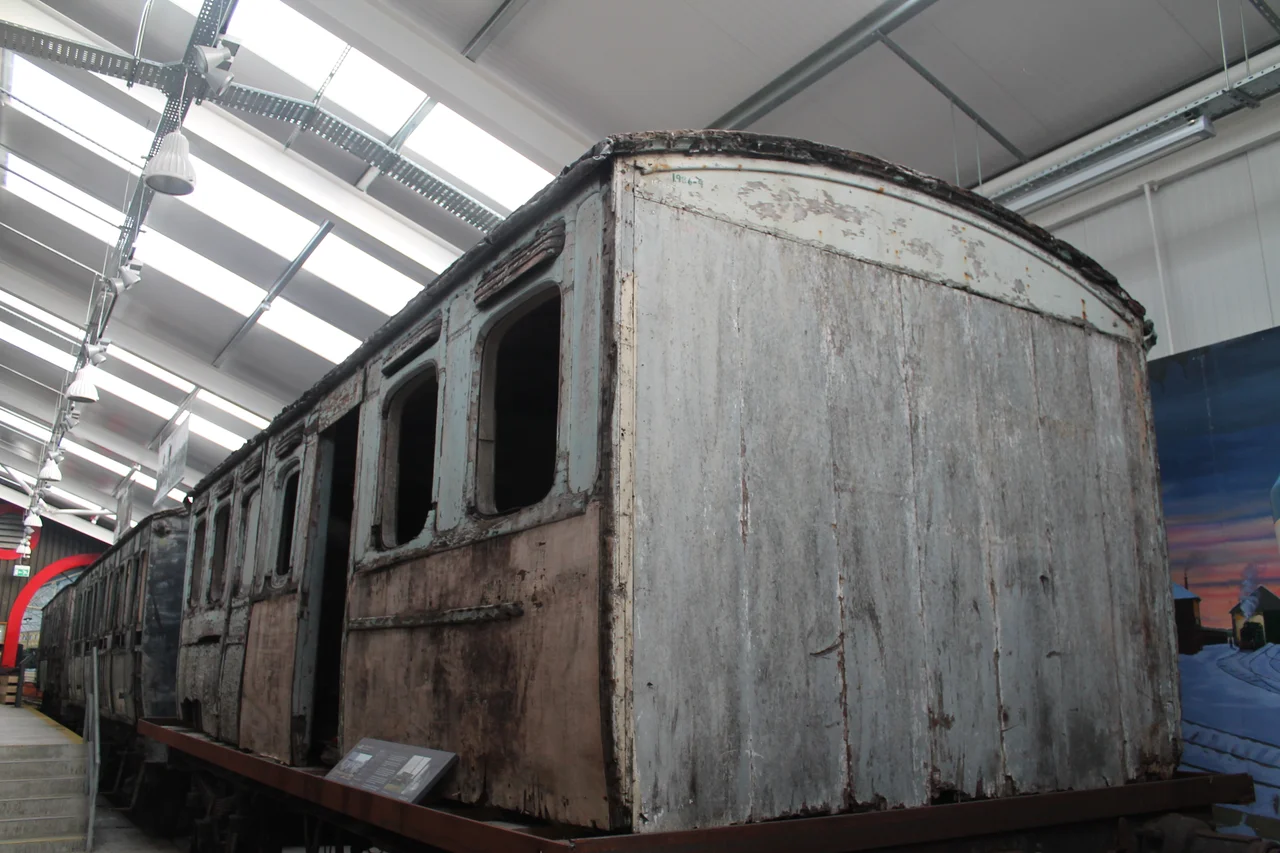
Ireland adopted a five-foot-three-inch railway gauge in the 1840s. It is wider than the British standard, narrower than the Russian, and it is found in active service almost nowhere outside Ireland. Every other heritage railway in Northern Ireland uses narrow gauge or the British four-foot-eight-and-a-half. The DCDR is the only full-gauge tourist railway on the island, which means its rolling stock cannot be borrowed from across the Irish Sea. Every carriage, every locomotive, every signal cabin has been sourced or salvaged from Irish lines that have closed. Five of the six surviving Belfast and County Down Railway carriages are at Downpatrick. So is the sole surviving Ulster Railway carriage, number 33 - the oldest passenger carriage in Ulster, dating from the dawn of Irish railways.
Buildings Moved Brick by Brick
Several of the railway's structures arrived at Downpatrick by being taken apart somewhere else and rebuilt on site. The station building was originally the town's Gas Manager's House, moved brick by brick from across the road. The signal cabin came from Kingsbog Junction on the Belfast-Derry line. Downpatrick East Signal Cabin was originally the North Cabin at Bundoran Junction, reassembled here in 2011 and opened to the public in 2017. The locomotive shed was originally a goods shed at Maghera. The water tower was relocated from Antrim. The arch over the main gate is based on a design from Cookstown. Walking the site is a kind of compressed tour of Irish railway architecture - structures that would otherwise have been scrap have ended up sharing one yard.
Magnus and the Abbey
The two passenger termini honour places older than the railway. King Magnus' Halt at the south end serves the burial site of Magnus Barefoot, the Norwegian king killed near Downpatrick in 1103, whose grave was not really accessible by road before the railway opened it up. Inch Abbey Halt at the north end serves the ruins of a Cistercian monastery founded by John de Courcy in 1180, sitting beside the River Quoile across from Downpatrick's cathedral hill. Trains run on Saint Patrick's Day specials to Inch Abbey, on Halloween specials to Magnus' Grave, on Santa Specials to the Loop Platform in December, and most weekends through summer. The steam locomotives in regular service - Orenstein and Koppel numbers 1 and 3 - are small German-built tank engines, but the railway also owns a 1875 GSWR No. 90, Ireland's oldest operational steam engine.
Twice Closed, Twice Reopened
The volunteers who keep the railway running have learned what railway people always learn: the trains will be stopped by something. In November 2023, Storm Ciarán pushed three to six feet of floodwater across the entire site for nearly a week. Rolling stock soaked. Infrastructure damaged. The line stayed closed for almost a full year while volunteers assessed and repaired. Trains resumed on 26 October 2024. Before that, the railway had closed during COVID and reopened in July 2022. Before that, it had grown from a single E-class diesel and a brake van in 1987 to a fleet of eighty-five vehicles - three steam locomotives, twelve diesels, seven railcar sets, twenty-four carriages, thirty-nine wagons. Awards have piled up: Heritage Railway Association recognition almost yearly, the European Heritage Open Days every autumn, film and television appearances from Derry Girls to The Lost City of Z. The trains run. The volunteers turn up. The triangle holds.
From the Air
The DCDR operates around 54.33N, 5.72W on the northern outskirts of Downpatrick. Track loops between Downpatrick station near Down Cathedral and Inch Abbey Halt on the Quoile estuary, with the South Line running toward King Magnus' Halt. Best viewed at 1,000 to 2,500 feet from the southeast, with Down Cathedral on its hill as the navigational anchor. Belfast City (EGAC) lies 23 nm north-northwest, Newtownards (EGAD) 14 nm north. The line sits in a flat estuarine landscape - flooding from the River Quoile is a regular hazard.
Nearby Stories
- Carrickfergus Castle 5.1 km away
- Lurgan 6.7 km away
- Slieve Gullion 6.9 km away
- Silent Valley Reservoir 13 km away
- Castledawson 19 km away
- Port Logan Lifeboat Station 21 km away
- Pasages (steam trawler) 30 km away
- Chicken Rock Lighthouse 31 km away