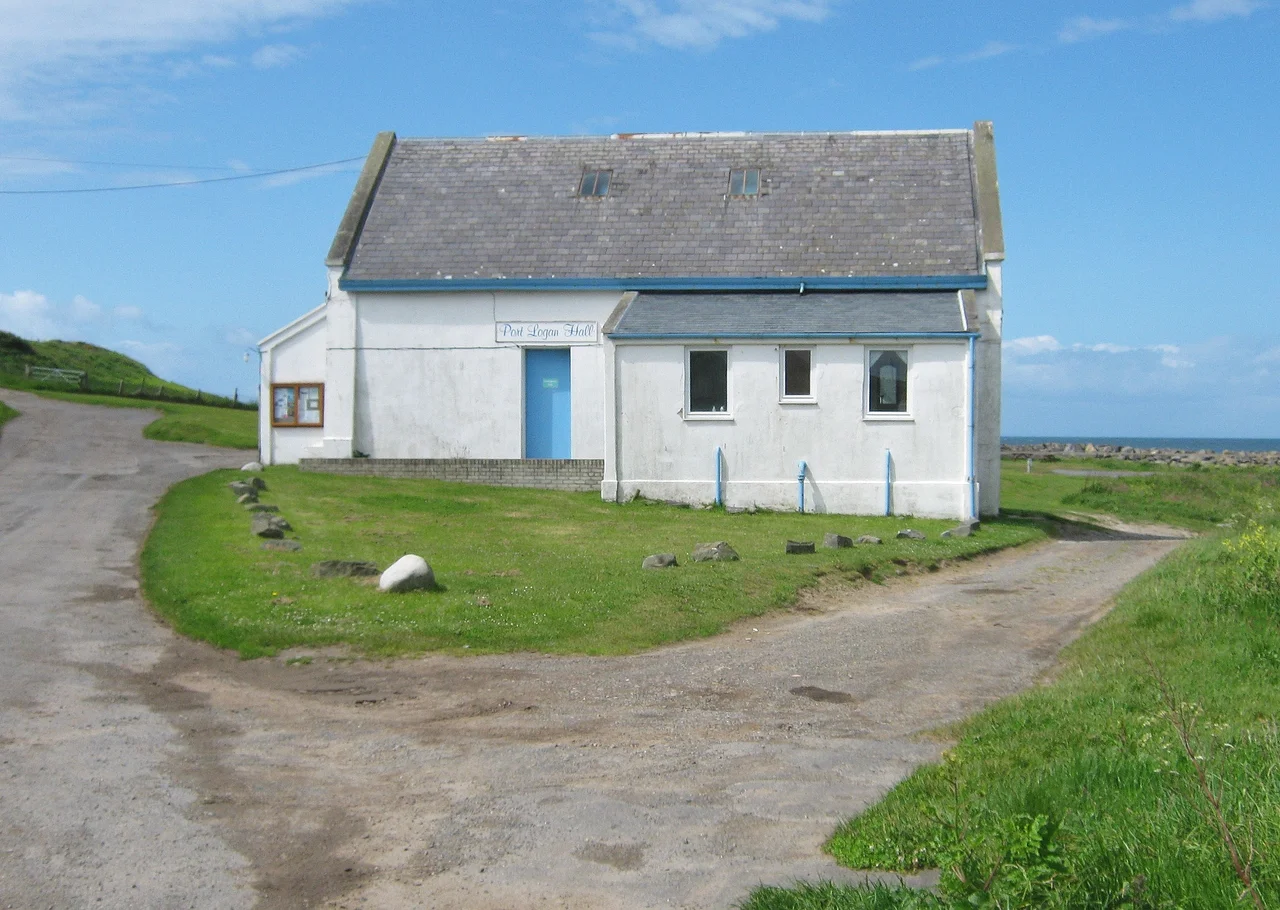

Port Logan Lifeboat Station
On the night of 16 December 1867, exactly one year after the new Port Logan lifeboat had been exhibited in Glasgow, a barque called the Strathleven, on passage from Demerara to Glasgow, went on the rocks about seven miles from Port Logan. Fifteen men were clinging to the rigging when the lifeboat reached them. They were all brought ashore alive. The detail that turns the rescue from a Victorian newspaper paragraph into something stranger came afterward: the captain's wife, it emerged, had been among those who made donations the year before, when the very same lifeboat had been on display in Glasgow. She had paid, in effect, to save her own husband. That is the kind of story the Port Logan Lifeboat Station collected during its sixty-six years on the western shore of the Rhins of Galloway.
A Boat Brought South by Four Railways
The station opened in 1866. The first lifeboat was a 30-foot self-righter, designed to be rowed with ten oars or sailed, and it cost the Royal National Lifeboat Institution £232 - a sum that included its launching carriage and full equipment. Getting it to Port Logan was itself a Victorian logistical feat. Four railway companies - the Great Northern, the North Eastern, the North British Caledonian, and the Glasgow and South Western - carried it from Edinburgh and Glasgow to Stranraer free of charge, donating their freight as a kind of corporate philanthropy. From Stranraer, the boat travelled by road on its carriage to Port Logan, where a large crowd watched it arrive in December 1866. The donated route survives in the records because the RNLI's magazine, The Lifeboat, reported the gift in its July 1867 edition - a paper trail that links a lifeboat in a tiny Galloway village to the boardroom decisions of four of Britain's largest railway companies.
Barques, Brigantines and Hurricanes
The wrecks the station answered tell their own story of nineteenth-century sail-power and the prices it paid. The barque Britannia of North Shields, en route to Greenock from Mauritius, was driven ashore on the night of 12 January 1875; her crew saved themselves by clambering over rocks at low tide, but the fourteen men sent to salvage the cargo were caught by a storm and rescued by the lifeboat Edinburgh and R. M. Ballantyne. In January 1897, the brigantine Prospect was in difficulties off Drummore, on passage to Portaferry with coal. The lifeboat was carried overland to Scratby Bay and launched at half past noon into moderate gale-force winds and snow showers; her crew of four were rescued, landed at Drummore at six in the evening, and the boat was left there overnight because snow had closed the roads. On 5 November 1911, the schooner Glide - again carrying coal, again at Drummore - was caught by a hurricane. The lifeboat Thomas McCunn was hauled near to the scene, launched into the storm, and brought off three crew. The pattern is the same every time: a vessel in trouble, often coal-laden, often in conditions that made launching itself a feat, and a small crew putting out anyway.
The Boats by Name
The boats themselves accumulated names that read like a roll-call of donors and dedications. Edinburgh and R. M. Ballantyne served two stints - the second from 1887 as ON 86, replaced after seven years by the Frederick Allen (ON 364), funded from the legacy of the late Miss E. C. Allen. The Thomas McCunn (ON 575) arrived in 1907. Each name represents a will, a bequest, a public subscription - the entire RNLI funding model writ small in a Galloway harbour. The boats wore those names through bad nights at sea, and the names outlived the wrecks they answered. By the early twentieth century, motor lifeboats were transforming the service; pulling-and-sailing boats were being retired one by one. At a meeting on Thursday 14 January 1932, the RNLI's committee of management decided to close the Port Logan station. The work continued from neighbouring Portpatrick, which still operates an all-weather lifeboat today; the empty boathouse at Port Logan eventually became the village hall, used now for weddings, Hogmanay, and the community cinema.
A Coast That Asked This Much
Why was a lifeboat needed at Port Logan at all? Look at the chart: the Rhins of Galloway is a long peninsula sticking out into the Irish Sea, with the open North Channel to the west. Vessels from Glasgow, Greenock, Belfast and Liverpool all worked these waters, and the prevailing south-westerly weather could turn a routine voyage into a fight for the shore in hours. The Mull of Galloway lies south, the Irish coast 25 miles west, and a vessel embayed by a westerly gale on the Rhins coast had nowhere to run. Sixty-six years of service, dozens of rescues, no record of a Port Logan crew member lost - the village paid for those statistics by keeping ready, in all weather, the small wooden boat that pulled toward whatever was happening offshore.
From the Air
The former Port Logan Lifeboat Station sat on the western shore of the Rhins of Galloway at approximately 54.723 deg N, 4.959 deg W, about 14 nm south of Stranraer. From the air, Port Logan's planned village curls around its sandy bay, with the long causewayed quay running north - a recognisable hook of stone against the beach. Open Irish Sea stretches west; the Mull of Galloway tapers south. Glasgow Prestwick (EGPK) is the nearest sizeable airport, roughly 65 nm north-east; West Freugh (EGOY) sits just north near Stranraer. Visual landmarks include the bell-tower on Port Logan's quay, the broad arc of Port Nessock Bay, and Logan Botanic Garden's tree canopies inland from the village.
Nearby Stories
- Glasserton 6 km away
- Battle of Glen Trool 9.5 km away
- Ballantrae Lifeboat Station 11 km away
- International Institute of Space Commerce 11 km away
- Bangor Abbey 12 km away
- Downpatrick and County Down Railway 20 km away
- Portavogie 23 km away
- Cushendall 29 km away