
Glasserton
From the top of a small standing stone called the Wren's Egg, on the shortest day of the year, the setting sun drops behind a single isolated rock far out in Luce Bay. On every other day of the year, it sets further west. Whoever put the Wren's Egg here, 3,000 to 4,000 years ago, knew the geometry of this coast intimately. Glasserton parish is full of clues like that: a stone here, a cist burial there, a cup-and-ring mark on a hillside, a cave where a saint reportedly hid. The Statistical Account once described the parish church as 'romantically embosomed in wood,' as if it were 'a druidical temple, or the sacred grove of some Syrian idol.' Even the 18th-century clergyman could feel it.
Where Ninian Came to Pray
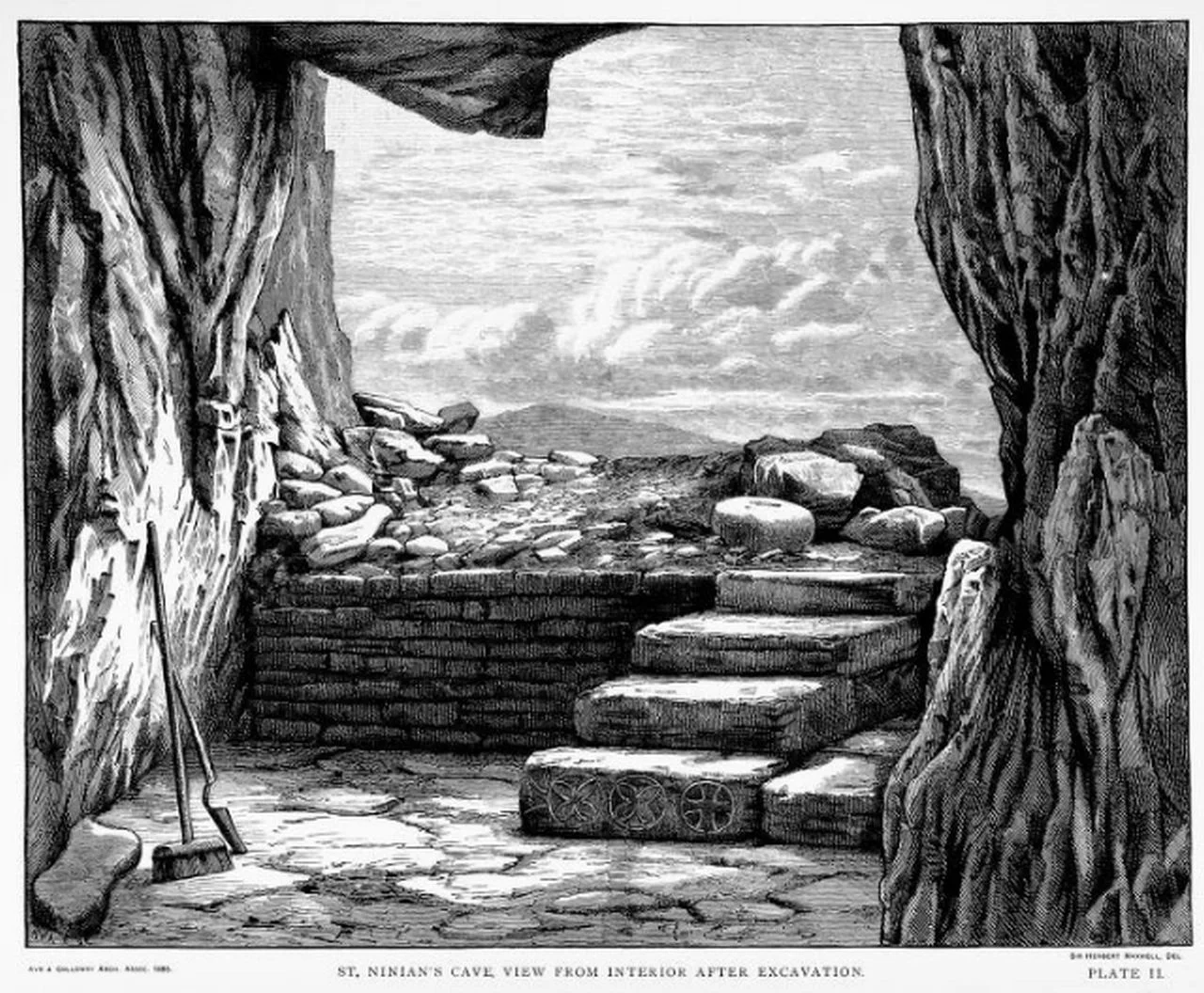
Saint Ninian, also called Saint Ringan, the first Bishop of Galloway, is said to have lived for a while in a cave near Physgill, a coastal cleft now known as St Ninian's Cave. He used it, the tradition runs, by way of penitence; the place would have been his austere counterweight to the busy mission centre he founded a few miles north at Whithorn. Pilgrims have walked the path from the cave to the priory for fifteen centuries. The parish itself runs about eight miles long, contains 13,477 acres, and its name is thought to derive from a Saxon word for 'bare hill,' a fittingly plain description of this rolling, windswept land between the moor and the bay.
Bronze Otters and a Real One
Near the ruined chancel of Kirkmaiden Church, a bronze otter perches on the headland, sculpted by Penny Wheatley as a memorial to Gavin Maxwell. Maxwell was the naturalist and writer who lived here, exercised his tame otter Mij on the beach below, and turned the experience into Ring of Bright Water, the 1960 book that became one of the best-loved nature memoirs of the 20th century and a 1969 film. The Maxwells of Monreith have lived in this parish for centuries. Their original tower house, known as The Dowies behind the Fell of Barhullion, has been restored by the Landmark Trust. The restored chancel at Kirkmaiden serves as their burial vault, and includes the historian and naturalist Sir Herbert Maxwell.
Five Kingdoms from a Single Hill
A Maxwell once boasted that from the Fell of Barhullion, the highest point above Monreith village, he could see five kingdoms on a clear day. He counted Scotland under his feet, England across the firth, Ireland west across the sea, the Isle of Mann to the south, and, looking up, the Kingdom of Heaven. The boast is preserved in family memory more than in cartography, but the view does take in an extraordinary stretch of the British and Irish coasts. Below the fell, Monreith offers something rare on the Galloway coast: sandy beaches with safe swimming, rock pools, and caves, one of them streaked red and known locally as the Butcher's Cave. At the end of the Black Rocks sands, a man-made flounder pool still holds its old shape, built to trap fish as the tide receded.
The Wraith-Bell in Luce Bay
Glasserton specialises in stories that won't quite stay dead. When Kirkmaiden parish was united with Glasserton, legend says, the pulpit and bell were loaded onto a boat to be carried across Luce Bay to a sister church in Kirkmaiden Parish in the Rhins. A sudden storm rose, the boat foundered, and the bell went to the seabed. Ever after, the story goes, whenever a descendant of the McCullochs of Myrton was about to die, the wraith-bell rang from the depths of Luce Bay. Whether or not anyone has heard it lately, the parish has plenty of other voices: four ancient hill forts, Bronze Age cists at Blairbuy Farm, the Drumtroddan standing stones, and a coast where dolphins and basking sharks still pass in the warm North Atlantic Drift.
From the Air
Glasserton parish stretches around 54.7355N, 4.4836W on the south-west of the Machars peninsula. The Fell of Barhullion is the most prominent hill and a useful waypoint, with views over Monreith Bay, Luce Bay and the Isle of Man on a clear day. St Ninian's Cave is on the coast a couple of miles south-east of the village. Best viewed at 1,500-3,000 ft. Nearest airports: Dumfries (EGDD), Prestwick (EGPK), and Isle of Man Ronaldsway (EGNS) across the bay.
Nearby Stories
- Ardwell 2.1 km away
- Point of Ayre Lighthouse 8.7 km away
- Battle of Glen Trool 9.8 km away
- Ballantrae Lifeboat Station 11 km away
- Solway Firth 13 km away
- Dumfries 17 km away
- St Bees Lifeboat Station 17 km away
- Portavogie 34 km away