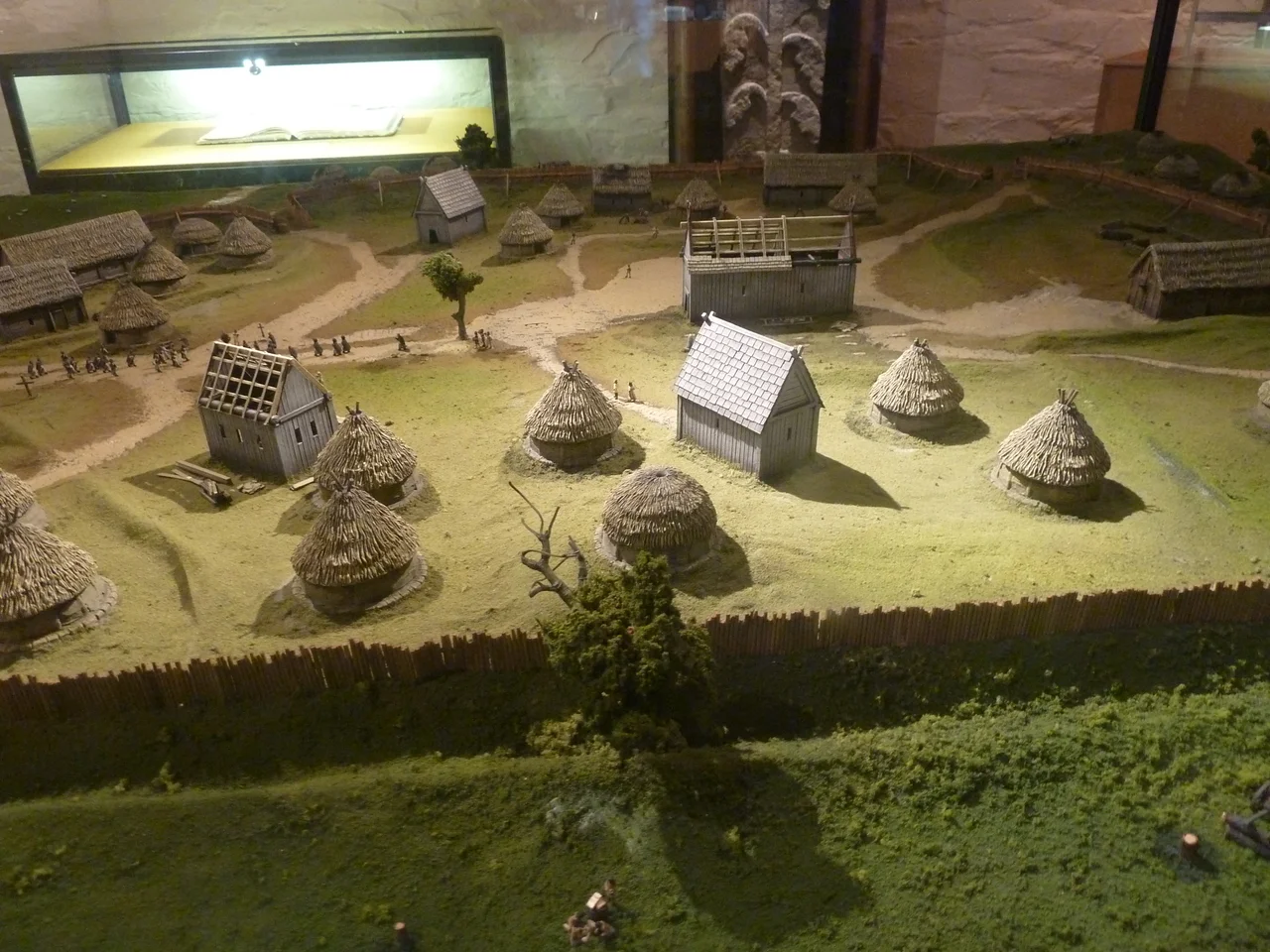

Bangor Abbey
Three thousand monks. That is the number the medieval Annals give for the brotherhood that looked to Saint Comgall for guidance when he died in 602. Three thousand, gathered inside an earthen rampart on the southern shore of Belfast Lough, studying scripture, theology, logic, geometry, arithmetic, music, and the classics. The monastery Comgall had founded in 558 had become, within fifty years, the greatest school in Ulster and one of the leading houses of early medieval Christianity. They called the place the Vale of Angels, because Patrick was said to have once rested here and seen the valley filled with angels. The monks themselves they called the Light of the World.
Comgall and the Austere Rule
Comgall was born in County Antrim in 517 and educated at Clooneenagh and Clonmacnoise, the great inland monasteries. The spirit of monasticism was running strong in sixth-century Ireland, and many young men were seeking solitude to serve God. Comgall retired to a lonely island first - the typical first step. Friends persuaded him out of his hermitage, and he founded the monastery at Bangor sometime between 552 and 559, with the Annals of Tighernach and the Annals of Innisfallen giving 558 as the most likely date. The rule he established was severe: incessant prayer, constant fasting, asceticism that would have driven most away. It drew people in instead. Inside the great rampart enclosing the monastic buildings, students worked through a curriculum that was already by sixth-century standards encyclopaedic - the trivium and the quadrivium, scripture and chant, the Latin classics and the Irish lore.
The Missionaries Who Crossed the Sea
What made Bangor matter beyond Ireland was what its graduates did when they left. In 580, a monk named Mirin took Christianity to Paisley in western Scotland and died there full of sanctity, according to the medieval chroniclers. Ten years later, in 590, Columbanus set out from Bangor with twelve companions including Saint Gall. They crossed to Continental Europe and began founding monasteries: Luxeuil in Burgundy, where Columbanus imposed the same severe rule he had learned at Bangor; St Gallen in Switzerland, which still bears Gall's name; Bobbio in Italy, where Columbanus died in 615 and where the Antiphonary of Bangor would later be housed for over a thousand years. Bangor's missionaries helped re-Christianise a Continent that had lost much of its religious infrastructure to the fall of Rome and the migration of peoples.
The Antiphonary
Between 602 and 691, monks at Bangor compiled what is now called the Antiphonary of Bangor - a collection of Latin hymns, prayers, and antiphons used in the monastic offices. The manuscript travelled to Bobbio in Italy with Columbanus' tradition and stayed there for over a thousand years. It is one of the earliest dateable monastic manuscripts to survive from Ireland and has been described as one of the most precious witnesses to the early Irish church. The music it preserves was sung in the choral antiphonal style for which Bangor was famous - call and response, the laus perennis or perpetual praise where companies of monks relieved each other so that prayer continued day and night without interruption. Bernard of Clairvaux wrote in the twelfth century that at Bangor the divine offices were maintained "so that not for one moment day and night was there an intermission of their devotions."
Burning, Raiding, Decline
Like many early Irish monasteries, Bangor was destroyed and rebuilt repeatedly. The Annals of Ulster record that Bangor burned in 616 and again in 755, when the buildings would still have been mostly wood. Then came the Vikings. Easily accessible from Belfast Lough, the monastery was a natural target. Between 822 and 824, Norse raiders sacked the place repeatedly - the Annals of Ulster and the Four Masters both record that learned men and bishops were killed, while the shrine containing Comgall's relics was stolen. In 958, Tanaidhe MacUidhir, the abbot of Bangor, was killed - probably another Viking casualty. By the late tenth century, the great school had declined past recovery. The Antiphonary in Bobbio outlived the abbey that had produced it.
What Remains
Nothing now remains of Comgall's original buildings. The tower of the current church dates only from the fourteenth century, when Saint Malachy's twelfth-century reform of Irish monasticism had brought stone back to Bangor. A mural in the church shows Christ ascending to heaven with Comgall, Gall, and Columbanus at his feet - the three saints whose vocations had begun here. In the Private Chapel at Clandeboye, built into the wall, sits the shaft of a Celtic High Cross found in the abbey precincts, probably from the eighth century. It may have stood on the Cross Hill near Bangor Castle, where a seventeenth-century map shows it marked. The Bangor Sundial, broken now and displayed outside the town hall, is another fragment. The Light of the World left almost no buildings. It left a monastic tradition that still runs through European Christianity.
From the Air
Bangor Abbey sits at 54.656N, 5.675W in the centre of Bangor, on the southern shore of Belfast Lough. Best viewed from 1,500 to 2,500 feet on a southerly track, with the abbey tower visible near the town centre and Bangor Bay opening to the north. Belfast City (EGAC) lies 7 nm west-southwest. Belfast Lough is a busy shipping channel - watch for ships transiting to and from the Belfast docks. Newtownards (EGAD) lies 5 nm south.
Nearby Stories
- Larne 1.2 km away
- Ahoghill 3.5 km away
- Castleskreen 4.9 km away
- Lough Neagh 6.1 km away
- Kingsmill Massacre 14 km away
- Pasages (steam trawler) 23 km away
- Ballantrae Lifeboat Station 34 km away
- St Patrick's Isle 39 km away