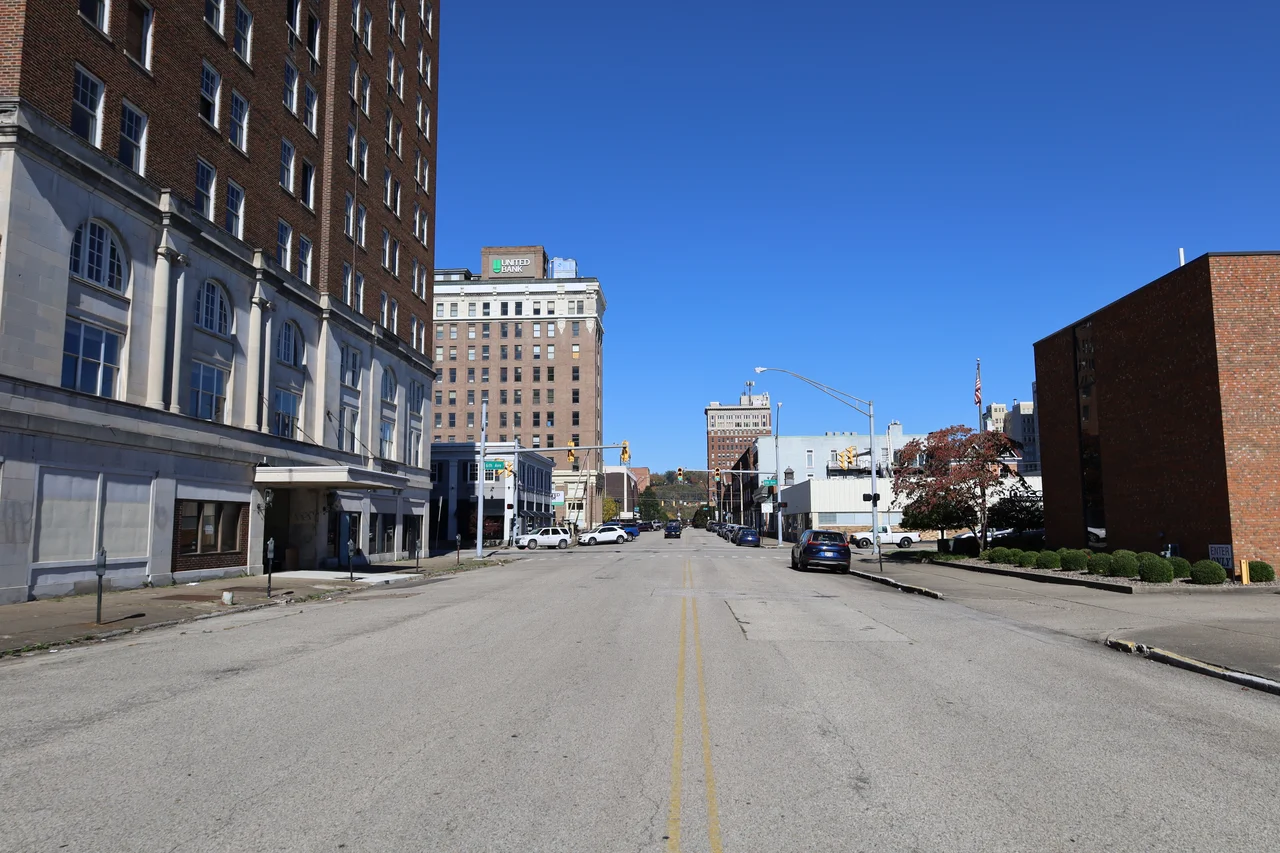

Downtown Huntington Historic District
When Collis P. Huntington decided to build a new city as the western terminus of his Chesapeake and Ohio Railway in 1871, he did not pick an existing town. He bought farmland on the south bank of the Ohio River and laid out a brand-new grid for what would become Huntington, West Virginia. The downtown that grew up over the following sixty years - brick commercial blocks, an opera house, churches, a Carnegie library, a movie palace, a city hall - is mostly still standing. The Downtown Huntington Historic District preserves 112 contributing buildings across the original 1986 designation and a 2007 boundary expansion. The grid C. P. Huntington drew is now a National Register district, and most of the city's nineteenth- and early twentieth-century architecture is still doing its original job.
The 1885 Opera House
The Davis Opera House, built around 1885, is the oldest commercial structure in the district. Theaters of its era served as the entertainment centerpiece of small American cities - venues for traveling theatrical companies, opera and musical performances, lecture series, and the broad cultural calendar that defined urban life before radio and movies. The Davis stood for decades before Huntington's later movie palaces eclipsed it, but the building itself has survived. The Love Hardware Building, also from around 1884, anchors another corner. Together these structures are the earliest commercial survivors from Huntington's first generation of post-railroad construction, the wooden and brick buildings that emerged in the first decade after the city's founding.
The Bigger Anchors
Larger anchors followed as the city grew. The Frederick Building dates from 1906, the Huntington City Hall from 1915, the West Virginia Building from around 1924, and the Huntington Arcade from 1925. The Anderson-Newcomb/Stone and Thomas Building - now the Marshall University Visual Arts Center - dates from around 1902 and represents the kind of substantial department store that defined American downtown shopping for the better part of the twentieth century. The 1928 Keith-Albee Theatre, separately discussed, is one of the great surviving movie palaces of its era and probably the district's most architecturally distinctive single structure. Each building marked a phase of the city's growth, with the most ambitious construction concentrated in the 1900-1930 period when Huntington's economic and demographic peak coincided with the high water mark of American downtown commercial architecture.
Five Churches
The district includes five historic churches, each a substantial congregation building in its own architectural idiom. Trinity Episcopal dates from 1882, the oldest of the group. First Presbyterian was completed in 1895. Johnson Memorial Church traces its lineage through three building dates of 1886, 1912, and 1935. First United Methodist (originally First Methodist Episcopal) opened in 1913, and Fifth Avenue Baptist Church in 1916. The churches are clustered enough that downtown Huntington has the distinct character of an American small city built when religion was a public institution that anchored neighborhoods with substantial stone and brick architecture. The buildings are still active congregations, not converted to other uses - a notable preservation success.
Government and Public Buildings
Several civic buildings within the district are separately listed on the National Register. The Cabell County Courthouse anchors local government. The U.S. Post Office and Court House represents federal presence in the city. The Carnegie Public Library at Fifth and Ninth, built in 1903 as Andrew Carnegie's gift to the city, served as the public library until 1980 and is now home to Huntington Junior College. The Campbell-Hicks House is a residential survivor preserved within the commercial district. The cluster of public and quasi-public buildings - government, education, library, postal - gives the district more institutional density than a purely commercial historic district would have.
The Grid from Above
From the air, downtown Huntington reads as a tight rectangular grid of blocks pressed against the south bank of the Ohio River. The river runs east-west; the avenue numbering runs from First Avenue near the river up to higher numbers as you move south. The cross streets run from First Street near the eastern edge of downtown to higher numbers as you move west. The historic district occupies the densest core of this grid, with the tallest surviving buildings clustered around the Fifth and Ninth Street axis. The original C. P. Huntington layout is still legible - this is one of the more intact nineteenth-century railroad-town grids in the eastern United States, with most of its original buildings still standing in much of their original form. The grid is the bones. The district is the flesh that grew on those bones.
From the Air
Located at 38.416 degrees north, 82.432 degrees west, in downtown Huntington, West Virginia. Recommended viewing altitude 3,500 to 5,500 feet AGL for clear views of the historic grid and Ohio River. Nearest airport is Tri-State (KHTS), about 4 nautical miles east-northeast. The downtown grid is one of the more intact railroad-town layouts in the region, easily identifiable from above by its tight regularity and proximity to the river.
Nearby Stories
- Battle of Scary Creek 6 km away
- Portsmouth 7.2 km away
- Fred M. Vinson Museum and Welcome Center 14 km away
- Staats Mill Covered Bridge 24 km away
- Lake Tight 25 km away
- Battle of Blair Mountain 32 km away
- Lower Shawneetown 35 km away
- The Kentucky Meat Shower: When Flesh Fell From a Clear Sky 68 km away