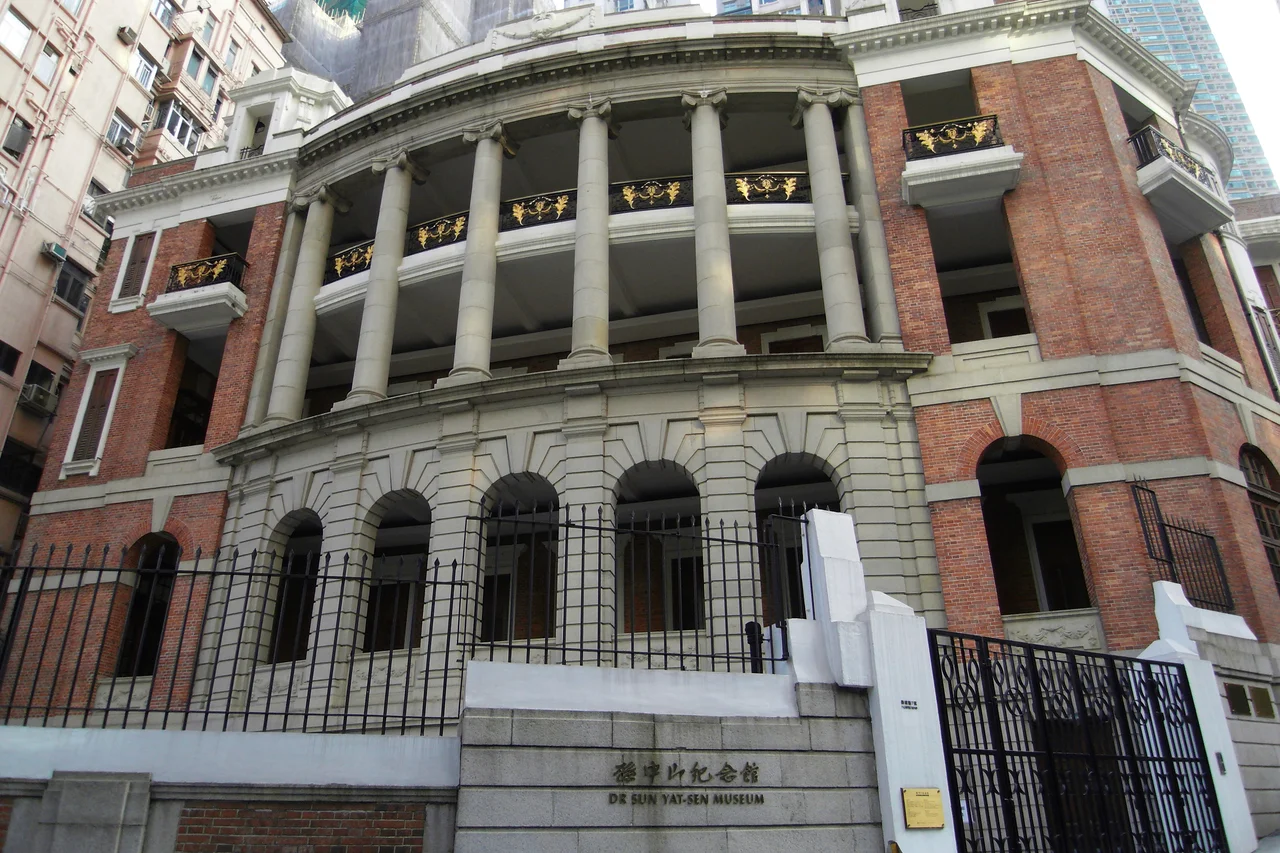

Dr Sun Yat-sen Museum
Sun Yat-sen never set foot in Kom Tong Hall. That irony is one of the more interesting facts about the museum that now bears his name: the connection is real but indirect, a web of classmates, brothers, and shared revolutionary sympathies rather than any direct physical presence. The Hall was built in 1914 by Ho Kom-tong as a family residence, one year after the 1911 Revolution that Sun led had succeeded in toppling the Qing dynasty. Ho and Sun had graduated from The Government Central School in the same year, 1886, and Ho's elder brother Sir Robert Ho Tung supported Sun's cause. That network of relationships — combined with the Hall's proximity to other sites on the nearby Dr Sun Yat-sen Historical Trail — made it the natural home for a museum when the government went looking for one.
A Building Worth Saving
The Church of Jesus Christ of Latter-day Saints occupied Kom Tong Hall from 1960 to 2004, using it for worship services and as the administrative headquarters for its Asia-area operations. When the Church outgrew the space and moved to a new 14-storey building on Gloucester Road in Wan Chai, it faced a decision: sell the property intact or demolish it for the higher price a vacant lot would fetch. In October 2002, the Church submitted a demolition permit application to the Building Authority. Community concern followed, and after negotiations with the Hong Kong Government, the Church agreed to sell the building intact. In February 2004, the government acquired it for HK$53 million and announced a conversion budget of HK$91.3 million. The restored museum opened on 12 December 2006, marking what would have been Sun Yat-sen's 140th birthday. The Antiquities and Monuments Office declared it a monument on 12 November 2010.
The Architecture of Colonial Wealth
Kom Tong Hall is one of the more extravagant pieces of Edwardian architecture in Hong Kong. Greek-style granite columns frame the facade. Red brick walls rise around windows and doors dressed in granite. Ornate ironwork decorates the balconies. Inside, Baroque and Rococo excess is everywhere: a grand staircase with carved wooden railings and ornamental balustrading climbs from basement to second floor, the ceiling panels of the main rooms are adorned in moulded plaster highlighted with gold leaf, and Art Nouveau stained-glass windows line the main staircase and other prominent positions. Crystal chandeliers, hardwood wainscoting, fireplaces, patterned floor tiles, and wooden louvre windows complete the picture. The Hall occupies roughly 2,560 square metres across four storeys and was among the first buildings in Hong Kong constructed with a steel frame and concealed built-in electrical wiring.
Two Staircases, One Social Order
Among the details that make Kom Tong Hall legible as a document of its era is a subtle architectural division: the Hall has two staircases. One at the front was for use by the Ho family; one at the back served the mui tsai — the domestic servants, typically young girls from poor families placed in household service, a practice that persisted in Hong Kong into the mid-twentieth century. The staircases encode a social hierarchy that the museum now asks visitors to reckon with. The Baptist font installed during the decades of Church occupancy was preserved at the government's request as an acknowledgement of that period in the building's history. A plaque on the facade still notes that the Church maintained the Hall well and left behind a cultural legacy.
Sun Yat-sen's Hong Kong Years
The museum's exhibitions focus on something the city itself sometimes overlooks: how central Hong Kong was to the revolution that created modern China. Sun came here for secondary school and stayed for his medical education at the College of Medicine for Chinese on Hollywood Road, graduating in 1892. He established the Revive China Society's headquarters in Hong Kong in 1894, using the relative freedom of the British colony to organise what would have been impossible on the Qing mainland. He met comrades at To Tsai Church on Hollywood Road. He used a trading house on Staunton Street as cover. The exhibitions in Kom Tong Hall trace this geography of conspiracy through documents, photographs, and interactive displays. Audio guides are available in Cantonese, Mandarin, and English; the museum is accessible on foot from Sheung Wan MTR station.
From the Air
The Dr Sun Yat-sen Museum stands at approximately 22.282°N, 114.151°E on Castle Road in the Mid-Levels district of Hong Kong Island. From the air, the Mid-Levels are visible as a band of dense residential towers occupying the hillside above Central's commercial core. The museum itself is a low-rise historical building and not individually distinguishable from altitude, but the neighbourhood around Hollywood Road and the steep streets climbing toward Victoria Peak are recognisable. The nearest major airport is Hong Kong International Airport (VHHH), approximately 20 nautical miles to the west-southwest on Chek Lap Kok island.
Nearby Stories
- Lok Ma Chau Loop 2.3 km away
- Portas do Cerco 2.3 km away
- Kweilin Incident 17 km away
- Wanshan Archipelago Campaign 34 km away
- Nanxiong Formation 115 km away
- Battle of Nanpeng Island 148 km away
- Heyuan 169 km away
- Cape Maobitou 632 km away