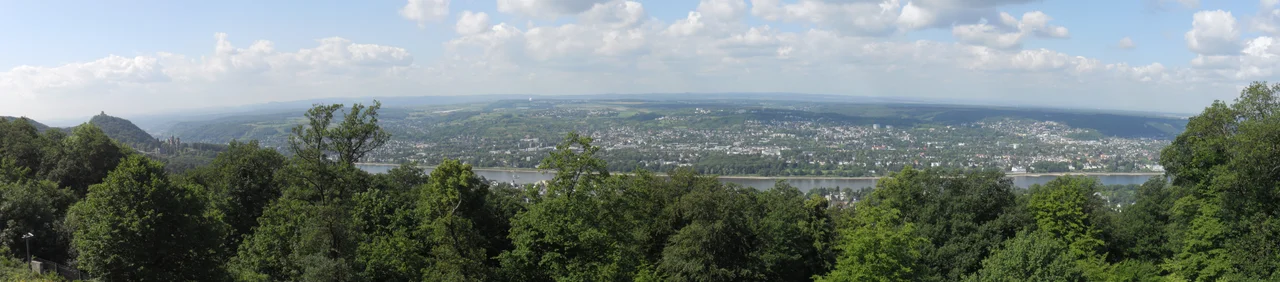

Drachenfels (Siebengebirge)
Lord Byron came to the Drachenfels in May 1816, fresh from his self-imposed exile, and the rock made it into Childe Harold's Pilgrimage as the line about castled crag and clustering vines. The Romantic tourist circuit on the Rhine pretty much starts there. By the 1820s every English visitor with a notebook was scribbling about the view; by 1883 a rack railway was hauling the unromantic mainstream to the top; by the 21st century the joke was that the Drachenfels is the highest mountain in Holland, on account of how many Dutch holidaymakers crowd onto the summit each weekend. It is 321 meters tall. It is not the highest hill in the Siebengebirge. It just happens to sit closest to the river, which is why dragons and quarrymen and Romantics and Dutch retirees have all wanted a piece of it.
How a Hill Becomes a Dragon
The Drachenfels formed about 25 million years ago when magma pushed up through the Rhineland crust but never quite broke the surface. It cooled in place into trachyte, a hard volcanic rock, and only later did weather and time wear off the softer layers above to leave the plug exposed. The Siebengebirge as a whole is a graveyard of these failed eruptions. The Drachenfels happens to be the one closest to the Rhine, which made its quarried stone the cheapest in the region to ship by barge. Romans quarried it. Medieval cathedral builders quarried it. The fabric of Cologne Cathedral, which took six centuries to finish, is largely Drachenfels trachyte hauled the 50 kilometers downstream. Quarrying ended in 1836 when the Prussian government bought the operation outright, a remarkably early piece of conservation thinking. The cathedral got its stone; the dragon got to keep its rock.
Siegfried's Cave, and Other Stories
Long before the Romantics arrived, the hill had a name and a story. In the Nibelungenlied, the medieval German epic, Siegfried slays the dragon Fafnir in a cave somewhere along the Rhine and bathes in its blood to become invulnerable. Local tradition placed the cave inside the Drachenfels - dragon's rock - and the story has lived there ever since. Other dragon legends accumulated. One has prisoners being sacrificed on the hill, including a Christian maiden who held up a small cross; the dragon, terrified by the holy symbol, plunged into the Rhine and was never seen again. Another, mercifully briefer, has the dragon attacking a gunpowder barge and being blown up. In 1913 a Nibelungenhalle was built about a third of the way up the slope, hung with painted scenes from Richard Wagner's operas by the symbolist Hermann Hendrich. Wagner had recycled the same dragon for his Ring cycle three decades earlier. The hill collected its tellings.
The Castle That Outlived Its Purpose
Between 1138 and 1167, Archbishop Arnold I of Cologne built a small castle on the Drachenfels summit to guard the southern approaches to his territory. It was a bergfried with a chapel and quarters for servants, never a major fortress, and by the early modern period it was already strategically irrelevant. In 1634, during the Thirty Years' War, Protestant Swedish troops slighted the castle - that medieval English verb that means systematically dismantled to deny it to anyone else. It was never rebuilt. Quarrying then chewed away at the lower walls for two more centuries until only fragments stood. Today the ruin is a few jagged stones on the summit, picturesque rather than imposing, and the modern restaurant at the top is built in a careful glass cube that replaced a 1970s brutalist hulk demolished in 2011. The first restaurant on the new glass building's terrace opened on 30 November 2012.
The Romantic Industry
What made the Drachenfels famous was not the dragon and not the castle but the Romantic generation that needed both. The Napoleonic Wars ended in 1815. English tourists started traveling again, the Rhine became the prestige itinerary, and Byron's stanza in Childe Harold gave the hill a literary anchor. Heinrich Heine wrote about it from the German side. Edward Bulwer-Lytton wrote about it from the English side. The view of Konigswinter and the Drachenfels became a Photochrom postcard staple by 1900. In 1883 a rack railway, the Drachenfelsbahn, opened to handle the demand, climbing the slope on a 20-percent grade. The line still runs. Dutch tourists in particular adopted the hill as their first proper elevation when traveling upstream from the Netherlands, which is why locals joke about the highest mountain in Holland. The Germans have a different nickname for it: Schwiegermutterfelsen, mother-in-law rock, because of how mothers-in-law are said to be brought there and gently encouraged to take in the view from the cliff edge. The joke is older than it should be.
Wine on a Slope That Refuses Machines
On the south face of the Drachenfels, where the trachyte holds the sun all afternoon and frosts melt early in spring, vineyards have clung to the slope since at least the Middle Ages. The Drachenfels is the northernmost vineyard slope along the Rhine, ten kilometers downstream from the more famous vineyards around Oberdollendorf. Riesling dominates, as it does almost everywhere on the German Rhine, but the steep parcels also grow Gewurztraminer, Scheurebe, Dornfelder, Kerner, and the three Burgunders - Grau, Weiss, and Spat (Pinot Gris, Pinot Blanc, and Pinot Noir). The slopes are too steep for machinery. Everything is pruned and picked by hand, just as it was in the era when monks ran most of the vineyards along this stretch of the river. The wines are not the most renowned in Germany, but they have the particular character of trachyte and the particular geography of being the last northern outpost where Riesling reliably ripens. The dragon, if it is still in there, drinks well.
From the Air
Coordinates: 50.6653, 7.2097. The Drachenfels is a sharp, rocky peak rising to 321 meters above sea level on the Rhine's east bank, directly opposite Bad Godesberg. Easily identified by its prominent ruin and the Schloss Drachenburg neogothic castle on its lower slopes. Recommended viewing altitude 3,500-5,000 feet for the full Siebengebirge ridge. Nearest major airport: Cologne Bonn (EDDK), 17 nm north-northwest. Watch for ridge lift off the Siebengebirge in westerly winds and for the EDDK Class C/D shelf. Best photographic angle is from the west bank of the Rhine looking east at low sun.
Nearby Stories
- Marienstatt Abbey 5.7 km away
- Baumwollspinnerei Ermen & Engels 14 km away
- Düren-Neuss railway 15 km away
- Operation Chastise 15 km away
- Battle of Hurtgen Forest 22 km away
- Zwingenberg Castle 147 km away
- Basilica of Saint-Pierre-aux-Nonnains 153 km away
- Fort Jeanne d'Arc 169 km away