
Dripsey
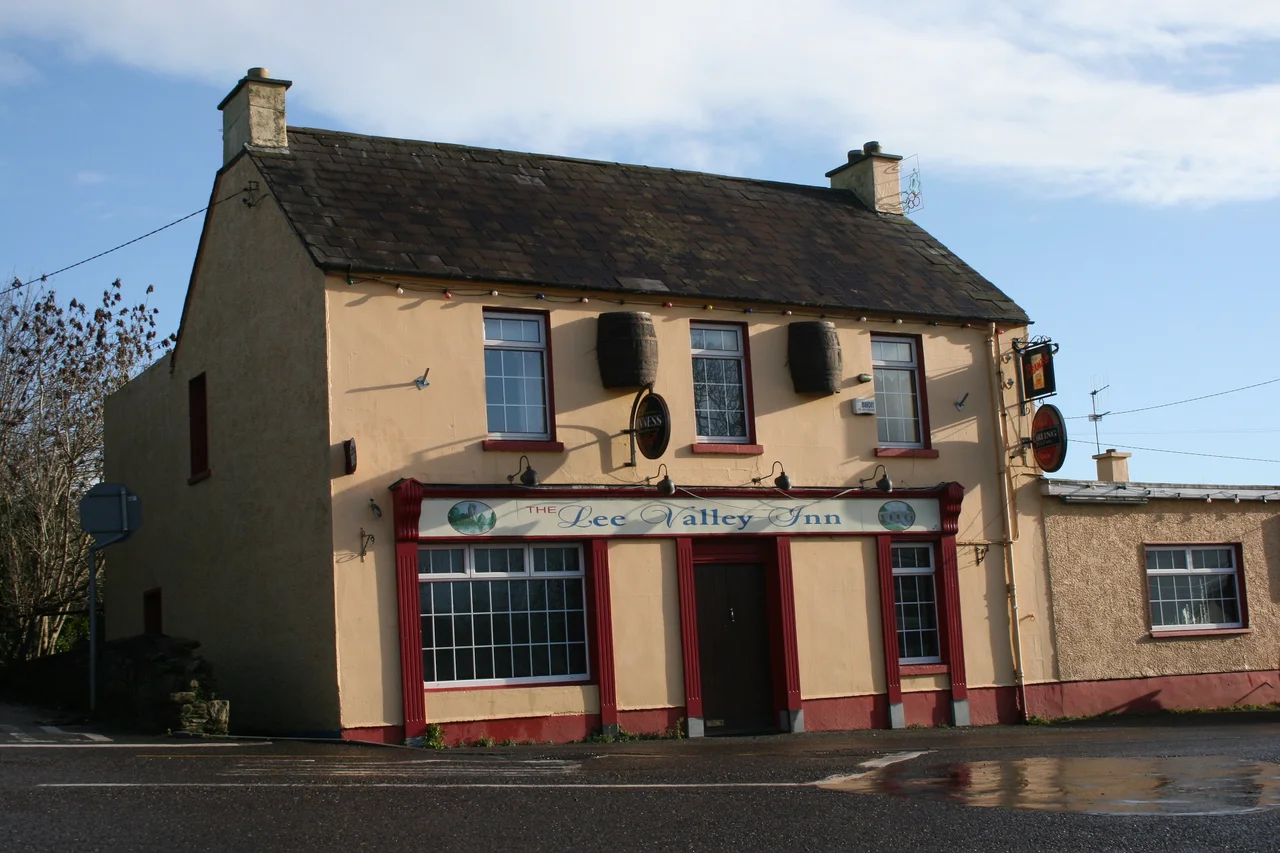
For nine years between 1999 and 2007, the village of Dripsey held the Guinness world record for the shortest Saint Patrick's Day parade. It measured 23.4 metres - the distance between the front doors of the village's two pubs, The Weigh Inn and The Lee Valley. Then The Lee Valley closed, and there was no second pub to walk to, and the record ended. This is the kind of place Dripsey is. The kind that names its parade after the distance to the next pint. But Dripsey is also the kind of place where the IRA waited in winter mud for a British convoy in January 1921, and where a woman called Mary Lindsay walked to Ballincollig Barracks to tell what she knew, and where seven people died as a result. Both things are true. The village holds them at the same time.
Muddy river, model village
The name itself is hydrological. Dripsey comes from the Irish Druipseach, meaning muddy river - a literal description of the Dripsey, a tributary of the Lee that runs through a deep, well-wooded glen south of the village. The village has three parts. Lower Dripsey, Dripsey Cross, and the Model Village. The Model Village is the most populated section, and the name appears in the census records up to 1966. It got that name not from any planned ideal but because it grew up around a mill. In the early 1800s, a paper mill in the glen employed 400 people on a six-acre site. Samuel Lewis described it in 1837: "situated in a deep and well-wooded glen; the buildings are of handsome appearance." When the paper mill failed in 1864, a woollen mill took over. Sixty cabins called Blackpool housed the workers. A second wave of building in the late 1800s produced the seventy houses people called the Model Village, after the model industrial settlements of England.
Carrignamuck, and the families who came after
Walk the back road to Coachford and a five-storey tower house rises out of the trees. Carrignamuck was built in the 15th century by the MacCarthy Clan of Munster as an outpost of Blarney Castle, securing the western reach of their lordship. In 1650, Cromwell's general Lord Broghill battered the tower's eastern wall and took it. The MacCarthys did not return. The Colthurst family bought the estate and, in the 18th century, built a country house called Dripsey Castle a hundred metres from the older ruin - a Georgian seat looking out across the lands their ancestors had won by force. The Colthursts gave way to the O'Shaughnessys, who held the estate through much of the twentieth century. Andrew O'Shaughnessy, who owned the woollen mill and served as an MP from 1924, lived there until his death in 1956. The house sold in 2015 to a UK-based buyer with Cork connections. The mill closed in the early 1980s. The two towers - medieval and Georgian, ruined and inhabited - still stand a hundred metres apart, marking nine hundred years of one valley's history.
Godfrey's Cross, 28 January 1921
On the afternoon of 28 January 1921, an IRA ambush party was waiting at Godfrey's Cross, halfway between Coachford and Dripsey, for a British convoy that regularly used the road between Ballincollig Barracks and Macroom. News of the ambush had leaked. A local woman, Mrs Mary Lindsay, drove to Ballincollig and told Colonel Dowling, the commanding officer, what she had heard. The British column left the barracks around 3pm, dismounted at Dripsey, and surrounded the ambush position from multiple sides. The IRA scouts saw them and raised the alarm. The officer in charge ordered a withdrawal; firing broke out anyway. Five wounded IRA volunteers and three uninjured ones were captured, along with two civilians. The military tribunal at Victoria Barracks tried them in February. The two civilians and one volunteer, Jeremiah O'Callaghan, were acquitted. The remaining defendants were sentenced to death. Captain James Barrett, badly wounded, died a prisoner in March 1922. Volunteer Denis Murphy's death sentence was commuted to twenty-five years. Mary Lindsay and her servant James Clarke were taken hostage by the IRA in an attempt to bargain for the lives of the condemned men. When the executions went ahead in mid-March, Lindsay and Clarke were killed by their captors. The monument on the road from Dripsey to Coachford names the IRA volunteers. Lindsay and Clarke have no such marker.
What is left, what continues
The woollen mill on the Dripsey River exported blankets, bedspreads and tweeds to Britain, New Zealand, Canada and the United States from 1876 until the early 1980s. When it closed, the Model Village kept its name. The water treatment plant still draws from the river. The Cork offices of the Environmental Protection Agency are headquartered in the village. The award-winning Dripsey Garden Centre brings visitors from across the county on weekend afternoons. There is one pub now where there used to be two. There is a primary school and a pre-school. In 2009, the local hurling club won both the Junior B County final and the Junior All-Ireland - the latter after beating Tullogher Rosbercon of Kilkenny - and the village put up bunting. The Saint Patrick's Day parade has not resumed. Without the second pub, it has nowhere to go.
From the Air
Dripsey lies at 51.9167 N, 8.7500 W in the Lee Valley about 20 km west of Cork city, on the R618 between Coachford and the city. The Dripsey River runs north-south through the village to meet the Lee. Carrignamuck Tower House and the Georgian Dripsey Castle stand together about 1 km south of the village core. The wooded glen of the old mill site is the most prominent natural feature from the air, cutting south through the rolling pasture. Cork Airport (EICK) is 18 km southeast. Recommended viewing 1,000-2,500 ft AGL. In clear conditions the village's Model Village layout - terraced workers' housing in regular rows - is distinctly visible against the surrounding farmland.
Nearby Stories
- Ballyvourney 1.6 km away
- Castlemartyr 3.9 km away
- Ballybeg Priory 4.1 km away
- Kilbrittain 5.2 km away
- Shanbally Castle 10 km away
- Skibbereen 17 km away
- Castleisland 22 km away
- SM U-27 118 km away