
Drossinis Museum
The villa is called Amaryllis, and Amaryllis was never a real woman. She was a character in one of Georgios Drossinis's earliest and most popular works, and the poet loved her enough to name his last home after her. He died here in 1951, and the house in the leafy Athens suburb of Kifisia became a museum to a man who spent his life fighting over a single, surprising question: which Greek should Greeks actually write in?
The Battle Over a Language
It sounds like an odd thing to fight about, but in the 1880s it shook Greek letters. The written language of the elite was katharevousa, an artificial "purified" Greek that reached backward toward the ancients. The language people actually spoke was Demotic. Drossinis, born in 1859, joined with Costis Palamas and Nikos Kampas to found the New Athenian School, the literary "1880s Generation" that renewed Greek literature and fought to make the living, spoken tongue the language of poetry. It was a campaign for the soul of how a nation expressed itself, and Drossinis spent his long career on its front lines, as poet, editor, and tireless man of letters.
The Almond Tree Still Blooming
Drossinis's most famous poem was inspired by his cousin Drosina. He called it Anthismeni Amygdalia, "Blooming Almond Tree," and it was set to music almost immediately. More than a century later, Greeks still sing it. In the museum's largest and most affecting room, the Folk Hall, the people of his poems stand in life-size clay, most sculpted by Angeliki Vlachopoulou. Here is Drosina, and Amaryllis, and Ersie, the heroines of his stories. Here too is Morfoula, a tenant farmer's daughter on his family's land in Evia, whom he met as a young man and for whom he wrote his favorite poem, To Moiroloi tis Omorfis, "The Beauty's Lament." Fiction and memory share the same room.
A Working Life in Print
The Intellectual Hall holds the other Drossinis, the engine of Greek publishing. He was editor-in-chief of Estia, the newspaper that ran daily from 1894 and shaped Greek public life. He launched and edited a small library of journals aimed at the intellectual rebirth of his people, from the Journal of Great Greece to New Greece and National Education. With Demetrios Vikelas, the first president of the modern Olympic movement, he co-founded the Society for the Propagation of Beneficial Books and served as its lifelong secretary. Manuscripts, his correspondence with thinkers at home and abroad, and shelves of the books he wrote and edited fill the room. From a high post in the Ministry of Education, he poured himself into schooling, writing readers and fairy tales for children with a teacher's care.
The Man Among His Things
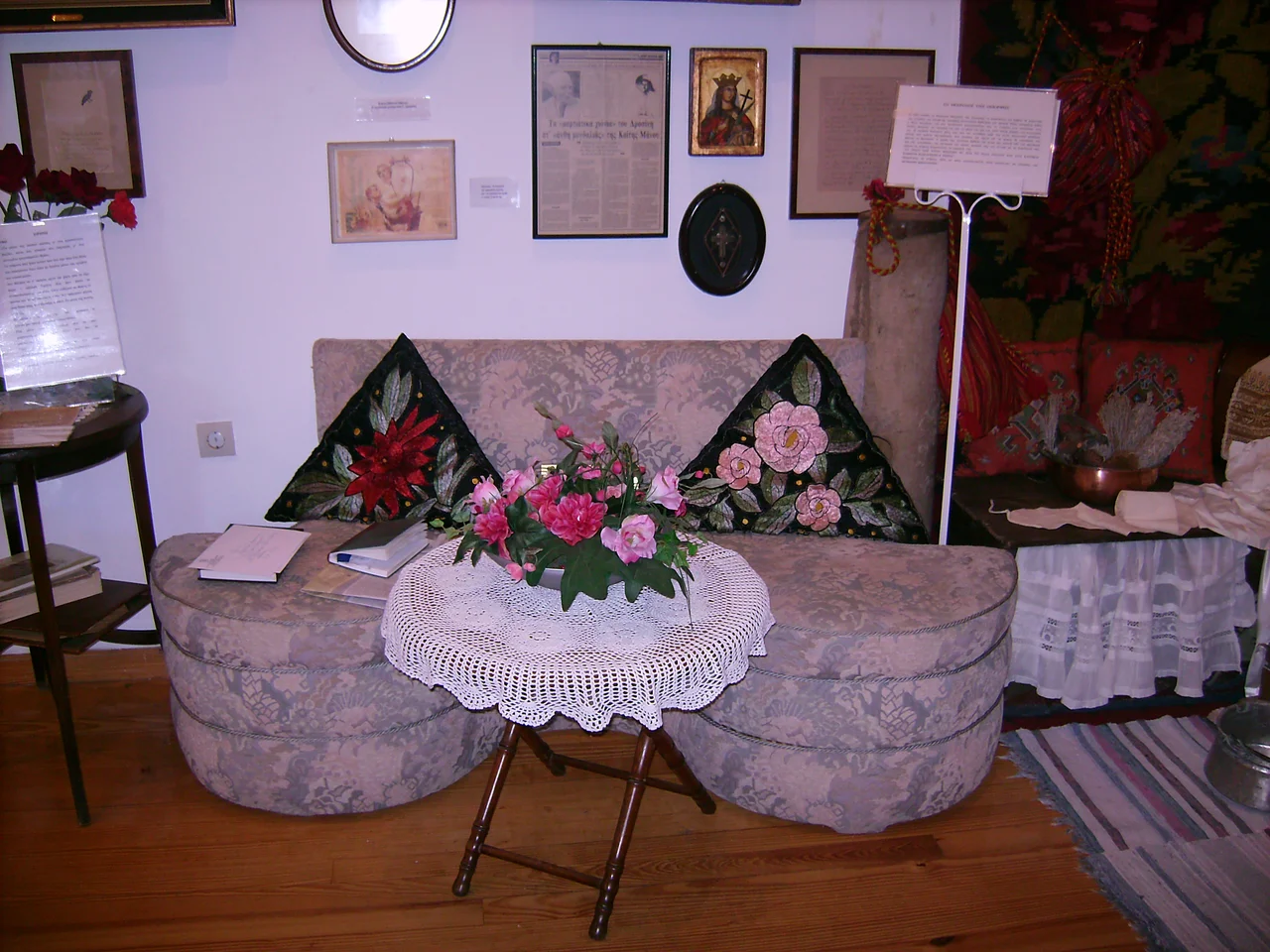
The third room is the most intimate. It is the Emotional Hall, set in Drossinis's own bedroom, and visitors often feel the poet has only just stepped out. Photographs of Mesolonghi, his family's ancestral city, hang beside images of friends and family. Fishing and hunting gear speaks of a deep love of nature; he wrote books about both. Religious icons mark a sincere faith. At the center, sculptor Angeliki Vlachopoulou portrayed him seated in his armchair in old age, surrounded by the world he made. A small sofa nearby recalls Kate Manou, his last muse, and his appetite for life right to the end. Below it all, on the ground floor, is the Municipal Library of Kifisia, placed there by Drossinis's own wish, so that books and readers would always share his house.
From the Air
The Drossinis Museum sits in central Kifisia, an affluent green northern suburb of Athens, at roughly 38.07°N, 23.81°E, at the foot of Mount Pentelikon. From the air the area reads as a band of dense tree cover and low villas distinct from the harder urban grid closer to the city center, with the marble-quarried flank of Pentelikon rising to the east. Nearest airport is Athens International (LGAV), about 26 km to the southeast. Clear, dry Attic weather offers the best views north toward the mountain and south across the Athens basin.
Nearby Stories
- Great Sand Beach 5 km away
- Battle of Delium 7.7 km away
- Tower of Aliartos 9 km away
- HMHS Britannic 10 km away
- Saronic Gulf 15 km away
- Sousaki Volcano 17 km away
- Sanctuary of Apollo Maleatas 24 km away
- Skyros 66 km away