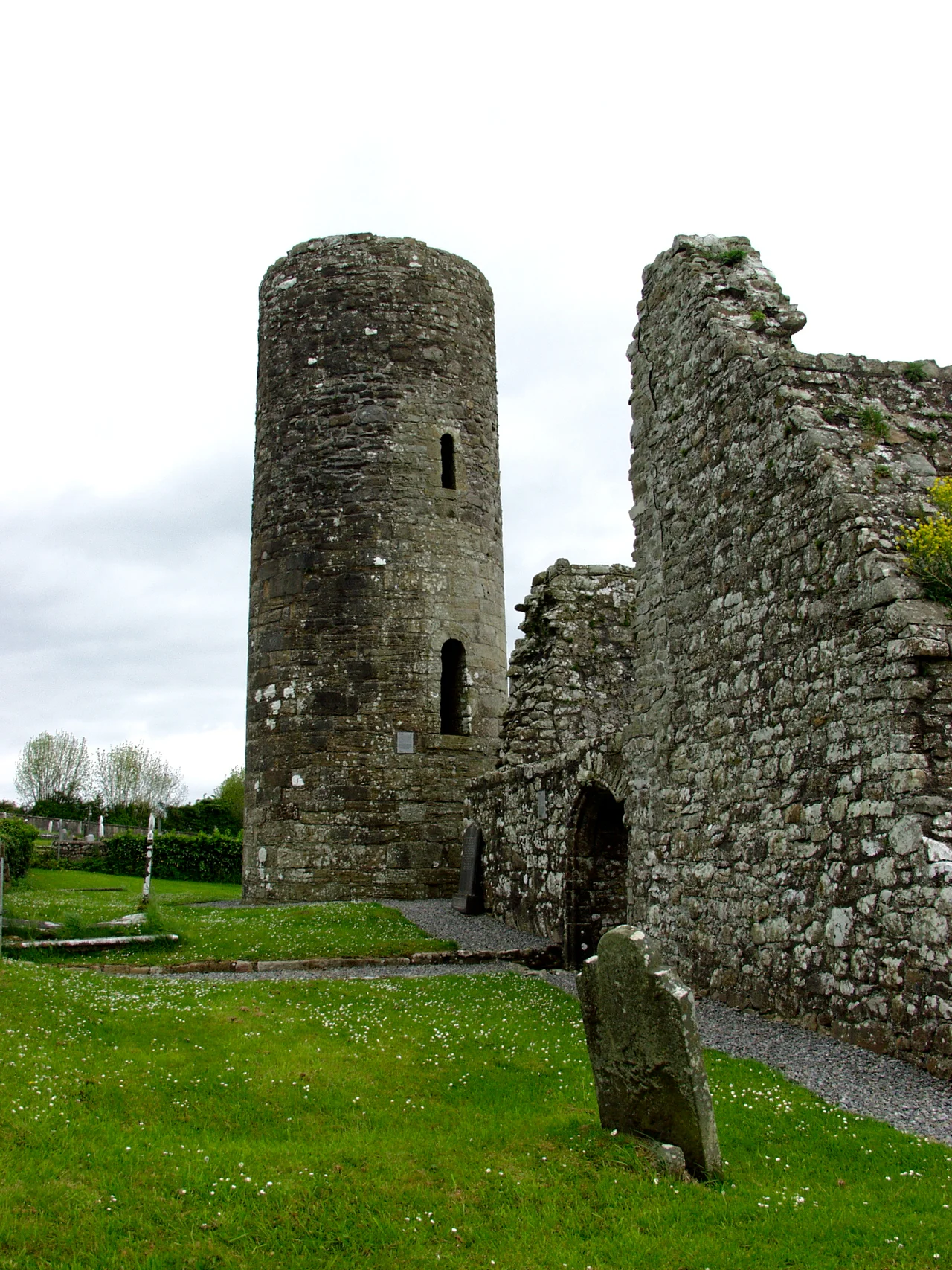

Drumlane
Saint Columba is said to have brought Christianity to Drumlane in the year 555. A century later, Saint Mogue made the Connachta nobleman Faircheallaigh its first abbot, and the Faircheallaigh family — anglicised long afterwards as Farrelly — would supply the abbots of Drumlane for the next nine hundred years. There is a 12-metre round tower standing here still, beside the ruined nave of an Augustinian priory, in the middle of the drumlin country of west Cavan. Most visitors who find it have to be looking for it. The Vikings burned it in 836. Rival clans burned it again in 1246. Henry VIII confiscated it in 1539. It is still standing.
The Field of Drumlins
Drumlane takes its name from the landscape: a *drumlin* is a low rounded hill formed of glacial till, and Cavan is one of the most extensively drumlin-covered counties in Ireland — soft ribbed moraines laid down by the last ice age, scattered with lakes and oak woods. The townland sits near the village of Milltown, and the surrounding townlands all carry names that begin with *drum* ("ridge") or *derry* ("oak grove"). The crannogs in nearby Derrybrick Lough — man-made islands used for protected living — show that people had been farming this country for two thousand years before Columba arrived. The site Drumlane occupies was already significant when Christianity reached it. The earliest monastery was built of wood from those oak forests, and burned and rebuilt many times before stone replaced timber in the twelfth century.
Between Two Breifnes
Drumlane stood on the borderline between East Breifne (the O'Reillys' country) and West Breifne (the O'Rourkes' country), and the priory served as both spiritual centre and burial place for chiefs of both clans. This was not always a peaceful arrangement. In 1246 the church was burned in a feud between the O'Rourke lords of West Breifne and the O'Reillys of East Breifne. In 1261 Hugh O'Conor, King of Connacht, fought Hugh O'Reilly at Drumlane. Battles flared again in 1314 and 1338 — the O'Conors and the O'Rourkes defeated the O'Reilly clan repeatedly. Peace finally came in 1391 with a division of Breifne into separate lordships. In 1487, Fergal O'Reilly was killed in an internal clan feud and buried at Drumlane; in retribution, the town itself was burned to the ground. The priory rose again each time, an Augustinian institution that had become the richest ecclesiastical foundation in Cavan — thirty-two polls of land, around eight hundred acres of pasture and arable.
The Round Tower and the Carved Heads
What stands today is the buttressed ruin of the priory church and its round tower. The tower is 11.6 metres tall and 15.8 metres around the base, the only surviving round tower in the Church of Ireland Diocese of Kilmore. The church itself measures 32.6 metres long by 6.1 metres wide inside — a nave and screened chancel that grew over centuries in fits and starts. You can read the architectural history off the walls: round-headed twelfth-century windows on the round tower; the dog-tooth Romanesque doorway on the west front; hooded Gothic arches added in the thirteenth century; and a flamboyant tracery east window from the fifteenth. On the outside of the east window, two heads are carved into the stone — a bearded king and his queen, perhaps twelfth-century benefactors of the church — alongside the head of a bishop or abbot. Inside the church a richly carved tomb slab leans against the north wall, and fragments of Romanesque chevron decoration suggest there was once a far grander cloister attached to the priory.
Confiscated and Abandoned
Drumlane's official medieval life ended in 1539 when Henry VIII dissolved the monasteries. The priory was confiscated to the Archbishop of Dublin and later leased to the O'Reilly family for a nominal rent, which they declined to pay in full. By 1583 the estate had been forfeited and broken up. The church itself was re-granted to the new Anglican Diocese of Kilmore and used for Protestant worship for nearly two centuries. A replacement church called St Columba's was built nearby around 1820, and the old Drumlane church was un-roofed and abandoned. It went into State ownership as a National Monument in 1882 and is now under the stewardship of the Office of Public Works.
Names That Outlasted the Buildings
What survives at Drumlane, alongside the round tower and the ruined nave, is one of the most complete records of religious continuity in Ireland — abbots, priors, and parish priests recorded by name back to the seventh century. Faircheallaigh, abbot in 624. Conchobhar, abbot in 965 (after the records lost in the burnings). A long line of Magaurans and Magaghrans and Ó Faircheallaighs. A summer 2021 geophysical survey by the local Drumlane History and Heritage Group identified the buried footprint of a substantial ecclesiastical building about a hundred metres south of the church — almost certainly the rest of the priory complex, including a chapel and the canons' accommodation, still waiting under a Cavan pasture field. The old graveyard around the ruins is still used by local families, with headstones reaching back to the eighteenth century. Drumlane has been holding its people for fourteen hundred years.
From the Air
Drumlane lies at 54.06°N, 7.48°W in west-central County Cavan, near the small village of Milltown. From cruise altitudes of 3,000–5,000 ft the round tower and ruined nave are visible as a distinct grey shape on a low ridge in the drumlin landscape; Lough Oughter and its many small islands lie a short distance south. The nearest controlled airspace is Belfast (EGAA), about 105 km northeast; Dublin (EIDW) lies south. Knock (EIKN) is to the west. Conditions are usually marginal VFR — low cloud, drizzle — so plan for it. Clear days reveal one of Ireland's most spectacular concentrations of small loughs, drumlin hills, and surviving monastic ruins.
Nearby Stories
- Clonfin Ambush 3.5 km away
- Lisgoole Abbey 4.7 km away
- Tulsk 11 km away
- Carrick-on-Shannon 12 km away
- Abbey of Kells 12 km away
- Bailieborough Castle 14 km away
- Belleek, County Fermanagh 18 km away
- City Status in Ireland 24 km away