_(cropped).JPG)
Duchy of Athens
For two and a half centuries, the Parthenon was a Catholic church. The temple Pericles raised to Athena, already converted to an Orthodox shrine of the Virgin, rang with Latin Mass under a French lord who called himself the Sire d'Athènes. The Greeks who lived below the Acropolis had their own name for him: Megas Kyris, the Great Lord. This was Athens after 1205, a city ruled not by Greeks or Byzantines but by crusaders who had taken a wrong turn on the way to Jerusalem.
How a Crusade Took Athens
The Fourth Crusade was meant to liberate the Holy Land. Instead, in 1204, it sacked Constantinople and carved up the Byzantine Empire among Western adventurers. One of them was Otto de la Roche, a minor knight from Burgundy. As the dust settled across Frankish Greece, Otto found himself master of Attica and Boeotia, the ancient heartland of Plato's city. He never bothered with the grander title at first, styling himself simply Lord of Athens. Yet from the foundation of his duchy in 1205, everyone called him duke anyway, and the title was made official only in 1260. The de la Roche family that he founded would rule for a century, and they did something unexpected for conquerors: they made Athens flourish.
A Palace on the Sacred Rock
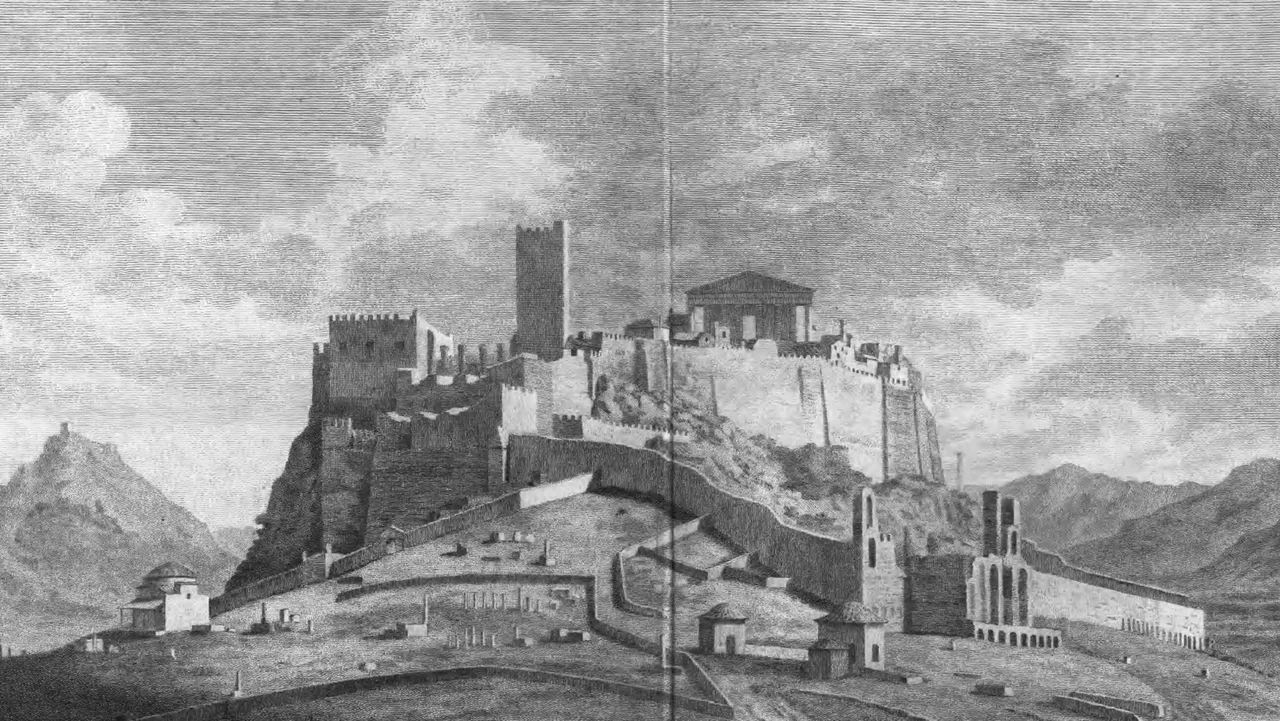
The dukes did not build a new castle. They moved into the Acropolis. The Propylaea, the marble gateway through which ancient processions once climbed to Athena's altar, became the entrance hall of a feudal court. The buildings of the sacred rock served as the ducal palace, and the Parthenon itself, long since the Orthodox church of the Theotokos Atheniotissa, was rededicated as the Catholic Church of Saint Mary of Athens. Pope Innocent III confirmed the first Latin archbishop, Berard, in all the rights of his Greek predecessors. The customs of the church of Paris were imported wholesale, though few Western clergymen relished being sent to so distant a see. Beneath this Latin overlay the Greek Orthodox church survived, illegal and unofficial, its clergy worse educated than before but unbroken.
The Catalans Who Killed Their Employer
The peace ended in blood. In 1308 the duchy passed to Walter V of Brienne, who hired the Catalan Company, a band of hardened mercenaries founded by the freebooter Roger de Flor, to fight his wars in Greece. When victory was won and Walter tried to dismiss the Catalans and cheat them of their pay, he made a fatal miscalculation. In 1311, at the Battle of Halmyros, the Catalans turned on him. They slew Walter and the flower of the Frankish nobility on the field, then simply kept the duchy for themselves. Overnight, Athens passed from French to Catalan hands. French gave way to Catalan as the language of the court, and the feudal law of the Assizes of Romania was replaced by the Customs of Barcelona.
Florentines, Then the End
The Catalans ruled under the distant crown of Aragon until 1388, when the Florentine banking family of Acciaioli seized Athens with Navarrese help. Nerio Acciaioli and his heirs governed a city that had now changed masters three times without a single Greek among them. Venice held the duchy briefly, the Florentines returned, and in 1444 Athens became a tributary of Constantine Palaeologus, the last man who would wear the Byzantine crown. The reprieve was short. In 1456, three years after Constantinople fell, the Ottoman general Turahanoğlu Ömer Bey conquered the remnants of the duchy. Yet the title proved stubbornly immortal: "Duke of Athens and Neopatras" lived on among the Kings of Sicily and, through them, the Kings of Spain, who carry it to this day.
The Forgotten Centuries
Shakespeare gave Theseus the title Duke of Athens in A Midsummer Night's Dream, a faint echo of this real, strange chapter that most visitors to the Acropolis never learn. For 250 years the rock above Athens was a medieval European castle, its fortifications expanded under the de la Roche and Acciaioli lords. A tall Frankish tower rose beside the Propylaea and stood until 1874, when it was finally pulled down to restore the classical view. The crusaders who never reached Jerusalem left their mark not in scripture but in stone, ruling the cradle of democracy as a fief of chivalry until the Ottomans closed the book.
From the Air
The Acropolis of Athens sits at approximately 37.97°N, 23.72°E, the marble centerpiece of the modern city. From the air the limestone rock with the Parthenon atop it is unmistakable, ringed by the dense low sprawl of central Athens with Mount Lycabettus rising to the northeast. The nearest major airport is Athens International (LGAV), about 33 km east-southeast; downtown helicopter and small-aircraft traffic stays well clear of the historic core. Best viewing on the clear, dry days typical of the Attic summer, when visibility across the Saronic Gulf is excellent.
Nearby Stories
- Great Sand Beach 5 km away
- Battle of Delium 7.7 km away
- Tower of Aliartos 9 km away
- HMHS Britannic 10 km away
- Saronic Gulf 15 km away
- Sousaki Volcano 17 km away
- Sanctuary of Apollo Maleatas 24 km away
- Skyros 66 km away