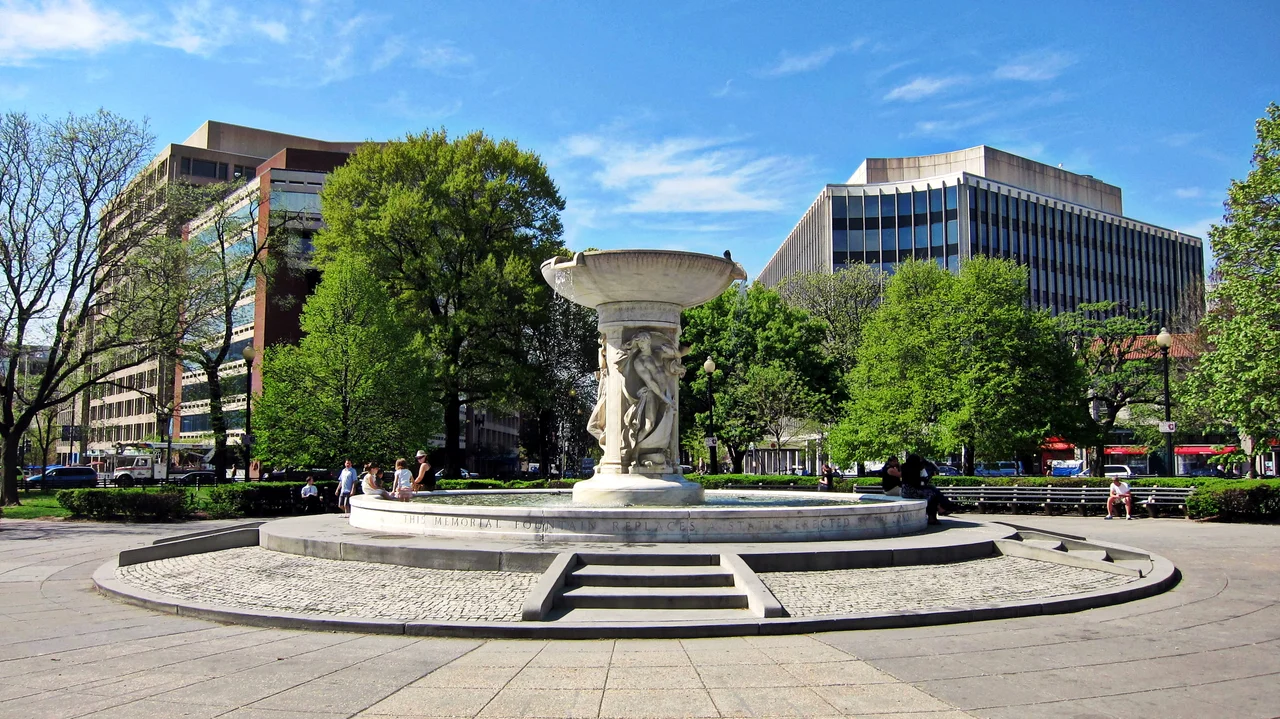

Dupont Circle Fountain
The same two men who made the Lincoln Memorial also made this fountain. Henry Bacon, the architect, designed the marble shell. Daniel Chester French, the sculptor whose seated Lincoln watches the Mall from inside Bacon's temple, carved the three allegorical figures who hold up the upper basin. The Sea, the Stars, the Wind. They face out in three directions across a busy traffic circle in northwest Washington, eight feet tall, twelve tons of marble apiece. The fountain has stood at the center of Dupont Circle since 1921. It replaces an earlier bronze statue of the man whose family paid for the marble. The statue is in a park in Delaware now. The fountain stayed.
An Admiral and a Failed Attack
Rear Admiral Samuel Francis Du Pont was born into the chemical and gunpowder family in 1803 and joined the Navy as a midshipman at the age of twelve. By the Civil War he was one of the senior officers in the service. He led the squadron that captured Port Royal Sound in South Carolina in November 1861, securing one of the most important Union footholds on the Confederate coast and making the naval blockade actually effective. His career stalled in April 1863 when he led a fleet of ironclad monitors against Charleston Harbor and was repulsed. Du Pont himself believed the operation had been politically forced on him before the ironclads were ready, and he wrote bitter private letters defending himself. The naval high command disagreed. He was relieved of command, never received another at sea, and died in Philadelphia in 1865, the year of the war's end. He was sixty-one. The defeat at Charleston shadowed his reputation for the rest of his life and beyond.
Pacific Circle Becomes Dupont
The Army Corps of Engineers began laying out the traffic circle at the intersection of Massachusetts, Connecticut, and New Hampshire Avenues in 1871. It was called Pacific Circle at first because it sat at the western edge of the city's residential development. In February 1882 Congress renamed it for Du Pont and authorized a memorial statue. The bronze figure of the admiral, by Launt Thompson, was dedicated on December 20, 1884 at a cost of $20,500. President Chester Arthur attended, along with Senator Thomas Bayard, Admiral David Dixon Porter, and General Phil Sheridan. The circle around it was landscaped with exotic plants and several hundred trees. For the next thirty years, the bronze admiral stood at the center of one of Washington's most fashionable residential neighborhoods, watching carriages roll past.
The Family Replaces the Statue
Within a generation, the Du Pont family decided the bronze statue was not the memorial they wanted. The admiral's niece, Senator Willard Saulsbury Jr.'s wife, led the campaign for replacement. The family insisted on two conditions: no government funds, and the Commission of Fine Arts must approve the design. Congress agreed in February 1917, and the family hired Henry Bacon and Daniel Chester French, then at the peak of their careers as the team designing the Lincoln Memorial (which was under construction from 1914 to 1922). Bacon designed a Beaux-Arts marble fountain harmonized with the neighborhood's existing neoclassical mansions, especially the nearby Patterson Mansion. French carved the three Arts of Ocean Navigation supporting the upper basin. The bronze admiral was disassembled and shipped to Rockford Park in Wilmington, Delaware, the Du Pont family's hometown, in 1920.
Sea, Stars, Wind
The completed fountain was dedicated on the afternoon of May 17, 1921 in a ceremony described by reporters as simple but impressive. First Lady Florence Harding attended. So did Secretary of War John Weeks and Secretary of the Navy Edwin Denby. Sailors served as ushers. The Navy Band played, the public was let in, and the surrounding park filled. The double-tiered fountain is white marble on a concrete base. The upper basin is about three feet high and eleven and a half feet across, weighing fifteen tons. The shaft supporting it weighs another eight tons. The three allegorical figures, each eight feet tall and weighing twelve tons, represent the elements a nineteenth-century naval officer worked with: the Sea, holding a ship; the Stars, looking up to navigate; and the Wind, billowing a sail.
The Streetcar Years and After
In 1949 the District began building a streetcar underpass beneath Dupont Circle to relieve the traffic that already congested the intersection. The fountain was carefully disassembled and put in storage. Two years later, when the underpass was complete, the marble was reassembled in its original location. The plumbing system was replaced at the same time. The workers reinstalling the fountain forgot one detail: they did not connect the new pipes to the basin. The fountain stood dry for a year before someone noticed the error and fixed it. The streetcar tunnel was closed when Washington's streetcar system was shut down in 1962, and the underpass has had various uses since, including a brief stint as a food court in the 1990s. The fountain has run continuously since 1951. The Dupont Circle Fountain is one of eighteen Washington Civil War monuments collectively listed on the National Register of Historic Places in 1978. The National Park Service maintains it. Office workers eat lunch around it. Buskers play to its rim. The Sea, the Stars, and the Wind have not moved in over a hundred years.
From the Air
Dupont Circle is at 38.9095 degrees north, 77.0434 degrees west, at the intersection of Massachusetts, Connecticut, and New Hampshire Avenues in northwest Washington. Best viewed at 1,500 to 2,500 feet AGL with the diagonal converging avenues clearly visible. Reagan National (KDCA) is four nautical miles south across the Potomac. The site sits inside the P-56 prohibited area; viewing is from authorized riverside approaches.
Nearby Stories
- Gunston Hall 1.1 km away
- 2023 Baltimore Shooting 4.9 km away
- Battle of Middleburg 6.6 km away
- Crownsville Hospital Center 10 km away
- Battle of Loudoun Heights 13 km away
- First Battle of Rappahannock Station 20 km away
- Howard County, Maryland 21 km away
- Harriet Tubman Underground Railroad 50 km away