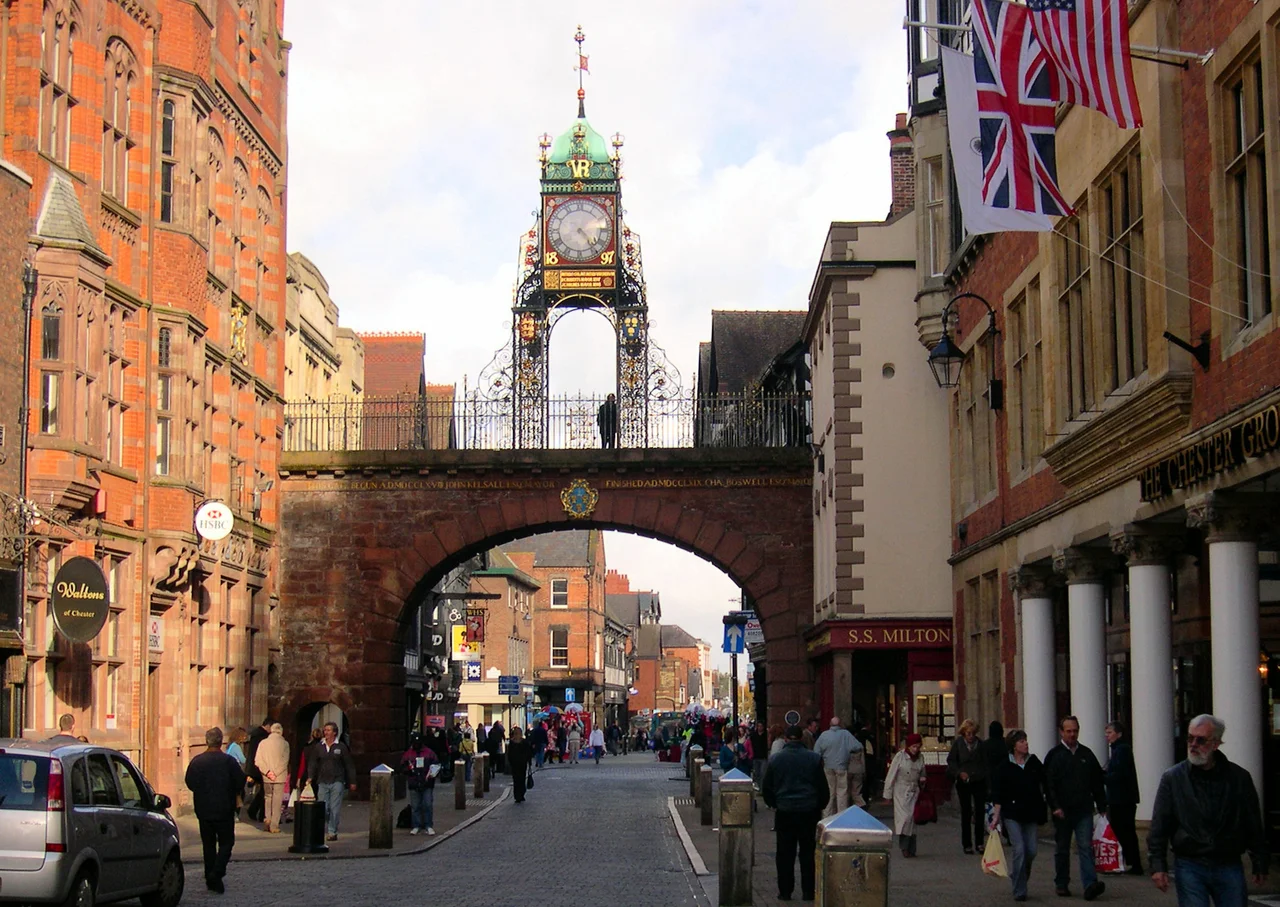

Eastgate, Chester
Cameras outnumber locals on the steps below the Eastgate clock most afternoons. The clock has stood there since 1899, its four faces watching over a junction the Romans surveyed in the first century, and it is said to be the most photographed timepiece in England after Big Ben. People queue for the angle, the one that catches the wrought iron cupola against Chester's red sandstone. They have been queuing for it since cameras were heavy boxes on wooden tripods.
A Roman Front Door
Chester was founded around AD 74 or 75 as the Roman fortress of Deva Victrix, a rectangle with rounded corners on the navigable head of the River Dee. The east gate was the most important entrance from the start; the road through it ran to Manchester and then over the Pennines to York. Just outside, to the north, lay the parade ground where the Twentieth Legion drilled. The first gate was timber. By about AD 100 the Romans had reinforced the defences with sandstone, rebuilding the gate and its towers in stone, and the line of that wall has been the line of Chester's wall ever since.
Layers of Stone
In 907, the Saxon kings of Wessex refounded Chester as a burh, and the Roman gate was probably still standing. By the medieval period the Eastgate had been rebuilt as a tall rectangular tower with octagonal corner turrets, the design perhaps influenced by Caernarfon Castle, which dates its construction most likely to the early fourteenth century. An excavation in 1971 found a portion of the northern flanking turret, carved from cream-coloured sandstone instead of the red that the rest of the city favoured. Outside the gate, excavators in 1991 dug down through three ditches: a shallow Saxon trench filled with rubble, a deeper medieval cut, and a later drainage channel. Waterlogged for centuries, the ditches preserved organic materials that almost never survive elsewhere in Chester.
The Earl's Elegant Arch
By the eighteenth century the city walls were no longer defensive. The Cestrians had turned them into walkways, and the medieval gates obstructed the carriages, carts, and packhorses that wanted to get through. Eastgate went first. In 1768 it was rebuilt as a three-arched sandstone structure with balustraded parapets, an "elegant arch" paid for by Richard Grosvenor, 1st Earl Grosvenor, and designed by his surveyor of buildings, a Mr Hayden. The new gate carried the wall walkway over the road below, which was the point: the wall could still circumnavigate the city without forcing pedestrians to detour. That sandstone arch is still what people walk and drive through today.
Diamond Jubilee Ironwork
The idea of crowning the gate with a clock came up first in 1872, when Hugh Grosvenor, then the 3rd Marquess of Westminster, asked the Chester architect John Douglas to draw up designs. The Marquess offered to pay half. The Chester Improvement Committee refused to fund the rest, and the scheme died. It revived for Queen Victoria's diamond jubilee in 1897. The committee considered a statue, a clock in the Town Hall, even a donation to the Queen's Institute of Nurses. They settled on the gate. Douglas's first stone design would have darkened the neighbouring houses, so he came back with openwork wrought iron pylons supporting a clock with a face on each of its four sides, topped by a copper ogee cupola. The clock mechanism was made by J. B. Joyce of Whitchurch in 1897. The cast iron inscriptions came from Coalbrookdale. The ironwork itself was forged by James Swindley of Handbridge, who happened to be John Douglas's cousin.
Eighty Years of Winding
Edward Evans-Lloyd, a Chester solicitor and freeman of the city, paid for the clock faces and mechanism. The tower itself was raised by public subscription. The corporation agreed to maintain it forever. On 27 May 1899, three days after Queen Victoria's eightieth birthday, the clock was formally opened. For the next seventy-five years, J. B. Joyce sent a technician up from Whitchurch every week to wind it; that arrangement ended in 1974, and an electric mechanism replaced the wind-up in 1992. Souvenir hunters once stole the hands, so the council glazed the faces in 1988. The whole structure, gate and clock together, was designated Grade I listed in July 1955. The clock keeps time over a junction where Roman legionaries once watched their parade ground, and the queue at the steps continues to form.
From the Air
Located at 53.191N, 2.889W on the east side of Chester's walled city centre. The Eastgate sits within the rectangle of the Roman wall circuit, recognisable from altitude by its sandstone outline. The clock's copper ogee cupola is too small to spot from cruising height but the city walls themselves form a clear ovoid on the landscape, bisected by the Eastgate Street axis running east to west. Nearest airports: Hawarden (EGNR, 4nm west) and Liverpool John Lennon (EGGP, 18nm north). The River Dee curves south of the city.
Nearby Stories
- Goodison Park 1.5 km away
- First Battle of Middlewich 2.4 km away
- Whittington Castle 4.2 km away
- Worsley 9.5 km away
- Gwrych Castle 14 km away
- Lilleshall Abbey 22 km away
- Cymer Abbey 31 km away
- Celtic Array 70 km away