.JPG)
Eden Hotel
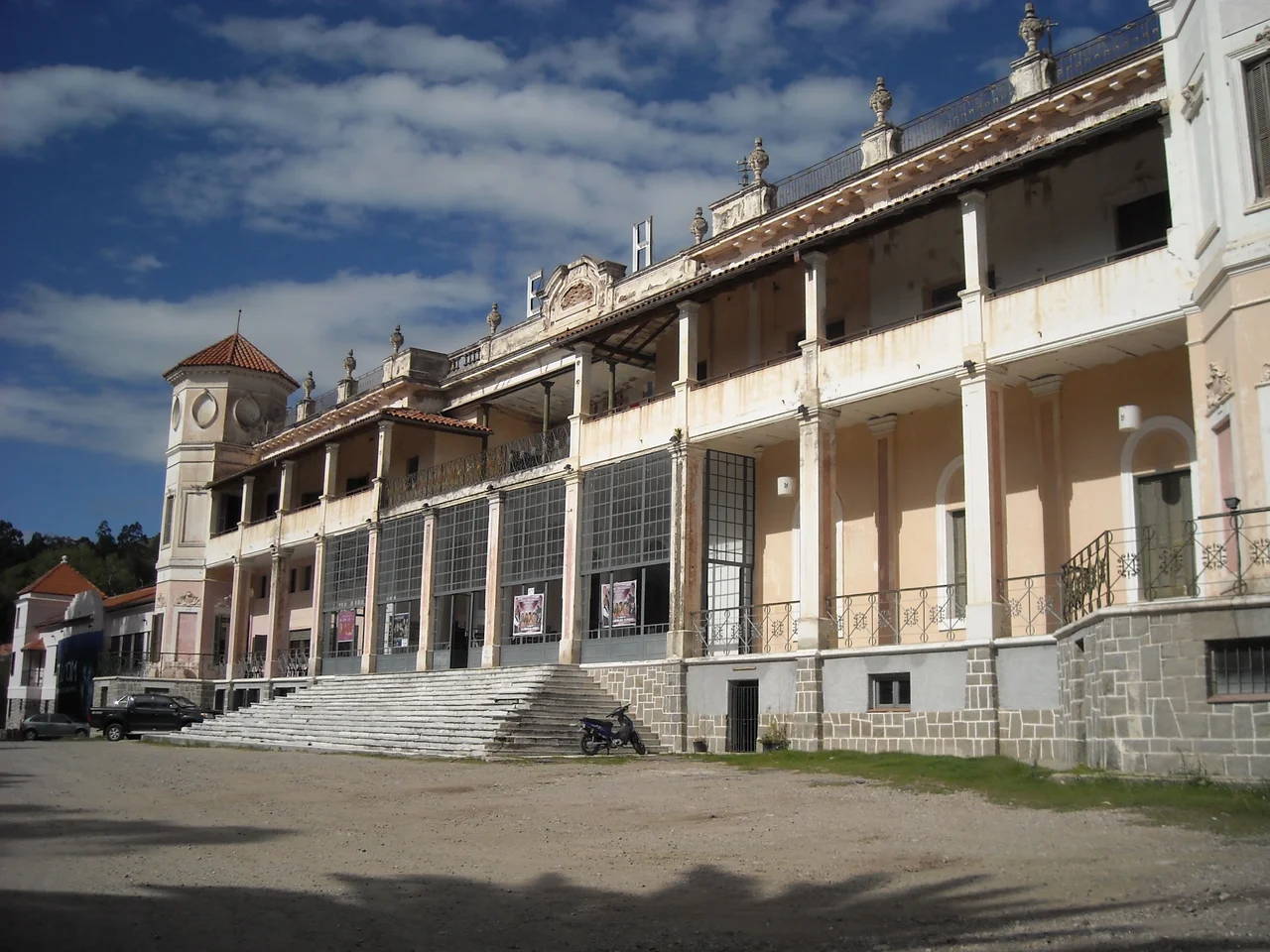
Albert Einstein once slept here. So did Argentine presidents, opera singers, and the European aristocracy who came to take the mountain air. They climbed a staircase of Carrara marble into one of South America's first truly grand hotels, where elevators and central heating were marvels and the dining hall could seat two hundred and fifty. The Eden Hotel was built to dazzle, and for half a century it did. What its guests in the glory years could not have known was who would one day own the place, and what those owners would believe.
A Palace in the Punilla
A German army officer named Roberto Bahlcke raised the hotel in 1897 at La Falda, in the green folds of Córdoba's Punilla Valley. The architecture was unapologetically European: French-inspired towers, German ornamental flourishes, materials shipped across the Atlantic. The ambition was to make this corner of the Argentine sierras into a resort to rival anything in the Old World. At its height the building held a hundred rooms, two winter gardens, a ballroom, a reading room, and balconies looking out over a park planted with imported trees. The early plumbing was almost comically aristocratic, just four bathrooms per floor; later renovations would expand the count to thirty-eight.
The Eichhorns
The hotel changed hands more than once. Its founding company dissolved in 1905 under financial strain, and in time the property came to Walter and Ida Eichhorn, German-Argentines who would define the Eden's darkest chapter. The Eichhorns were not quiet about their politics. They were documented supporters of Adolf Hitler and the Nazi Party, and under their management the hotel became a gathering point for pro-Nazi sentiment in the German-Argentine community, a place where the regime's broadcasts were received with enthusiasm rather than horror. The glittering resort that had hosted Einstein, a Jewish refugee from exactly that regime, now flew its loyalties in a very different direction.
Enemy Property
History caught up with the Eichhorns in 1945. Argentina, which had spent most of the war neutral, finally declared war on Germany, and the government seized the Eden Hotel as enemy property. The grandeur never recovered. A series of attempts to reopen the hotel sputtered and failed, and in 1965 it closed for good. Looters from the surrounding town carried off what they could, and the building slid toward ruin until 1988, when it was declared a historic monument in an effort to halt the decay. The marble staircase still stands, but it climbs now through empty, echoing rooms.
Telling the Truth From the Legends
The ruin has become a destination of a different kind, a centerpiece of what scholars call dark tourism, where decline and mystery draw the crowds that luxury once did. Daytime tours trace the real history and architecture; night tours lean into ghost stories, especially the tale of a girl named Ana said to haunt the halls. Layered over all of it is the most persistent myth: that Hitler survived Berlin and hid here. Researchers at the National University of La Plata have studied how the hotel's marketing blends fact with fable. The honest record is sobering enough. The owners' Nazi sympathies are real and documented. The claim that Hitler himself walked these floors is not, however much a History Channel series enjoyed suggesting otherwise.
What the Ruins Hold
It would be easy to let the Eden Hotel become only a ghost story, all spectral girls and creaking floorboards. The harder truth is the one worth carrying away. This was a place of genuine beauty that chose, through the people who ran it, to align itself with one of history's great cruelties. The visitors who climb the Carrara marble today walk through both the glamour and the complicity at once. The hotel does not let you separate them, and perhaps it should not.
From the Air
The Eden Hotel sits at La Falda in the Punilla Valley at roughly 31.09°S, 64.47°W, about 18 km north of the railway town of Cosquín. From the air it appears as a large rectangular structure with distinctive towers set against the green valley floor, with the Sierras Chicas rising to the west. A viewing altitude of 3,000 to 5,000 feet AGL frames the building and its surrounding park within the valley. The nearest major airport is Ingeniero Aeronáutico Ambrosio L.V. Taravella International Airport (SACO) at Córdoba, roughly 65 km to the south-southeast. Clear, dry mountain air offers the best visibility over the valley.
Nearby Stories
- Battle of San Roque 11 km away
- Battle of San Cala 18 km away
- San José Charterhouse 40 km away
- Mar Chiquita Lake 137 km away
- Battle of Quebracho Herrado 169 km away
- Villa San Agustín 233 km away
- Sierra de las Quijadas National Park 237 km away
- Rafaela 240 km away