
Eden Project
In 1981 the BBC needed a planet. They were filming The Hitchhiker's Guide to the Galaxy and required a setting for Magrathea, the world that built worlds for the very rich. They found their alien landscape in a worked-out china clay pit near St Austell, a great white-grey scar in the Cornish earth. Twenty years later, on 17 March 2001, the same pit reopened as the Eden Project: two clusters of inflated geodesic domes housing rainforest and Mediterranean biomes, the largest such structures on Earth. The clay pit had spent 160 years yielding the white powder that glazes porcelain and coats paper. It would spend its next century yielding wonder.
The Pit That Built Itself
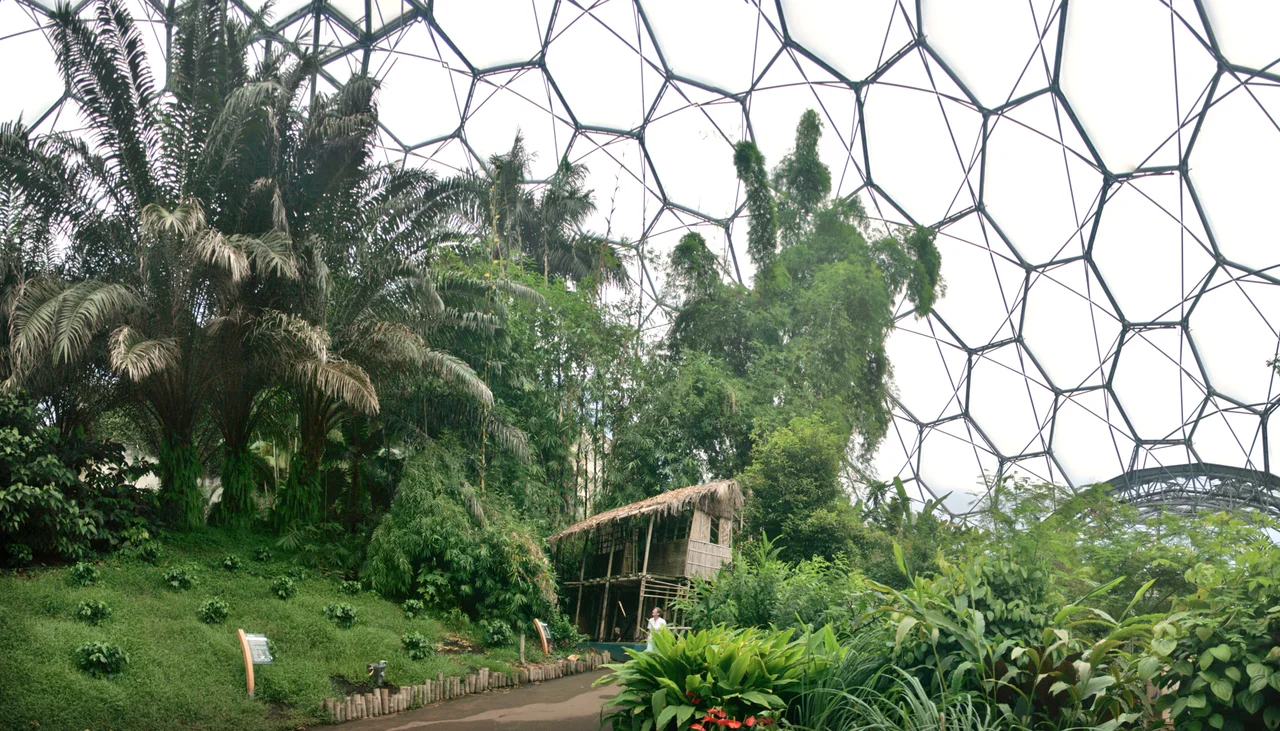
The site is still essentially a hole in the ground, 15 metres below the water table. When construction started in 1998, torrential rain flooded the pit and engineers had to install massive drainage systems before any building could happen. The biomes that rose from the floor were designed by Grimshaw Architects with structural engineering by Anthony Hunt Associates. The Rainforest Biome covers 1.56 hectares, 55 metres high, 100 wide, 200 long, kept tropically warm and damp, housing banana, coffee, rubber, giant bamboo. It is one of the largest indoor rainforests anywhere. The Mediterranean Biome is smaller, 35 metres high, with olives and grapes and warm-temperate species. The domes are not made of glass. Glass is too heavy. Instead each panel is a pillow of ETFE, ethylene tetrafluoroethylene, a thin plastic film inflated into a transparent cushion that acts as a thermal blanket. Some panels reach nine metres across. The whole structure is self-supporting: there are no internal columns. Rain washes the panels clean. Punctures are mended with ETFE tape.
Tim Smit's Garden
The project was conceived by Tim Smit, the record producer turned garden restorer who had already rescued the Lost Gardens of Heligan a few miles east, and Jonathan Ball, an architect. Smit's idea was less a tourist attraction than a botanical argument: that we are all dependent on plants, and we have forgotten it. The plants in the Eden Project are labelled with their medicinal uses, their economic uses, their cultural uses. The water that creates the rainforest's humidity is sanitised rainwater that would otherwise pool at the bottom of the pit; only handwashing and cooking use mains water. The Eden Project runs on Green Tariff electricity, including power from some of the earliest wind turbines in Europe, planted across nearby Cornish hills in the 1990s. In May 2021 drilling began on a geothermal well, nearly three miles down into the granite under the pit. By 2023 it was heating the biomes with 85-degree water pumped from the depths.
Phyllotaxis and the Seed
In September 2005 a third building opened alongside the biomes: the Core, an education centre with a copper roof shaped to the mathematics of plant growth. Grimshaw and the sculptor Peter Randall-Page worked out the geometry from phyllotaxis, the spiral arrangement of seeds in a sunflower head or scales on a pine cone, the Fibonacci spirals that pattern much of the plant world. Inside the Core sits Seed, Randall-Page's permanent installation: a 70-tonne egg-shaped piece carved from a single block of granite quarried at De Lank on Bodmin Moor, thirteen feet tall, its surface covered in protrusions that follow the same mathematical principles. The Core's copper came from traceable sources, part of Eden's wider campaign with Rio Tinto to map ethical metal supply chains. The lesson, repeated everywhere on site, is that plants taught us the patterns first.
Africa Calling and Other Lives
On 2 July 2005 the Eden Project hosted Africa Calling, the African concert in the Live 8 series staged around the world that day to put debt relief on the G8 agenda. Cornish choirs sing in the biomes regularly. The 2002 James Bond film Die Another Day used Eden as a location. The 2021 G7 Summit held an evening event among the domes. Since 2002, the Eden Sessions have brought thousands of music fans to the pit each summer: 2026 sees Pixies, Neil Young, Snow Patrol, Wolf Alice and Mika on the lineup, the biomes glowing as backdrop in the long Cornish dusk. In 2016 Europe's second-largest redwood forest was planted on site: forty Sequoia sempervirens saplings that could live 4,000 years and reach 115 metres. The biggest will outlive the visitors who saw them planted by a great many generations.
The Eden Diaspora
The model travels. Eden Project Morecambe is planned for the Lancashire seafront, with biomes shaped like mussels and a focus on the marine environment, expected to cost 80 million pounds, with the first 2.5 million in UK government funding arriving in July 2024. Eden Project Dundee, on the site of a former gasworks, received planning permission from Dundee City Council in June 2024. Qingdao on China's Shandong coast hosts an Eden focused on water. Eden Project New Zealand was planned for Christchurch but cancelled. The South Downs project remains under exploration. The Eden Project at home, the original, received over a million visitors in 2019, contributed over a billion pounds to the Cornish economy, and weathered both a major landslip in late 2020 and the Covid closures of 2021. It reopened. The biomes still rise from the white floor of the pit. The pit still rains. The forest still grows.
From the Air
The Eden Project sits at 50.36 degrees north, 4.74 degrees west, three nautical miles northeast of St Austell. The white china clay landscape around it is a distinctive feature of mid-Cornwall, visible from altitude as pale heaps and lakes contrasting against green pastureland. The biomes themselves form a cluster of bright bubbles in the depths of a quarry. Newquay Airport (EGHQ) lies twelve nautical miles northwest. Exeter (EGTE) is seventy nautical miles northeast. Best viewing in late morning or early afternoon when sun catches the ETFE panels and the contrast against the surrounding clay tips is sharpest.
Nearby Stories
- Mount Edgcumbe Country Park 2.6 km away
- Tintagel 4.2 km away
- Wheal Trewavas 6.1 km away
- Tehidy Country Park 14 km away
- Battle of Plymouth (1652) 15 km away
- Okehampton Castle 19 km away
- Goonhilly Satellite Earth Station 32 km away
- Action of 17 November 1917 101 km away