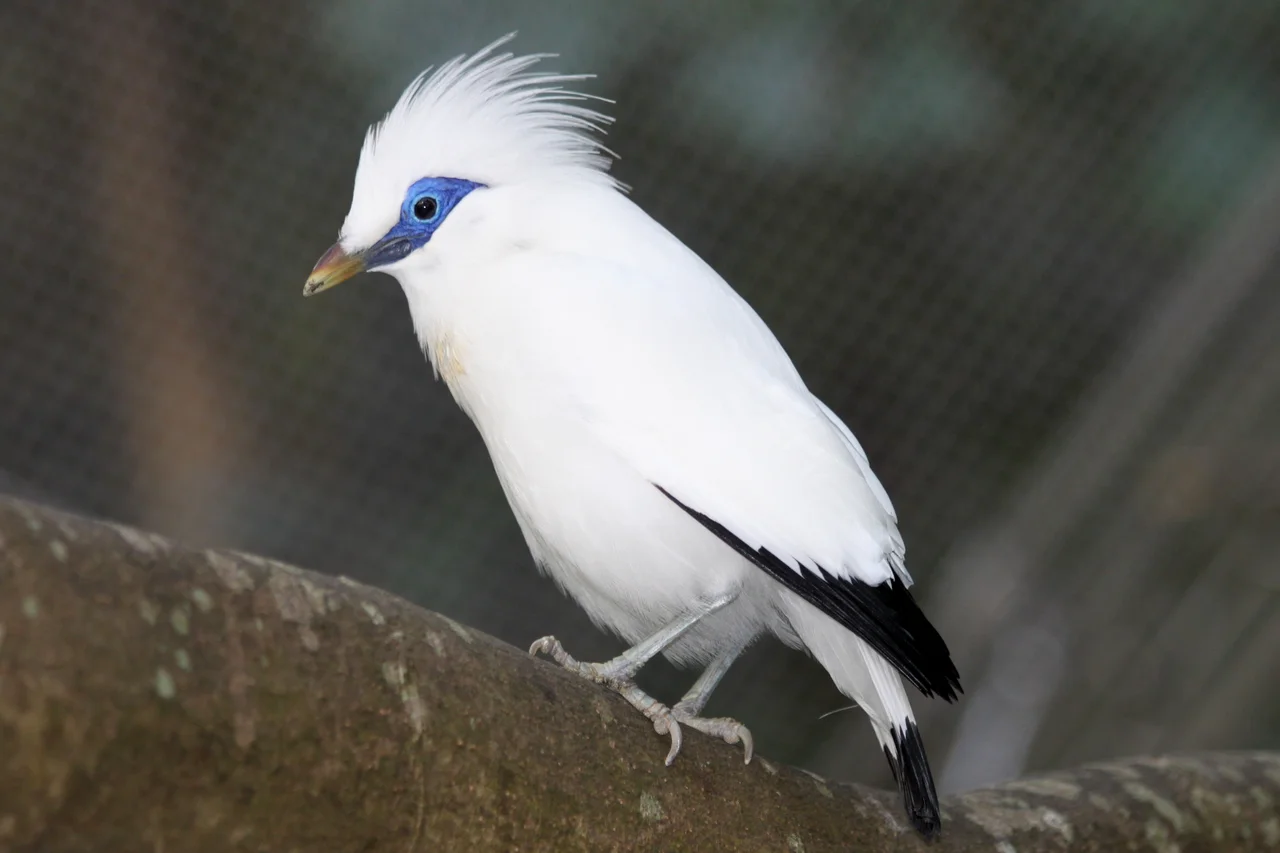

Edward Youde Aviary
A great argus pheasant somewhere above you announces its territory with a ringing call that travels the full 46-metre height of the valley. You're standing not in a forest clearing but in the middle of Central Hong Kong — a city of glass towers and double-decker trams — yet the canopy here is dense enough to muffle the street noise entirely. The Edward Youde Aviary drapes a 3,000-square-metre mesh over a natural valley at the southern corner of Hong Kong Park, and the effect is less zoo exhibit than genuine immersion: you walk the paths, the birds do not.
A Valley Repurposed
The site had a military past before it had feathers. The west-facing slope of the valley was once occupied by barracks, and the land bore the geometry of garrison life rather than natural topography. When Hong Kong Park was developed and the aviary designed in the late 1980s, planners retained the natural east-facing slope with its existing vegetation, letting the terrain itself become the enclosure's architecture. The valley drops from a highest point of 46.5 metres to a floor 16.5 metres lower, and the single mesh structure spans the entire depth. The result is vertical habitat — ground-dwelling pheasants and thrushes forage at the bottom while leafbirds and broadbills occupy the canopy — without the artificial tiers of a conventional bird house.
Six Hundred Wings
Opened to the public in September 1992 and managed at the time by the Urban Council, the aviary houses 600 birds across 80 species, all indigenous to the arc of territory stretching from Southeast Asia through Indonesia to New Guinea. The collection rewards slow walking. Great argus pheasants — which give what ornithologists describe as one of the most elaborate courtship displays in the bird world, fanning spotted tail feathers into an extraordinary wheel — share ground level with partridges and pigeons. Look up and you find the brilliant blue-and-green flash of long-tailed broadbills threading between branches. The entrance building displays a range of eggs, a quiet curatorial touch that frames the scale of avian diversity before you've taken a single step inside.
Hornbills and the Problem of Scale
Not everything can coexist in a walk-through setting. Large hornbills prey on smaller birds, so the aviary addresses the problem head-on: three separate display cages beside the main enclosure house the species that would otherwise thin the collection. Two cages hold the white-crested hornbill and the great pied hornbill respectively — birds whose oversized casqued bills look almost cartoonishly large at close range — while a third presents various species from the Malesian region. The separation is practical rather than punitive, and the close-range viewing the cages allow is, paradoxically, better than what you'd get wandering the open valley.
Pelicans and the Swamp Garden
A waterfowl lake adjoins the aviary through an inner lake, landscaped into a swamp that accommodates species needing standing water and reed margins rather than forest floor. Australian pelicans, great white pelicans, and radjah shelducks occupy the wetland zone, their broad wingspans and unhurried manner offering a complete tonal contrast to the quick, darting birds of the main enclosure. The swamp planting is dense enough to feel genuine rather than designed, and the transition from canopy forest to open water happens in the space of a few steps — a compressed ecological journey that the valley's topography makes possible.
Named for a Governor Who Did Not Leave
The aviary bears the name of Sir Edward Youde, who served as Governor of Hong Kong from 1982 until his death in office in December 1986 — the only British governor of the territory to die while serving. Youde was known for his commitment to the people of Hong Kong during a particularly fraught period: the Sino-British negotiations over the colony's future were conducted largely on his watch. Naming the aviary after him, opened six years after his death, was a deliberate act of civic memory. It is a fitting memorial for a man who spent his final years navigating a city in transition: this place, too, holds something wild within a structure it cannot quite contain.
From the Air
The Edward Youde Aviary sits at approximately 22.2766°N, 114.161°E within Hong Kong Park, just below the north-eastern slope of Victoria Peak (552m). From the air, Hong Kong Park appears as a rectangle of green in the dense urban grid of Central. The nearest major airport is Hong Kong International Airport (VHHH), located on Lantau Island approximately 30km to the southwest. At lower altitudes on approach or departure, the peak and the park's wooded valley are visible as a break in the surrounding skyline. Recommended viewing altitude: 1,500–3,000 feet, approaching from the south over the harbour.
Nearby Stories
- Lok Ma Chau Loop 2.3 km away
- Portas do Cerco 2.3 km away
- Kweilin Incident 17 km away
- Wanshan Archipelago Campaign 34 km away
- Nanxiong Formation 115 km away
- Battle of Nanpeng Island 148 km away
- Heyuan 169 km away
- Cape Maobitou 632 km away