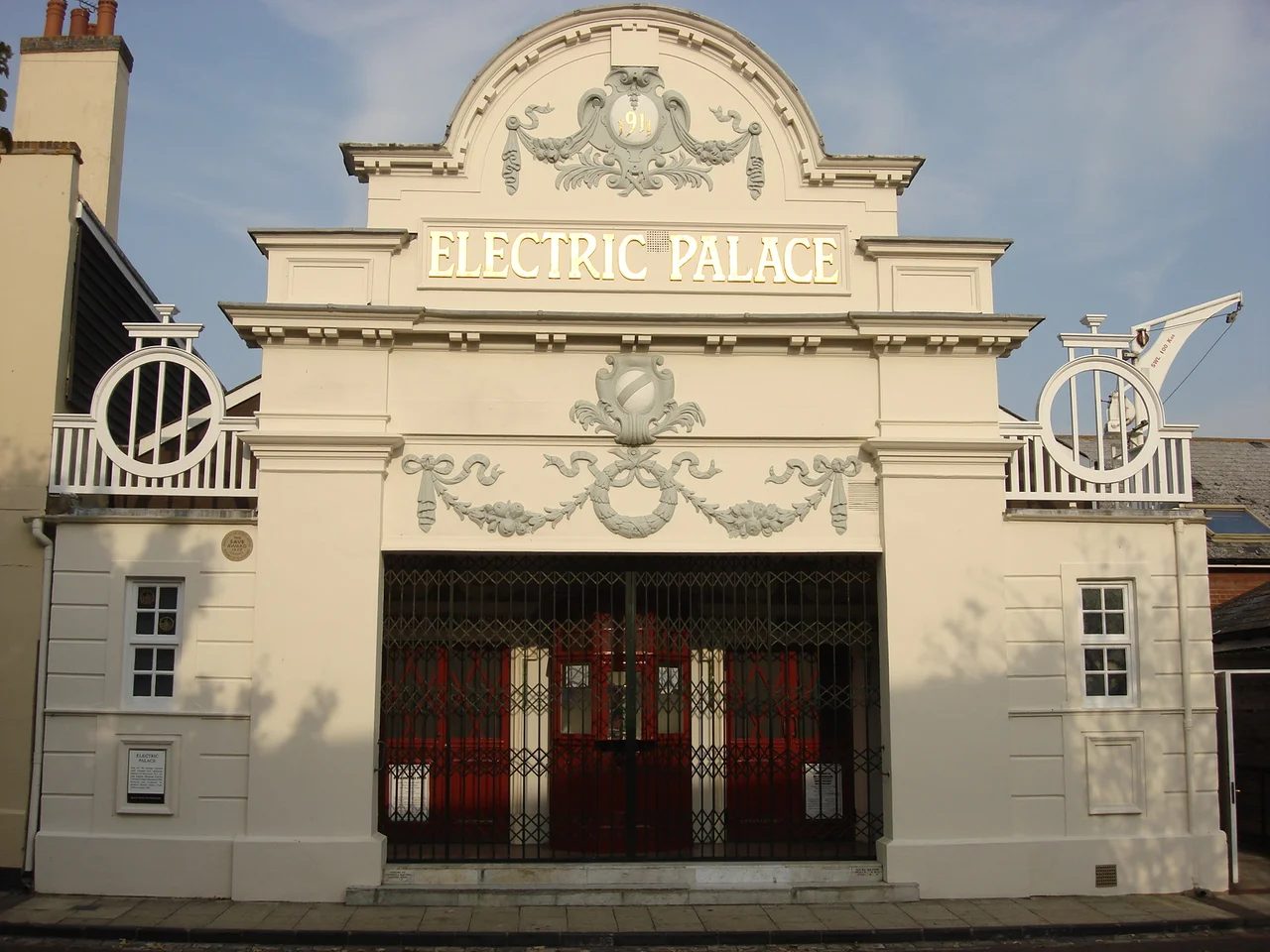

Electric Palace Cinema, Harwich
On Kings Quay Street in Harwich, behind a small ornamental frontage of plaster scrollwork and a cream-painted facade, sits one of the most extraordinary survivals in British cinema history. The Electric Palace was purpose-built in 1911 by a fairground showman who needed a permanent venue after new fire regulations made tent-shows impractical. He hired a twenty-six-year-old architect, gave him eighteen weeks, and £1,500. The result has barely changed in 114 years. The silent screen still hangs where it did in 1911. The original projection room is intact. The Crossley gas engine that powered the cinema's electric lights until 1925 is still in place, too heavy to remove. The Electric Palace is one of the oldest purpose-built cinemas anywhere in Britain to survive complete - and it is still showing films.
Charles Thurston Finds a Plot
Around the turn of the twentieth century, the East Anglian fairground showman Charles Thurston toured the region with a Bioscope show - a travelling tent fitted out as a moving-picture theatre. The novelty was enormous and the income real. Then the Cinematograph Act 1909 came into force. It required public film venues to meet new fire-prevention standards, with proper projection booths and exits, that no canvas tent could possibly satisfy. Thurston needed a permanent home for his films. In 1911 he obtained the lease on a site in Harwich's Kings Quay Street where the previous building had recently burned down. He hired a young Ipswich-based architect named Harold Ridley Hooper, just twenty-six, to design the building. The Electric Palace was Hooper's first major commission. He gave it an ornamented Edwardian frontage, an open-plan entrance lobby with a paybox still in use today, a small stage with dressing rooms behind the screen for vaudeville turns, and a tin-and-plaster auditorium that holds about 200 patrons. Construction took eighteen weeks.
Trafalgar and the Death of Nelson
The Electric Palace opened on Wednesday, 29 November 1911. The first film shown was 'The Battle of Trafalgar and The Death of Nelson' - a fitting choice for a Royal Navy port. Harwich at the time was a major naval base, and the cinema was an immediate success. Through the First World War, with sailors and dockworkers crowding the town, the Palace did good business. Programmes mixed films and vaudeville: acrobats, burlesque, hypnotists, conjurors, comedians. A young Scottish comic named Will Fyffe - later famous nationally - performed here while stationed at Felixstowe during the war. After 1918 business declined. The local population shifted to Dovercourt, where newer and plusher cinemas opened. The Palace muddled through four decades of half-empty houses, never quite failing, never quite succeeding. Sound arrived in 1930: 'The Singing Fool' with Al Jolson played on Vitaphone equipment that proved so unreliable it was replaced within a year by Western Electric sound-on-film.
The Flood and the Twenty-Five Years Dark
In late January 1953 the North Sea Flood breached the East Anglian coast in the worst peacetime disaster of modern English history. Harwich was badly hit. Sea water flooded the cinema's stalls. The Electric Palace dried out, repaired what it could, and reopened, but the flood had hollowed out the surrounding neighbourhood as well as the building. Population kept falling. After three more years of declining audiences, the cinema closed on 3 November 1956 with a final showing of 'Mad About Men,' a Glynis Johns comedy about a mermaid. The doors were locked. The projectors were left in place. For sixteen years the Electric Palace sat abandoned in a back street, forgotten by most of Harwich, while vandalism and corrosion worked over the projection room. The council eventually marked the building for demolition.
Gordon Miller and a Doggerel Poem
In 1972 Gordon Miller, a lecturer at Kingston Polytechnic, was leading a group of architecture students through Harwich on a survey project when he stumbled across the abandoned Palace. He recognised what he was looking at: a virtually unaltered Edwardian picture-palace, fittings and frontage intact, of a kind that had been almost entirely lost in Britain. Miller began a campaign to save it. The fight became national news. A local rhyme of the period captured the resistance and the eventual victory in faintly hostile doggerel: 'They came from Kingston to survey the town, and stopped us from pulling the old Palace down... this tumbledown shack, to Kingston-on-Thames may they carry it back.' In April 1975 the Electric Palace Trust was formed; the council granted a repairing lease, then sold the freehold. Sir John Betjeman, Poet Laureate, became the first patron. Restoration was largely the work of volunteers, painstakingly bringing the building back to working order over six years.
Re-opening, Patrons, Survival
The Electric Palace reopened on 29 November 1981 - exactly seventy years to the day after Charles Thurston had first opened its doors - and the BBC filmed the relaunch for 'Blue Peter.' The replacement projectors were Kalee Dragons taken from the Admiralty Cinema in Whitehall, where Winston Churchill had watched the wartime newsreel rushes. Over the next four decades the cinema rotated through its kit: better projectors from the Odeon in Clacton, carbon arc lamps from Stowmarket, a Dolby system salvaged from an Ipswich ABC. In 1998 an Arts Council lottery grant brought xenon lamps and a Dolby CP500 processor. In 2011, with help from a digital-cinema funding partnership, the Palace went fully digital in time to mark its centenary on 29 November 2011 with a screening of Terence Davies's 'The Deep Blue Sea.' The Kalee model 20 projectors stay in the booth, kept working so the cinema can still show 35mm prints from the BFI archive in the format for which they were made. Clive Owen has been patron since 2006. Queen Elizabeth II visited in 2004. The Electric Palace shows films every weekend, hosts jazz and folk nights, and remains - against improbable odds - very nearly the same building Harold Hooper drew in 1911.
From the Air
Electric Palace Cinema sits at approximately 51.95 N, 1.29 E, in the old town of Harwich on the Essex side of the Stour and Orwell estuaries, opposite Felixstowe. Recommended viewing altitude is 1,500-2,500 ft AGL; the building is on Kings Quay Street in the historic Harwich peninsula, two blocks inland from the quay. Felixstowe docks are immediately across the water. London Stansted (EGSS) is 47 nm west; Norwich (EGSH) 41 nm north. Class G airspace; mind Felixstowe port operations.
Nearby Stories
- Ickworth House 3.6 km away
- Framlingham 7.9 km away
- Castle Hedingham 8.6 km away
- Battle of Assandun 8.6 km away
- Margate Surfboat 33 km away
- 1382 Dover Straits Earthquake 41 km away
- Four Days' Battle 48 km away
- Battle of Lowestoft 85 km away